Danube River Cruise Guide for First Timers: Routes, Ports, Costs and Best Time to Go
A seven-night Upper Danube week, eleven cruise lines compared, what it really costs for two people, and the two months we would book. Written for first timers.
Last updated: September 12, 2026 :: Written by Sue Nelson, Travel Advisor | Adventures by MJ :: Reviewed by Sue Nelson, Travel Advisor
A Danube river cruise for first timers usually means seven nights between Budapest and Passau or Regensburg, on a ship carrying roughly 130 to 200 guests, with one included tour in every port. Published 2027 starting fares for that week run about $2,269 to $2,999 per person, double occupancy, and the classic route crosses four countries. The main season runs April through October, and Christmas market sailings fill late November and December.
Key Takeaways: Danube River Cruise for First Timers
The first-timer route is the Upper Danube, Budapest to Passau, Vilshofen or Regensburg, seven nights. The Lower Danube toward Bucharest is a second trip, not a first one.
Gate 1 Travel publishes the lowest entry fare at $2,269 per person land only, and Tauck the highest at $7,290. Same river. Very different week.
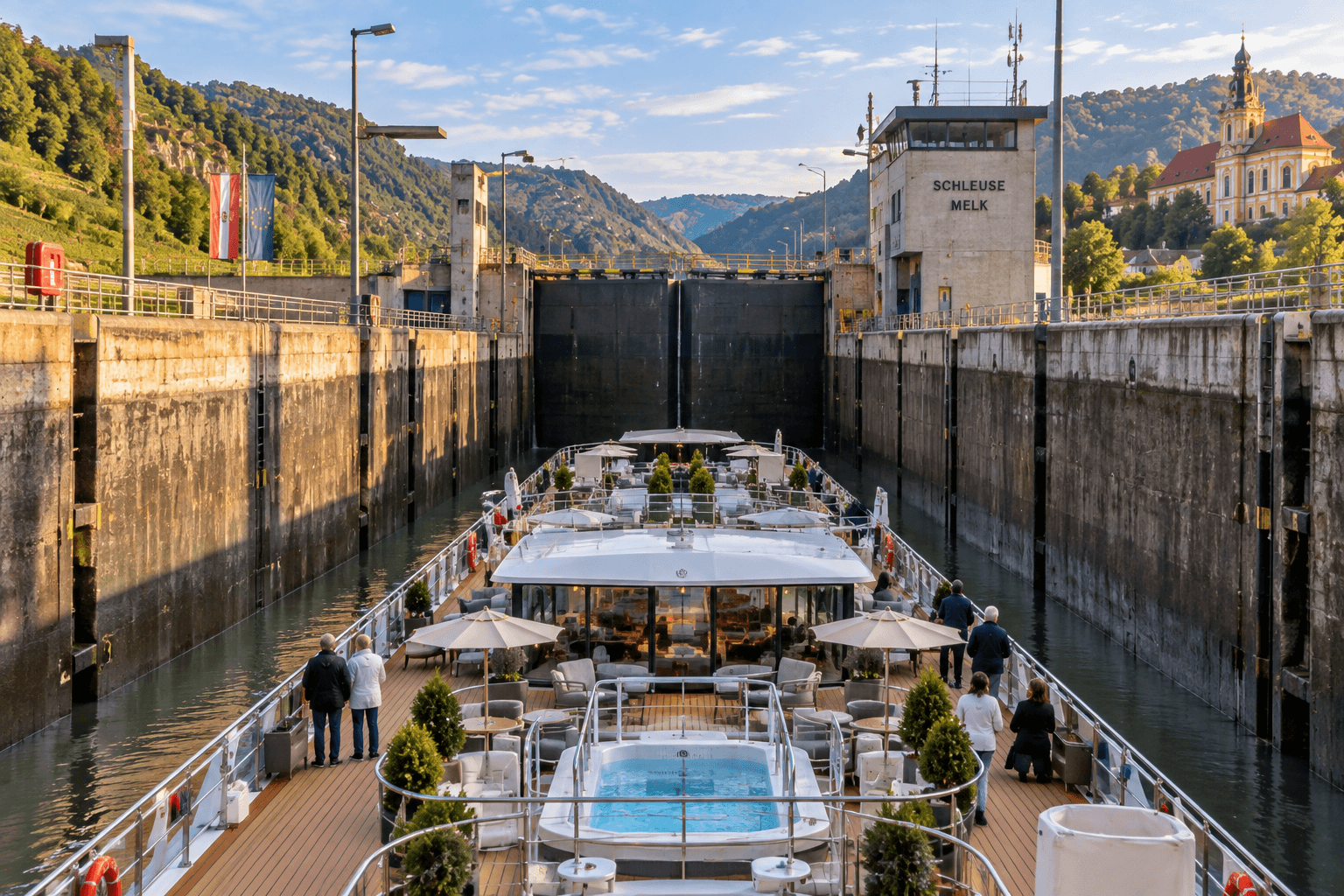
Ten locks sit between Passau and Vienna, which is why the ship moves at night and why you wake up somewhere new almost every morning.
Direction barely matters. Ports are identical either way. Westbound ends in Germany, eastbound ends in Budapest, and airfare usually decides it.
May and September are the sweet spot. Long days without August heat, and better water than high summer.
Celebrity Cruises enters river cruising in 2027 with five new ships, which is the first real shake-up in Danube inventory in years.
Budget $6,800 to $9,000 all in for two people, not the headline fare.
Danube River Cruise at a Glance
Everything a first timer needs to decide, in one table.
Question
The short answer
Which route
Upper Danube, Budapest to Passau, Vilshofen or Regensburg
How long
7 nights, sold as an 8-day package
Best months
May and September
Countries
4 on the classic week: Hungary, Slovakia, Austria, Germany
Published fares from
$2,269 to $2,999 per person
Realistic all-in, two people
$6,800 to $9,000
Ship size
Roughly 130 to 200 guests, 3 passenger decks
Locks you transit
10 between Passau and Vienna
Hardest part
Cobblestone. Two to four miles of walking most days
Book it when
9 to 12 months out for choice of cabin and date
Our first river cruise question is almost never about the river. It is about whether a Danube river cruise for first timers is actually worth the money, and whether a week on a 190-passenger ship is going to feel small. Fair questions. So this guide covers the routes, the ports, what the week really costs, and when to go, with the numbers pulled from the cruise lines and the waterway authorities rather than from other blogs.
And a quick note on how to read it. Anything labeled published comes from a cruise line’s own site or a government waterway authority, with the link. Anything labeled estimate is our planning range, not a guarantee. The difference matters when you are budgeting.
What Is a Danube River Cruise?
A Danube river cruise is a multi-night voyage on a long, low riverboat that sails the Danube between central European cities, docking in the middle of town rather than at an industrial port.
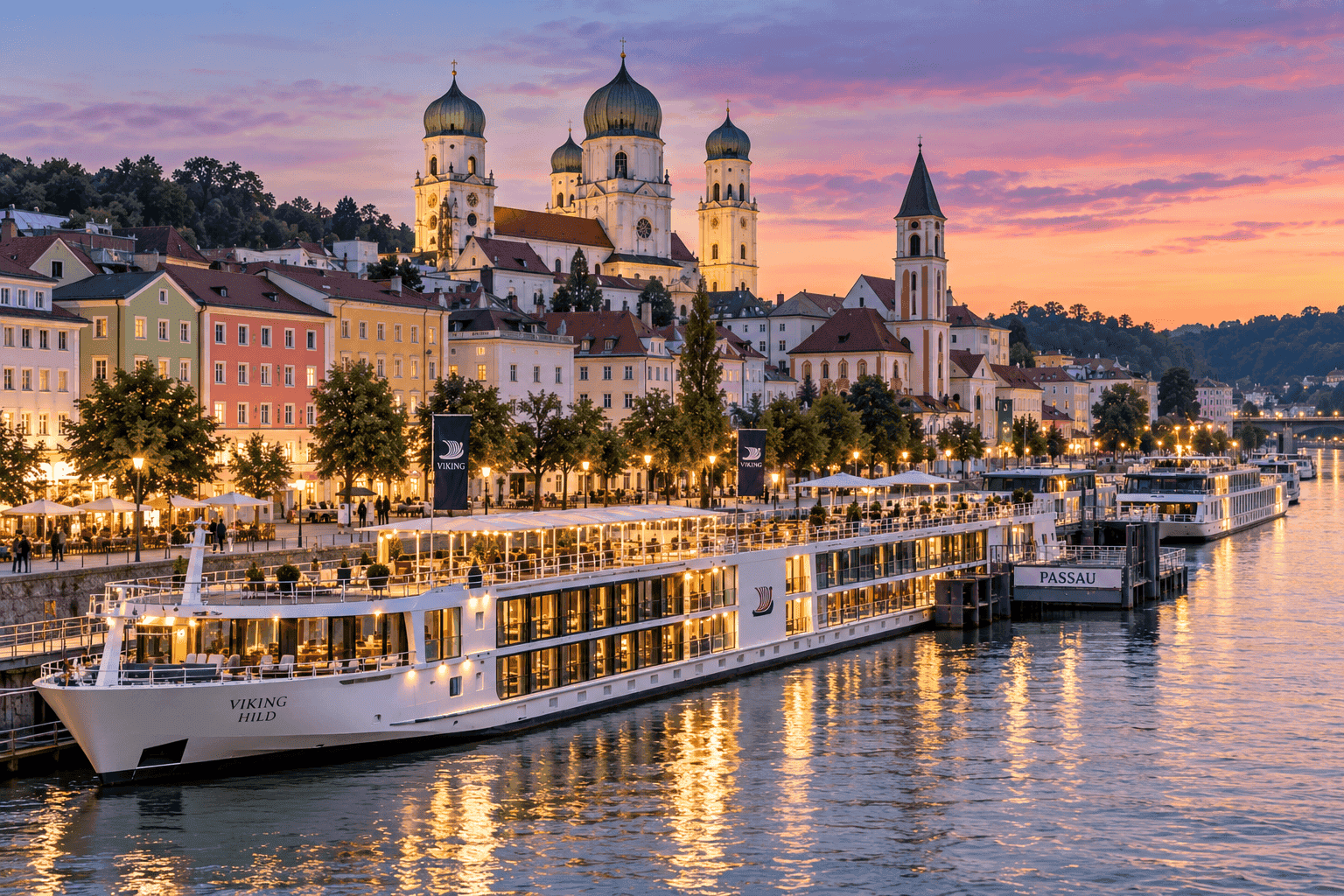
Passau sits at river kilometer 2,233, where the Danube, Inn and Ilz all meet.
The Danube runs 1,770 miles and passes through 10 countries, which makes it the second-longest river in Europe after the Volga, per Britannica. Cruise ships use a slice of that. The navigable waterway stretches 2,414.72 kilometers, measured upstream from Sulina on the Black Sea to Kelheim in Bavaria, according to the viadonau Manual on Danube Navigation.
Your ship holds somewhere around 130 to 200 people. It has three passenger decks, no casino, no climbing wall, and no waterslide. You get one dining room, maybe two, a lounge, a sundeck and a very good view. The trade is simple. You give up ship activities and you get to walk off into Vienna at nine in the morning without a tender, a queue or a shuttle bus.
If you are still deciding whether rivers are your thing at all, start with is a European river cruise worth it, then come back here for the Danube specifics.
Danube River Cruise Questions People Ask Out Loud
Short answers to the questions we get asked in the first five minutes of a phone call.
How long should my first Danube cruise be?
Seven nights. That is the classic Upper Danube week and it is the right length for a first trip. Shorter sailings cut Vienna or Budapest short, and longer ones add river you do not need yet.
Do I need to speak German or Hungarian?
No. Your cruise director and your guides work in English. So does almost everyone in the tourist parts of Vienna and Budapest. Learning “danke” and “köszönöm” is a kindness, not a requirement.
Will I get seasick on a river?
Almost certainly not. The Danube is flat water with no swell, and the ship is long and wide relative to its depth. People who cannot handle ocean ships are usually fine here.
Can I stay on the ship and skip a tour?
Yes, and some days you should. The ship stays docked while tours run, the bar and the sundeck stay open, and nobody makes you explain yourself.
Do I have to pay extra for the tours?
Not for the main one. Almost every line includes one guided excursion in each port, and sells optional upgrades alongside it. The upgrades are usually the small-group or food-focused versions.
How much walking is there on a Danube cruise?
More than you think. Plan on two to four miles a day on cobblestone, because the ships dock in old town centers and the tours are walking tours. Bring shoes you already trust.
Do I need a visa for a Danube river cruise?
Not for a US passport on the classic route. Hungary, Slovakia, Austria and Germany are all in Schengen, so you get a stamp and biometric registration rather than a visa. Your passport does need to be valid for at least three months past the day you leave.
Can I do a Danube cruise if I cannot walk far?
Maybe, and it depends on the ship more than the river. Most river ships are not built for wheelchairs or scooters, but several lines run slower-paced versions of the included tours. Read the accessibility section below before you put down a deposit.
Words You Will See on a Danube Itinerary and What They Mean
Nine terms that appear on every Danube brochure and confuse almost every first-time booker.
Term
What it actually means
Upper Danube
The Kelheim to Budapest stretch. Germany, Austria, Slovakia, Hungary. The first-timer route.
Lower Danube
Budapest down toward Bucharest and the Black Sea. Serbia, Croatia, Bulgaria, Romania.
rkm
River kilometer, counted upstream from the Black Sea. Vienna is rkm 1,920. Budapest is rkm 1,640.
Scenic sailing
Daylight hours the ship spends moving through something worth looking at, with no tour attached. The Wachau is the famous one.
Lock
A concrete chamber that raises or lowers the ship past a dam. Takes 20 to 40 minutes. Weirdly fun the first time.
Free-flowing stretch
River with no dam holding the water back. Prettier, shallower, more sensitive to drought.
Port charges
Mandatory fees for docking. Included by some lines, billed separately by others.
Pre-night
A hotel night the line sells you before embarkation, usually in Budapest or Munich.
Open-jaw
An air ticket that flies into one city and home from another, which is what a one-way river itinerary needs.
Danube River Cruise Routes and Itineraries: Upper Danube vs. Lower Danube
Book the Upper Danube for a first Danube river cruise itinerary, because it packs Vienna, Budapest, Bratislava and the Wachau Valley into one seven-night week.
Here is the split, and it is the single most useful thing to understand before you look at a single brochure.
Upper Danube
Lower Danube
Typical route
Budapest to Passau, Vilshofen or Regensburg
Budapest to Bucharest, or the reverse
Nights
7
10 to 14
Countries
Germany, Austria, Slovakia, Hungary
Hungary, Croatia, Serbia, Bulgaria, Romania
Headline sights
Vienna, Budapest, Melk Abbey, the Wachau
Belgrade, the Iron Gates gorge, Veliko Tarnovo
Locks
10 between Passau and Vienna
2 in total, both at the Iron Gates
Published fares from
$2,269 per person
$3,799 per person
Right for a first trip?
Yes
Not yet
The Upper Danube is dense. You are rarely more than a few hours from the next town, which is exactly what a first-timer wants. The Lower Danube is wilder and emptier, and the Iron Gates gorge is genuinely one of the great sights in Europe, but the ports are less familiar and the days are longer. Do the Upper Danube first. Then go back.
Named itineraries you will see on the Upper Danube: Viking’s Danube Waltz and Romantic Danube, AmaWaterways’ Melodies of the Danube and Magna on the Danube, Uniworld’s Enchanting Danube, Emerald’s Danube Delights, Avalon’s Danube Symphony and Tauck’s Blue Danube. They stop in mostly the same places. The difference is the ship and what the fare covers.
Danube River Cruise Itinerary Lengths: 7, 9, 10 and 14 Nights
If you are searching by length rather than by name, this is how the Danube breaks down.
7-night Danube itinerary: Budapest to Passau, Vilshofen or Regensburg. The classic. Vienna, Bratislava, the Wachau, Melk, Linz.
9-night Danube itinerary: usually the classic week plus Prague or Munich on land, as Tauck’s Blue Danube does.
10-night Danube itinerary: the Lower Danube, Bucharest to Budapest, or Emerald’s Munich to Budapest with extra Bavaria.
14-night Danube itinerary: Viking’s Grand European Tour, Budapest to Amsterdam, which is really three rivers stitched together by the Main-Danube Canal.
That canal, by the way, is why a Budapest-to-Amsterdam trip is possible at all. It runs 171 kilometers with 16 locks of its own, was finished in 1992, and climbs to more than 406 meters above sea level, per Britannica.
Danube River Cruise Itinerary Day by Day: A Sample 7-Night Week
A classic 7-night Danube river cruise itinerary runs Budapest, Bratislava, Vienna, Krems, Linz and Passau, with two nights docked in Budapest at the start and the Wachau Valley sailed on the Krems day.
Every line’s version of this week is close to identical, so instead of describing a generic one, here is Viking’s published Danube Waltz for 2027, Budapest to Passau, exactly as Viking lists it.
Day
Where you wake up
Country
What Viking publishes for the day
1
Budapest
Hungary
Arrive and embark. Buda’s Castle District and modern Pest
2
Budapest
Hungary
Cross the Chain Bridge, a museum, or a thermal spa
3
Bratislava
Slovakia
Hapsburg-era palaces and Bratislava Castle
4
Vienna
Austria
Architecture and the city’s classical music heritage, with an optional waltzing lesson at a Viennese dance school
5
Krems
Austria
Göttweig Abbey and its ceiling frescoes, in the UNESCO-listed Wachau Valley
6
Linz
Austria
The Old Quarter’s Hauptplatz, Market Hall and Mozarthaus
7
Passau
Germany
Patrician houses in the old town and Passau’s cathedral
8
Passau
Germany
Disembark, with optional post-cruise extensions
Source: Viking’s own 2027 Danube Waltz page, from $2,399 per person. Verified September 12, 2026.
Three things to notice, because they are the difference between reading a brochure and understanding a week.
Budapest gets two days and one of them is arrival day. Day 1 is a travel day. You land, you find the ship, you are jet-lagged, and whatever the brochure says about Castle District is theoretical. Which is exactly why a pre-night in Budapest is not a luxury. Add it and Day 2 becomes your second Budapest day instead of your first.
The Wachau is on the Krems day, and its timing moves. Melk sits at the upstream end and Krems at the downstream end, so the scenic stretch is sailed either before or after the port call depending on which direction you are going. Ask your cruise director on Day 4 when the ship enters the valley, then be on the sundeck. This is the one section of river nobody should sleep through and people do it every single week.
Day 8 is not a day. Disembarkation is early and you are at the airport by mid-morning. Anyone who counts Day 8 as a day of vacation is counting a shuttle bus.
AmaWaterways’ Magna on the Danube covers the same ports and adds Vilshofen, running Budapest to Vilshofen over 7 nights. Uniworld’s Enchanting Danube ends at Passau like Viking’s. Emerald’s Danube Delights extends to Munich by coach. The ports barely change across lines. What changes is the ship, the food and what the fare covers, which is the whole reason the comparison table further down this post exists.
Danube River Cruise Map: Where the Ports and Locks Actually Sit
Your ship covers roughly 775 river kilometers on a classic Danube week, and passes through ten locks between Passau and Vienna.
This is the part nobody explains, and it is the reason a Danube week feels so port-dense. Between Kelheim and Gönyü (Gonyu) on the Hungarian border, the Danube has sixteen power plants with locks. On the entire Middle and Lower Danube there are only two, both at the Iron Gates, per viadonau, Austria’s federal waterway company. Fourteen of the eighteen locks on the river have two chambers so ships can pass in both directions at once.
We mapped the ones you will actually transit against the ports you will actually visit, using river kilometer positions published by the Austrian federal waterway service DoRIS and the viadonau navigation manual. We call it the Adventures by MJ Danube Lock Ladder, and as far as we can tell nobody else has drawn it for cruisers.
Adventures by MJ Original Data
The Danube Lock Ladder
Every lock and port on a classic Danube week, drawn to scale by river kilometer. Kelheim rkm 2,414.72 down to Budapest rkm 1,640.
Cruise portLock you transitFree-flowing, no dam
The two green bands are the only free-flowing water on this stretch: the Wachau, rkm 2,038 down to 1,980, and the reach east of Vienna, rkm 1,921 down to 1,885.
Ports
rkm
Locks
Kelheim2,414.72
Regensburg2,376
Passau2,233
Linz2,128.19
Melk2,038.10
Vienna1,920
Bratislava1,885
Budapest1,640
Jochenstein2,203.20
Aschach2,162.67
Ottensheim2,146.82
Abwinden2,119.54
Wallsee2,095.06
Persenbeug2,060.42
Melk lock2,038.06
Altenwörth1,980.11
Greifenstein1,949.20
Freudenau1,921.05
245 km no locks Bratislava to Budapest
775river km on a classic week
10locks, Passau to Vienna
16locks, Kelheim to Gönyü
2locks on the whole Lower Danube
The two locks on the Middle and Lower Danube are Iron Gates I at rkm 942.90 and Iron Gates II at rkm 863.70, more than 700 km below Budapest. Fourteen of the Danube’s eighteen locks have two chambers, so ships pass in both directions at once.
Lock positions and chamber data: DoRIS, Austrian Federal Ministry waterway service. Lock counts: viadonau. Port river kilometers: viadonau Manual on Danube Navigation. Free-flowing stretches: viadonau. Compiled September 12, 2026 by Adventures by MJ.
Fourteen of the Danube’s eighteen locks have two chambers, so ships pass in both directions at once.
Two things jump out once you see it to scale. The locks cluster hard through Austria, ten of them in about 280 kilometers, which is why your ship sails overnight and why the schedule can slip by an hour or two. And the prettiest water on the route, the Wachau, is one of only two stretches with no dam holding it back.
Danube River Cruise Ports and Stops, Port by Port
A classic Danube river cruise ports list runs Passau or Vilshofen, Linz, Melk, Krems, Vienna, Bratislava and Budapest, with scenic sailing through the Wachau between Melk and Krems.
Here is what each one actually gives you, and where we would spend the extra night.
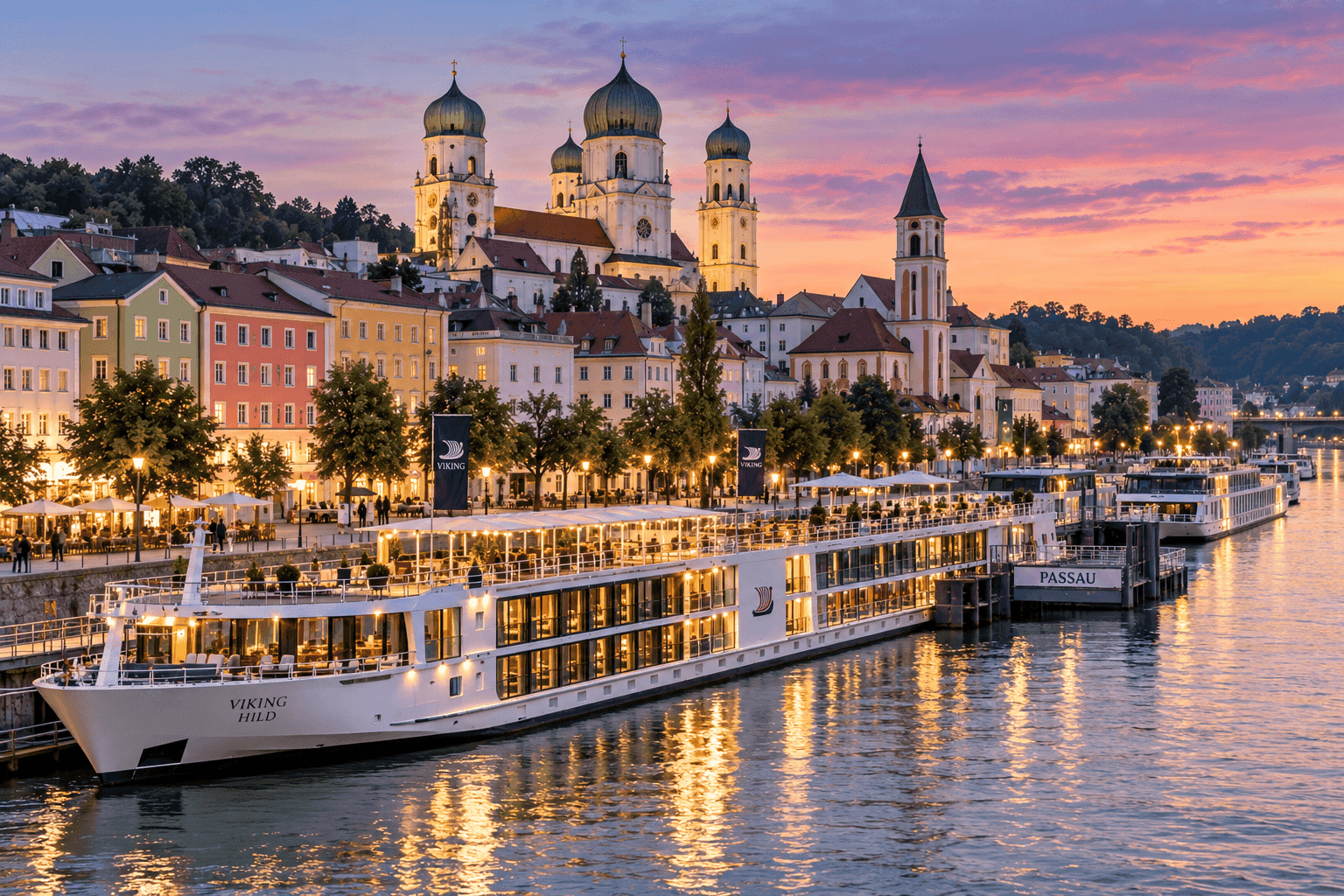
Passau and Vilshofen, Germany
Most westbound Danube cruises begin or end at Passau, rkm 2,233, or at Vilshofen a few kilometers upstream.
Passau is built on a point where three rivers meet, and the old town is small enough to walk end to end in an hour. St. Stephen’s Cathedral sits a short walk from the dock and is the one thing to see if you only have an hour. Vilshofen is tiny and exists on itineraries mainly because it is an easier berth, which AmaWaterways and Celebrity both use.
Linz, Austria
Linz sits at rkm 2,128 and is usually the jumping-off point for a coach trip to Salzburg.
Linz itself is underrated and almost nobody stays. Most lines offer Salzburg as the excursion, which is about 80 miles away and eats the whole day. If you have already been to Salzburg, stay in Linz and walk the Hauptplatz instead. We would.
Melk and the Wachau Valley, Austria
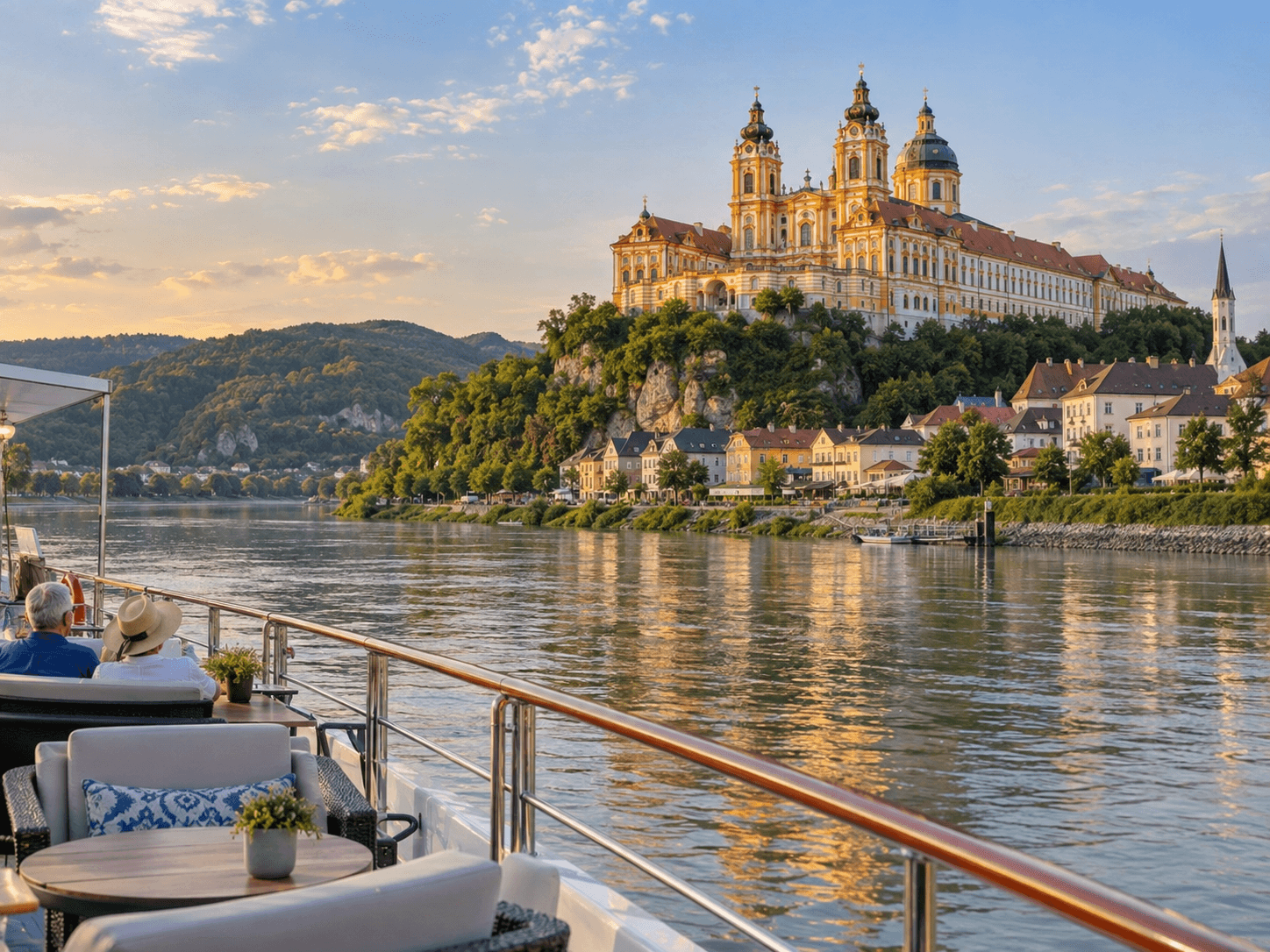
Melk sits at rkm 2,038 and marks the top of the Wachau, the one stretch of this cruise you should not sleep through.
Melk Abbey was founded in 1089 and the Baroque rebuild finished in 1736.
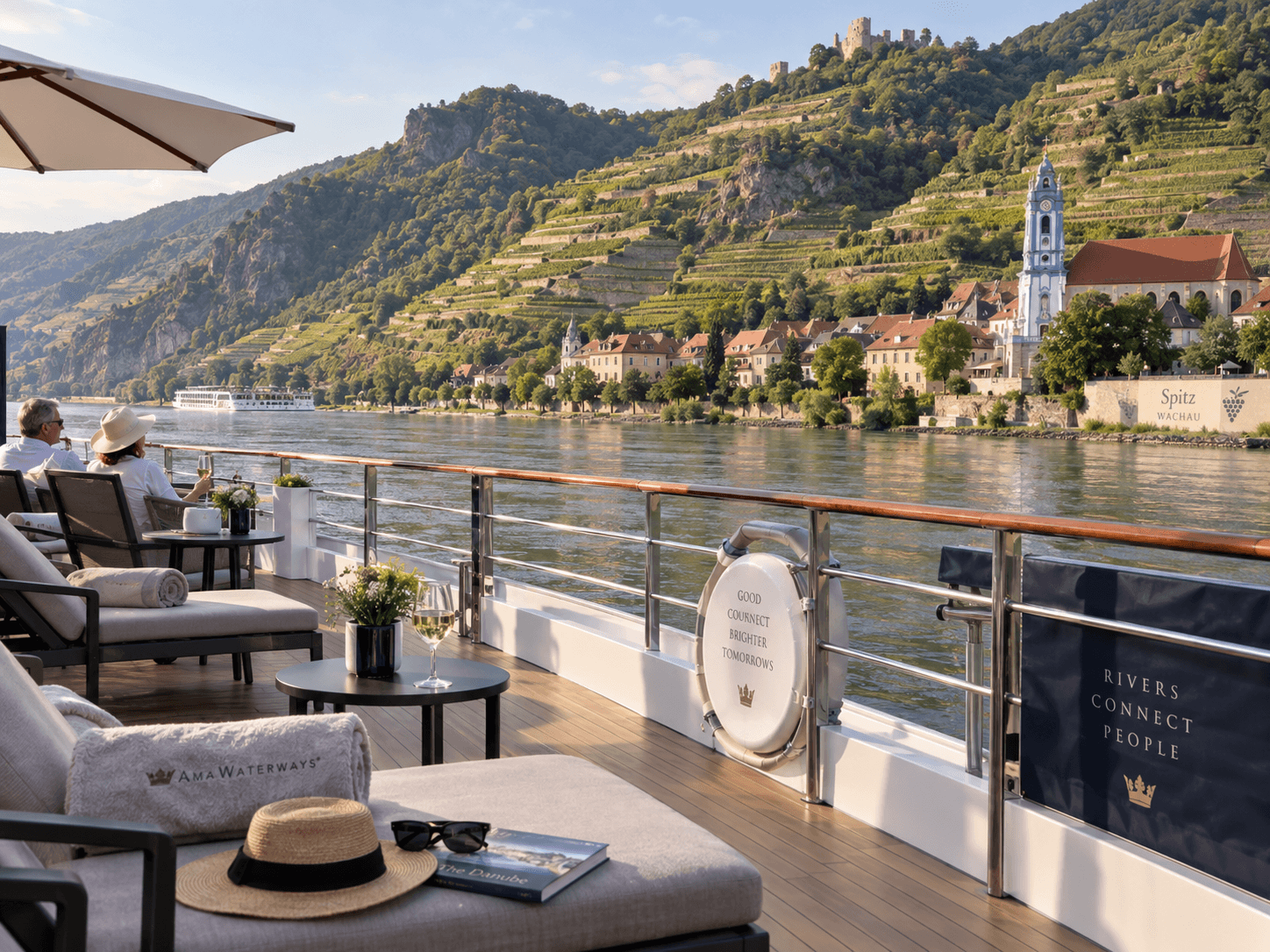
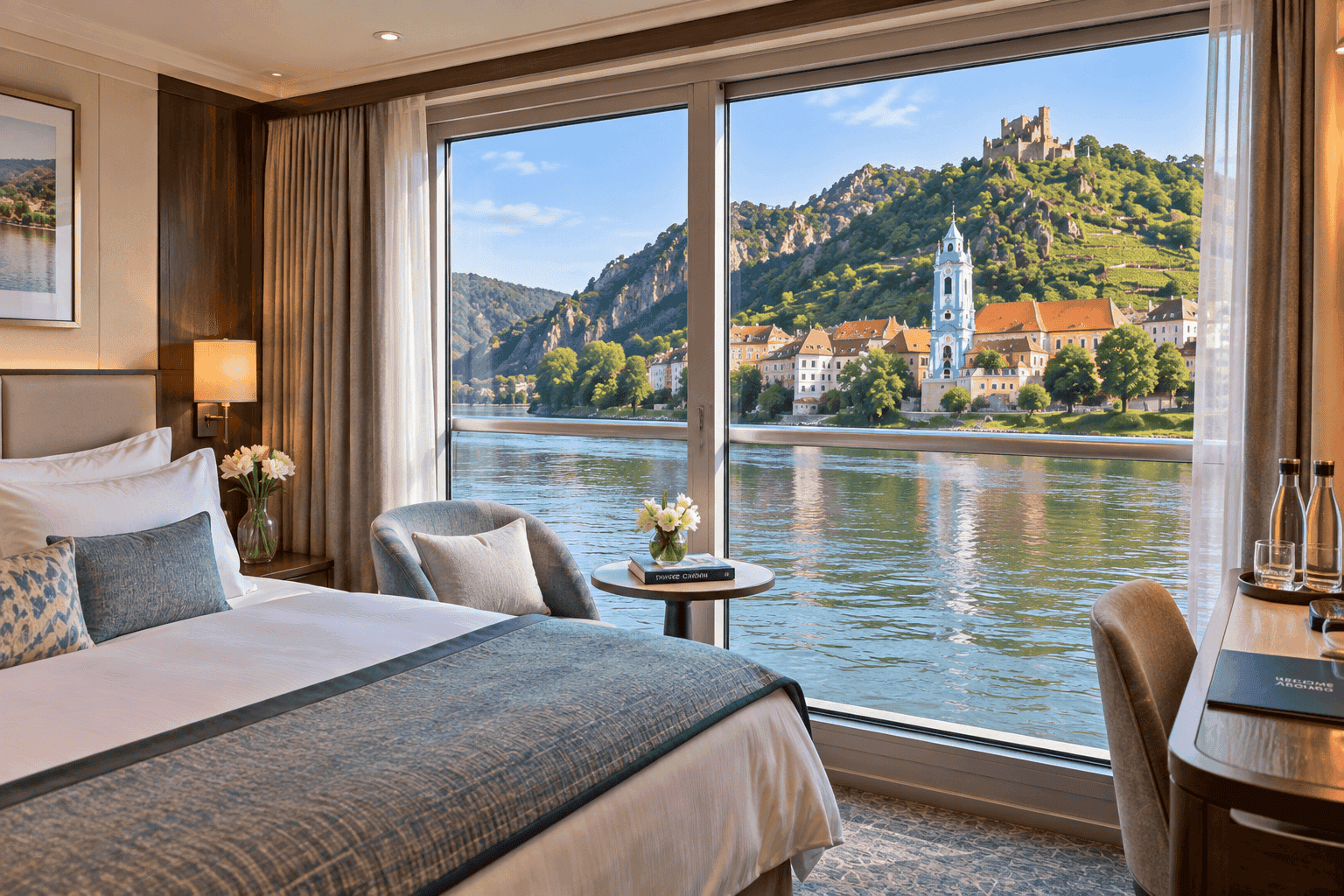
UNESCO inscribed the Wachau Cultural Landscape in 2000 and describes it as “a stretch of the Danube Valley between Melk and Krems, a landscape of high visual quality,” covering 18,462 hectares. See the UNESCO listing. Melk Abbey sits on a bluff above the town in aggressive Baroque yellow. Dürnstein (Durnstein) sits under the ruined castle that once held Richard the Lionheart. The hills are terraced with Grüner Veltliner vines.
Here is the practical bit. The Wachau is free-flowing river between the Melk and Altenwörth (Altenwoerth) power plants, so there is no lock to interrupt it. Be on the sundeck. Not in the shower.
The Wachau’s terraces grow mostly Grüner Veltliner and Riesling, and the stone walls are dry-laid.
Krems an der Donau, Austria
Krems sits at the downstream end of the Wachau and is the usual docking point for Göttweig Abbey.
Vienna is at rkm 1,920 and gets the longest port day on almost every Danube itinerary.
Schönbrunn has 1,441 rooms, which is why one included tour barely scratches it.
One included tour will show you the Ringstrasse and either Schönbrunn (Schoenbrunn) or St. Stephen’s. That is not enough Vienna. This is the port to add a night to, either before or after the cruise. The Kunsthistorisches Museum alone deserves half a day, and a concert evening is worth the upcharge even if you are not a classical music person.
Bratislava, Slovakia
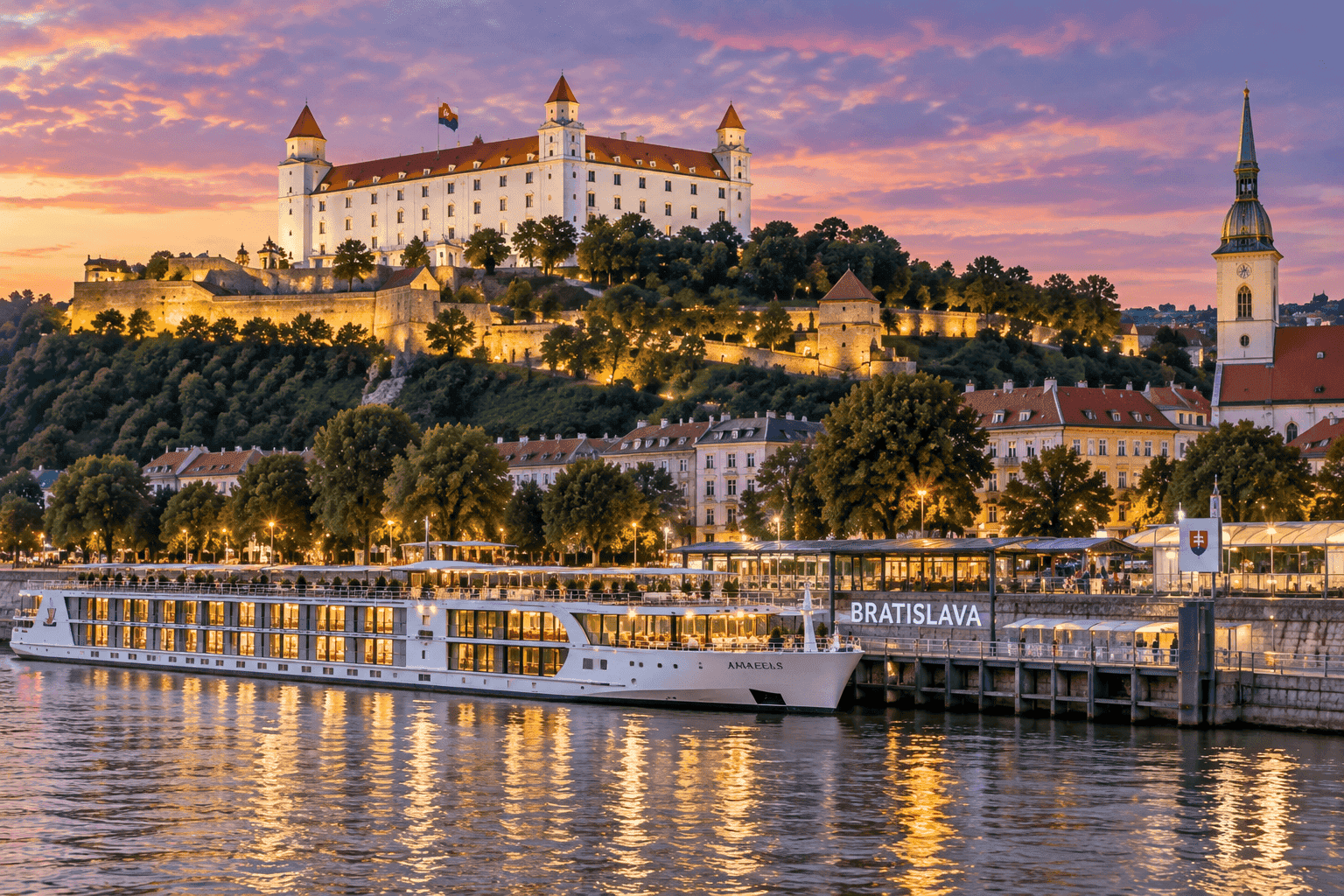
Bratislava is at rkm 1,885 and is the shortest real port day of the week.
Bratislava Castle is a 20 minute walk uphill from the cruise berth, and the view is the payoff.
Compact and cheap. Also a little scruffy in a way we like. The castle is a 20-minute walk uphill for the view. Most people are surprised by how much they enjoy it, mostly because expectations start low.
Budapest, Hungary
Budapest sits at rkm 1,640 and is the most photogenic dock on the river.
Ships tie up between the Chain Bridge and the Parliament building. The evening sail-in or sail-out through a lit-up Budapest is the single best 45 minutes of the cruise and every line schedules it deliberately. Add a pre-night or post-night here too. The thermal baths, the Great Market Hall and the Buda Castle hill all need more time than a port call gives you.
Which Direction Should You Sail the Danube, Upstream or Downstream?
Direction changes your travel logistics and almost nothing else, so pick the one with the better airfare.
This question gets asked constantly and the answer is boring. Eastbound and westbound Danube itineraries call at the same ports in reverse order. You will hear that downstream is faster because you are running with the current, and on the impounded Austrian Danube that difference is small because the water between the locks is barely moving.
What actually differs:
Westbound, Budapest to Germany. You start in the most dramatic city and end near Munich or Nuremberg airport. Easier onward travel to Prague or Bavaria.
Eastbound, Germany to Budapest. You finish in Budapest, which is a lovely place to end and an easy place to add nights. Munich is often the cheaper US gateway to fly into.
So: check both air routings, look at which end you want to spend extra nights in, and let that decide. Our own preference is eastbound, ending in Budapest, because a post-cruise night there is better value than a post-cruise night in Passau.
Which Airport Should You Fly Into for a Danube River Cruise?
Fly into Budapest (BUD) and home from Munich (MUC) on an open-jaw ticket, because those two airports serve the ends of almost every classic Danube week.
The airports, and which end of the week each one serves:
Airport
Code
Serves
Budapest Ferenc Liszt
BUD
The Budapest end of every Upper Danube itinerary
Munich
MUC
Passau and Vilshofen disembarkations, plus most Regensburg itineraries. Usually the best US fares of the group
Nuremberg
NUE
Nuremberg and Regensburg itineraries, including Celebrity’s Upper Danube
Vienna
VIE
Vienna-start itineraries and pre or post cruise nights
Prague
PRG
Tauck’s Blue Danube, which starts or ends in Prague on land
Bratislava
BTS
Rarely used by cruise lines, but a cheap European budget-airline hub near Vienna
Linz
LNZ
Small regional airport, almost never a cruise gateway
Two things worth knowing before you buy the ticket. A one-way river itinerary needs an open-jaw ticket, into one city and home from another, and a round-trip into a single airport means paying for a train or a flight across Europe on one end. And transfer inclusion varies: your line may cover airport transfers only if you buy their air package, so confirm which airport their transfer actually serves before you book a flight into a different one. Tauck includes transfers at both ends regardless.
If your fare difference is close, take the itinerary that ends in Budapest. Two post-cruise nights in Budapest beat two post-cruise nights in Passau, and it is not a close call.
Danube River Cruise Lines and Ships for 2027
Eleven major lines sail the Danube, and the fare gap between the cheapest and the most expensive is more than $5,000 per person for the same week.
This is the full entity table, sourced from each line’s own site on September 12, 2026. Fares are published starting prices per person, double occupancy, and they move.
Celebrity River Cruises is brand new. Celebrity publishes five river ships for its 2027 debut, with a 7-Night Upper Danube running Nuremberg to Budapest and a Danube Christmas Market sailing Budapest to Nuremberg. Celebrity’s own wording on inclusions: all sailings “include one shore excursion per day, Wi-Fi, all meals, and beverages including select wine, beer, cocktails, coffee and soft drinks with the opportunity to upgrade.” If you have Celebrity ocean status and have been waiting for a reason to try a river, 2027 is it. Trade and consumer press reported inventory moving very fast after the launch, so do not sit on it.
AmaMagna is a Danube-only ship, and it is physically enormous. AmaWaterways publishes 98 staterooms, 196 guests, 443 feet long and 72 feet wide, and their own materials describe it as twice the width of a traditional European river ship. It cannot sail the Upper Rhine at all, because published Upper Rhine lock dimensions cap beam at 12 meters. If cabin space matters more to you than anything else on the list, the Danube is the only river where you can get that ship.
Scenic, Amadeus River Cruises and Grand Circle also run Danube sailings and are worth a call if the lines above are sold out for your dates.
Danube River Cruises for Solo Travelers: Single Supplements and Solo Cabins
Three lines are currently waiving or cutting the single supplement on Europe river sailings, which is the cheapest a solo Danube week has been in years.
River cruising has a solo problem, and it is arithmetic. A cabin is priced for two, so one person traditionally pays a supplement of 100 percent to have it alone. That is the single biggest reason solo travelers write off river cruising, and right now it is the most negotiable line item on the whole trip.
What the lines publish, verified September 12, 2026:
Line
What they publish
Catch
AmaWaterways
Waiving the single supplement on select 2027 Europe sailings, most stateroom categories including balconies, promo code SOLOWAIVED
Offer ends September 30, 2026
AmaWaterways
Reduced single supplement of 10 percent on select Europe cruises, promo code SOLO10
Book by September 30, 2026, excludes premium suites
AmaWaterways
25 percent reduced supplement on entry-level Category E and D in Europe
Subject to availability
AmaWaterways
Dedicated single-occupancy staterooms with French balconies, 140 square feet, on AmaCello, AmaDante, AmaDolce and AmaLyra
Those four ships are not on the Danube ship list above. Confirm the river before you book
Avalon Waterways
Waiving the single supplement on most Europe departures, on Deluxe Staterooms and Panorama Suites. Avalon says 10 percent of their guests cruise solo
Most, not all, departures
Riviera Travel
“You’ll enjoy your own spacious double-occupancy cabin with no single supplement” on selected departures, plus dedicated single cabins or reduced supplements on select sailings
Riviera lists 15 solo river cruises across five rivers and does not say which ones carry the guarantee
And one genuinely new thing. Riviera Travel publishes MS George Eliot, launching in 2027, as what they describe as the first river cruise ship in the world built entirely for solo travelers, with no supplement required. Riviera lists solo sailings on the Danube among five rivers, but does not confirm which river George Eliot is deployed on. If you are solo and this sounds like your trip, ask Riviera directly about Danube dates.
Here is the part nobody tells you, and it matters more than the fare. Every one of these numbers is a promotion, not a policy. Waivers appear, sell out and expire, and the expiry dates above are real. A waived supplement in September does not mean a waived supplement in March. So if you are solo, the booking order flips: find the waiver first, then pick the week, instead of picking the week and hoping. That is the opposite of how couples should book this trip.
Solo travelers also do better on a river than on an ocean ship for a reason that has nothing to do with price. Open seating is standard on Danube ships, there are 130 to 200 people aboard rather than 4,000, and the cruise director learns your name by Day 2. A week of eating alone at an assigned table for two is a real risk on a big ship. It is close to impossible here.
For the two lines most first timers end up choosing between, we compared them head to head in Viking vs. AmaWaterways.
Danube River Cruise Accessibility for Limited Mobility: Elevators and Gangways
Most European river ships are not built for wheelchairs or scooters, and AmaWaterways says so in plain language on their own site, so anyone with mobility limits needs to confirm the specifics with the line before booking rather than after.
This question gets soft, cheerful answers all over the internet and it deserves a straight one.
AmaWaterways publishes this on their own first-timer FAQ: “Our ships are not equipped with facilities for guests with limited mobility. Motorcoaches, boats and minibuses used for transfers and shore excursions also are not accessible to guests with limited mobility requiring the use of mobility aids like wheelchairs, scooters or any other mechanical device.” They add that land packages and shore excursions “require a moderate-to-challenging amount of walking and sites may have steps and/or uneven terrain.”
That is one line’s wording about their own fleet, and it is the clearest published statement on the subject from any river line. Treat it as the baseline rather than the universal rule, because ships differ and some lines are further along than others.
Four things about river ships specifically that surprise people:
The elevator usually does not reach the sundeck. Where a river ship has a lift at all, it typically serves the interior passenger decks and stops below the top deck, because the sundeck is open air and the ship has to pass under low bridges. On the Danube that matters more than usual, since the sundeck is where you watch the Wachau from.
Gangway steepness depends on the water level. The ship sits where the river puts it, so the angle of the ramp to the quay changes by port and by week. A gangway that is flat in Vienna can be a climb in Linz.
Ships raft together. When berths are full, two or three ships tie up side by side and you walk across the reception deck of somebody else’s ship to reach the shore. It is normal and it is fine. But it adds thresholds and a stretch of walking that nobody mentions in a brochure.
The tours are walking tours on old stone. Vienna, Melk, Dürnstein, Bratislava and Budapest are medieval and Baroque town centers. Uneven cobblestone is the surface for most of the week.
None of that means a Danube cruise is off the table. It means the conversation happens before you pay a deposit. AmaWaterways, for example, publishes three activity levels on their walking tours and keeps “a limited number of canes with small sport seats as well as Nordic walking sticks to assist our guests who need extra support during excursions,” and their “gentle walkers” tours “typically move at a comfortable pace and make more frequent stops.” Several other lines run the same tiered-tour system under different names. That is often the single most useful accommodation on the trip.
6 questions to ask before you book
Ask these about your specific ship and your specific sailing, not about the line in general. Policies vary by vessel and the answer you want is in writing.
Does this ship have an elevator, and which decks does it actually serve?
Are there accessible or wider cabins, and are any of them on the same deck as the dining room?
Are there steps between the lobby and the dining room, or between the lobby and the gangway?
Can I bring a rollator, a folding wheelchair or a scooter aboard, and can it be stored in the cabin?
Do you offer gentle-walking or slower-paced versions of the included tours, and on which days?
Are motorcoaches used for transfers and excursions accessible, and if not, what happens on Salzburg day?
Get the answers by email. A cheerful yes on the phone is not the same as a written confirmation from the line, and this is one area where the difference shows up on the gangway in Linz.
If mobility is a real constraint, this is also the strongest argument for a Danube cruise over almost any other European trip. You are not changing hotels, dragging bags through train stations or walking to dinner. Your room comes with you and the town arrives outside the window. Just pick the ship deliberately instead of picking the fare.
A Note on Bike-and-Boat and Christmas Market Sailings
Two Danube categories sit outside the comparison above, and both are real options worth knowing about.
Vienna’s Christkindlmarkt on Rathausplatz has run in some form since 1298.
The Danube has a well-developed bike-and-boat market, where the ship carries your luggage and you ride the Danube cycle path between towns. It is a different product with a different price and a much more active day, and it does not belong in a table next to Viking. If you would rather pedal the Wachau than photograph it, search for it by name.
Christmas market sailings are the other one. Viking publishes Christmas on the Danube and Danube Christmas Delights at $2,999 per person, and Emerald’s Christmas Markets on the Danube at $3,242. The markets change the trip completely and the cost math too, which is why we gave them a whole separate post: Europe Christmas markets, river cruise versus DIY.
How Much Does a Danube River Cruise Cost?
Published 2027 Danube fares start around $2,269 per person for seven nights, but a realistic all-in budget for two people is $6,800 to $9,000.
The headline fare is the cabin. It is not the trip. Here is the honest arithmetic for a couple doing the classic seven-night Upper Danube week, anchored on Viking’s published $2,399 per person Danube Waltz fare.
Line item
Two people
Published or estimate
Cruise fare, 7 nights, lowest category
$4,798
Published, Viking Danube Waltz 2027
Round-trip air, US to Europe, open-jaw
$1,600 to $2,800
Estimate, varies hugely by gateway and season
Pre-cruise hotel, one night
$180 to $350
Estimate
Airport transfers both ends
$0 to $140
Included on Tauck, and on most lines if you buy their air
Port charges and taxes
$0 on Viking, $560 on AmaWaterways
Published, AmaWaterways lists $280 per person for 2027
Crew gratuities
$210 to $280
Estimate, roughly $15 to $20 per person per day
Optional excursions
$0 to $400
Estimate, one tour per port is already included
Drinks outside meal service
$0 to $300
Estimate, beer and wine at lunch and dinner are included
Realistic all-in total
$6,800 to $9,000
A French balcony is a floor-to-ceiling window that opens, with no usable floor space outside it.
And per person, because people search it both ways: $3,400 to $4,500 all in for the classic week, against a headline fare of $2,269 to $2,999.
A few things that genuinely move this number. Buying the line’s air package is sometimes cheaper than booking open-jaw yourself and sometimes much worse, so price both. A river-view cabin costs meaningfully more than the lowest category, and on a river it is worth more than it is on an ocean ship, since the view changes all day. We walked through that decision in river cruise cabin types explained. Gratuities are the line item people forget, and our river cruise tipping guide has the per-line detail.
One more. Tauck’s $7,290 looks wild next to Gate 1’s $2,269 until you read what is inside it. Tauck includes all gratuities to ship staff, drivers, local guides and Tauck Directors, airport transfers at both ends, port charges, porterage, all land excursions and admissions, plus premium spirits aboard. Gate 1 includes 20 meals, port charges, porterage and the listed shore excursions, with transfers only if you buy their air. Both are fair prices. They are just not the same product.
Best Time to Cruise the Danube, Month by Month
May and September are the best months for a first Danube river cruise, because you get long daylight without August heat or high-summer water risk.
Daylight is the underrated variable on a river cruise. You are looking out a window all day, so the length of the day is the length of the show. We computed sunrise-to-sunset hours for Vienna at 48.21 degrees north, on the 15th of each month. Call it the Adventures by MJ Vienna Daylight Table.
Month
Daylight at Vienna
What the month is like
April
13h 36m
Cool, green, thin crowds, some rain. Tulip-season pricing.
May
15h 09m
Our pick. Long days, comfortable walking weather, everything open.
June
16h 03m
Longest days of the year. Busier, warmer, pricier.
July
15h 43m
Hot. Sundeck at midday is not fun. Highest drought risk.
August
14h 24m
Hot and busy. European holiday month.
September
12h 40m
Our other pick. Harvest in the Wachau, softer light, fewer families.
October
10h 56m
Lovely and quiet, but the day is four hours shorter than June.
November
9h 18m
Shoulder. Cold and dark until the markets open.
December
8h 23m
Christmas market season. Dark by 4pm, which is the point.
Vienna gets 16 hours of daylight in mid-June and 8 hours in mid-December.
June has more than seven extra hours of daylight than December. That is not a small difference when scenic sailing is the product you bought.
The impounded Austrian Danube holds its depth better than the free-flowing Rhine, but the Danube is not immune, and summer 2026 proved it.
This deserves a plain answer because the internet is full of scary ones. Most of the Danube stretch a cruise uses is impounded, meaning dams hold the water at a working level. Ten of those dams sit between Passau and Vienna. That is why Austrian Danube itineraries are disrupted less often than Rhine ones.
Not never, though. Travel Weekly reported in July 2026 that the Danube in Romania hit its lowest level in three decades that summer. The two stretches most exposed on the Austrian Danube are the Wachau and the reach east of Vienna, both of which viadonau identifies as free-flowing.
What lines actually do when water drops: AmaWaterways alters itineraries and runs shallow-draft ships, Viking swaps guests between sister ships, Scenic Group and Emerald use ship swaps and modified embarkation ports, and Tauck adds hotel stays and sister-ship transfers. Riviera Travel told Travel Weekly it “has not and will not cancel.”
What you should do: book travel insurance, keep your itinerary expectations loose, and do not book a Danube cruise in late July if you are the kind of traveler who will be upset by a coach transfer.
What to Pack for a Danube River Cruise
Pack for a walking holiday with nice dinners, not for a cruise.
There is no formal night on a Danube ship. There is no dress-up gala. What there is, every single day, is cobblestone. Vienna, Melk, Dürnstein, Bratislava and Budapest are all old towns with uneven stone streets, and your feet will decide how much you enjoy them.
The plug situation is the one piece of good news. Germany and Austria both use Type F sockets at 230 volts and 50 hertz, and Hungary uses Type C and F at the same voltage, per Electrical Safety First. Slovakia uses Type E. A single hybrid C, E and F adapter covers every country on the classic route, which is not true on a Rhine cruise that ends in Switzerland.
Compact binoculars. The Wachau is the reason. Castle ruins, hillside abbeys and vineyard terraces slide past at walking speed and you will want to actually see them. Cheap ones are fine.
Packing cubes. River cabins are small and the closets are smaller. Cubes are the difference between unpacking once and living out of a suitcase all week.
A slim power bank. Port days are long, you are photographing everything, and there is no charging stop between Melk Abbey and the ship. Documents for a 2027 Danube sailing
Your US passport needs to be valid for at least three months beyond your departure from the Schengen area, and you should have two blank pages.
The EU’s Entry/Exit System became operational across Schengen in April 2026, which means biometric registration at your first entry point. ETIAS, the separate travel authorization, has not launched, and the timeline has shifted more than once. Confirm the current status at the official EU travel site before you travel rather than trusting a blog post, including this one. Hungary, Austria, Germany and Slovakia are all in Schengen, and Hungary uses the forint while the other three use the euro.
5 Mistakes First Timers Make on a Danube River Cruise
The most expensive mistake is treating the headline fare as the trip cost. The most common one is flying in the same morning the ship sails.
1. Flying in on embarkation day. A delayed connection means your ship leaves without you, and on a river itinerary it does not wait. Add a pre-night. Always.
2. Booking four nights instead of seven. The short sailings look like a bargain and then you get 90 minutes in Vienna. Seven nights is the product.
3. Choosing the Lower Danube first. The Iron Gates are spectacular and the Lower Danube is a better second trip than a first one. Start with Budapest, Vienna, Melk and the Wachau.
4. Skipping the pre or post night in Budapest or Vienna. These are two of the great European cities and a port call gives you a slice of each. One extra night in either changes the whole trip.
5. Assuming all-inclusive means the same thing on every line. It does not, and the $5,000 fare gap in the table above is almost entirely made of gratuities, transfers, excursions and drinks.
What We Would Book, and Why
For a first Danube river cruise we would book a seven-night eastbound Upper Danube in mid-May or mid-September, ending in Budapest, with a pre-night in Munich and two post-nights in Budapest.
On the line, our answer depends on one question: do you want the money spent for you, or do you want to spend it yourself? If you want the week handled with nothing to think about and no bill at the end, Tauck. If you want a very good ship at a fair price and you do not mind tipping and booking your own extras, Viking. If food matters more than anything else on the list, AmaWaterways. And if the budget is the constraint, Gate 1 with their air package is a genuinely good week for the money and we have no problem recommending it.
For what it is worth, our own family cruise history is Norwegian and Royal Caribbean, ocean side, and Mike and I both prefer Norwegian for Freestyle dining because we do not want to plan a vacation around an assigned dinner time. That preference carries straight over to rivers. Open seating is standard on Danube ships, and it is one of the quiet reasons river cruising suits people who found ocean cruising too regimented.
If you want a second opinion on your two candidate sailings, send them to us. Tell us the dates, the two lines you are weighing and where you are flying from, and we will tell you which one we would take and why, including if the answer is neither. No obligation and no sales pitch. We book these for a living and we would rather you get the right week than any week.
Grab Our First-Time River Cruiser’s Guide:
What to Know Before You Go
Thank you!
Check your inbox for your River Cruise Guide
Danube River Cruise FAQs
What is the best Danube river cruise for first timers?
The seven-night Upper Danube itinerary between Budapest and Passau, Vilshofen or Regensburg is the best Danube river cruise for first timers. It includes Vienna, Budapest, Bratislava, Melk Abbey and the Wachau Valley in one week. Viking’s Danube Waltz and AmaWaterways’ Melodies of the Danube are the two most-booked versions of it.
How many days do you need for a Danube river cruise?
Seven nights, which most lines sell as an eight-day package. That gives you a full day in Vienna and Budapest, half days in Bratislava and Melk, and daylight scenic sailing through the Wachau. Anything shorter starts cutting the two best cities.
Is the Danube or the Rhine better for a first river cruise?
Both are excellent first rivers and Viking prices their flagship Danube and Rhine weeks identically at $2,399. Pick the Danube if you want capital cities and Habsburg history, and the Rhine if you want castles and vineyards. We wrote a full head-to-head comparison rather than settling it in a paragraph.
What is included in a Danube river cruise fare?
Most lines include your cabin, all meals aboard, beer and wine with lunch and dinner, Wi-Fi, port charges and one guided excursion in each port. Airfare, crew gratuities, optional excursions and drinks outside meal service usually cost extra. Tauck and Uniworld include considerably more, which is why their fares start higher.
How much does a Danube river cruise cost per person?
Published 2027 starting fares run $2,269 to $2,999 per person for seven nights, with Tauck’s more inclusive 12-day product at $7,290. A realistic all-in figure including air, gratuities, transfers and a pre-night is $3,400 to $4,500 per person. The headline fare is roughly two thirds of what you will actually spend.
When is the best time to cruise the Danube?
May and September are the best months. You get more than 12 hours of daylight, comfortable walking weather and lower drought risk than July or August. December is a separate decision entirely, because Christmas market sailings trade daylight for market stalls.
Do Danube river cruises get cancelled because of low water?
Cancellations are rare on the Austrian Danube because ten dams hold the water at a working level between Passau and Vienna. Lines handle low water with ship swaps, modified embarkation ports and coach transfers rather than cancellations. Riviera Travel has publicly stated it “has not and will not cancel,” and the Danube is disrupted less often than the Rhine.
Are Danube river cruises good for families?
They can be, though the standard product is aimed at adults. Adventures by Disney runs family Danube departures on AmaWaterways ships with dedicated kids’ programming, and AmaMagna’s larger cabins suit families better than a standard river ship. Outside those, expect a quiet ship and an older crowd.
Which side of the ship is better on a Danube cruise?
Neither, and do not pay extra for a side. The river is narrow enough that both banks stay close, the channel bends constantly so the good view swaps sides all day, and the best Wachau scenery is a sundeck view anyway. Spend the money on a higher deck instead.
Final Thoughts
The Danube is the river we send most first-timers to, and the reason is not the scenery. It is the density. Seven nights and you have walked through four countries, seen two genuinely great capital cities, floated a UNESCO valley and never once packed a suitcase in between. That is a hard trick for any other kind of trip to pull off.
Just go in with the real number in your head instead of the brochure one. Book May or September if you can. Add the extra night in Budapest. And be on the sundeck when the Wachau starts.
Written by Sue Nelson, Travel Advisor | Adventures by MJ | Reviewed by Sue Nelson, Travel Advisor | Updated for 2027
Fares, inclusions, port charges and itineraries are published by each cruise line and change without notice. Figures labeled as estimates are our own planning ranges and are not quoted prices or guarantees. Water level policies, entry requirements and lock operations are subject to change. Confirm all details with the cruise line and with official government sources before you book or travel.
Affiliate Disclosure: This post may contain affiliate links. If you make a purchase through one of these links, we may earn a commission at no additional cost to you. We only recommend products and services we believe may be helpful to travelers.
Hi, I'm Sue. I plan cruises, all-inclusive resorts, and slow multi-country trips through Europe. I'm a certified Hawaii travel specialist, and I book through host agency Outside Agents as a member of the Travel Leaders Network. Twenty years in senior HR leadership before this, which mostly taught me how to read what people actually want. I live in Grain Valley, Missouri with my husband and business partner Mike.