How Much Is a Cruise Deposit? Every Major Line Compared
You pick the ship, you find the cabin, and then the screen asks for a thousand dollars. Here is what every major cruise line actually charges to hold a cabin, from MSC's $99 to Princess's newly raised $500, plus the two lines that publish no deposit schedule at all and what to use instead. Verified from each line's own policy on September 2, 2026.
Last updated: September 2, 2026 :: Written by Sue Nelson, Travel Advisor | Adventures by MJ
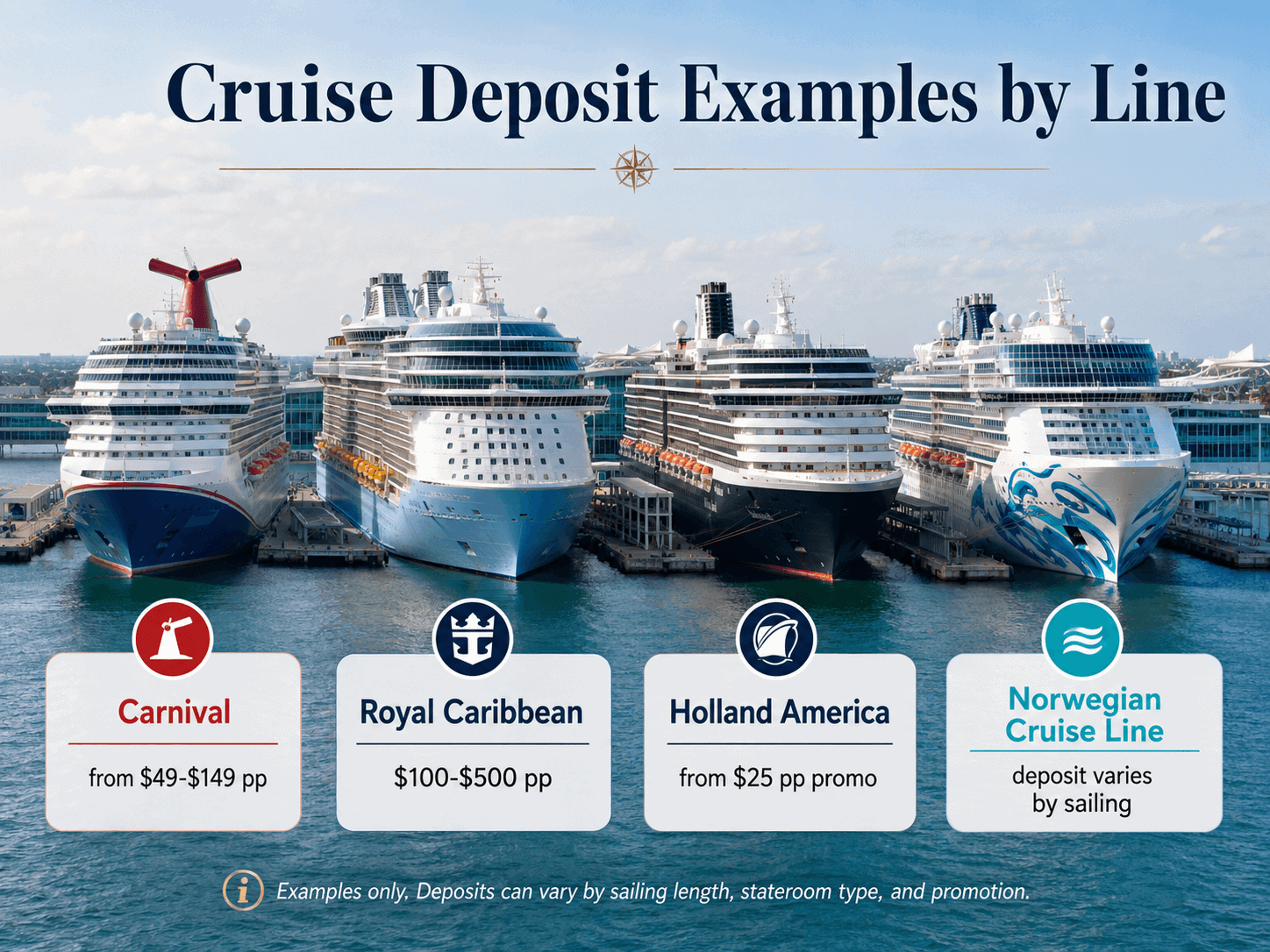
Most mainstream cruise lines charge a deposit of $99 to $500 per person, and the amount scales with the length of your cruise. A week in the Caribbean typically runs $250 per person on Royal Caribbean, Celebrity or Carnival, $199 on MSC, and $300 on Princess. Disney and Virgin Voyages charge a percentage of your fare instead, 10% and 20%. Two lines, Norwegian and Holland America, publish no deposit schedule at all.
Key Takeaways: Cruise Deposit Amounts
Deposits are almost always per person, not per cabin, which is the detail that surprises families most
The going rate for a 7-night mainstream cruise is $199 to $300 per person, so a couple is holding $400 to $600
Princess raised its deposits on September 2, 2026, to $125, $300 and $500 by cruise length, and moved final payment to a hard 120 days
Disney charges 10% of your fare and Virgin Voyages charges 20%, so their deposits rise with the price of the cruise
Norwegian and Holland America do not publish a deposit table, which is why every article on this topic hedges
Suites at Royal Caribbean, Celebrity and Princess are priced at 10% of fare or the standard deposit, whichever is higher
MSC does not charge a deposit for third and fourth guests aged 17 and under, which makes it the cheapest cabin on this list to hold
Luxury and river lines charge a percentage, not a flat fee, from Regent’s 15% to Silversea’s and Cunard’s 25%, and Viking’s flat $500 per person applies whether you sail 8 days or 15
Nobody warns you about the deposit. You spend three weeks picking a ship, you finally find the balcony cabin with the good location, you click “book,” and the screen asks for $1,000 before you have even chosen a dinner time.
So: how much is a cruise deposit, really? It depends on the line, the length of the sailing, and increasingly on how much you are spending, because several lines have quietly stopped using flat dollar amounts altogether. Below is every major line’s published number, verified on September 2, 2026, plus the two lines that decline to publish one and what you can use instead.
Fair warning: one of these numbers changed the same morning I wrote this. More on Princess in a minute.
Expect $99 to $500 per person on a flat-rate line, or 10% to 20% of your fare on a percentage-based line, with the amount rising as the cruise gets longer.
Here is the whole industry on one screen. Every figure comes from the line’s own published page unless noted.
Cruise line
Deposit
Charged per
Refundable by default?
MSC
$99 (0 to 4 nights) / $199 (5 to 14) / $300 (15+)
Adult, capped per stateroom
Yes, except Yacht Club
Royal Caribbean
$100 (1 to 5 nights) / $250 (6 to 9) / $450 (10 to 14) / $500 (15+)
Passenger
Yes, unless you choose a non-refundable fare
Celebrity
$100 (1 to 5 nights) / $250 (6 to 9) / $450 (10+)
Person
Yes, unless you choose a non-refundable fare
Carnival
$100 (2 to 3 days) / $150 (4 to 5) / $250 (6 to 9) / $400 (Alaska, Europe, Panama Canal, crossings)
Person
Generally no
Princess
$125 (5 days or fewer) / $300 (6 to 9) / $500 (10 to 44)
Guest
No
Disney
10% of voyage fare, before taxes and fees
Reservation
Yes, except Concierge
Virgin Voyages
20% of voyage fare, ticket price only
Booking
See cancellation policy
Norwegian
Not published
n/a
Varies by fare program
Holland America
Not published
n/a
No, on most promotional fares
Two things jump out of that table. The first is that a “cruise deposit” is not one thing anymore. The second is that on a 7-night Caribbean sailing, the cheapest line to hold a cabin on and the most expensive line to hold a cabin on are separated by a factor of about three, for a week on the same ocean.
Does the cruise deposit include taxes and port fees?
No. The deposit is a partial payment toward your cruise fare only. Taxes, port expenses and government fees come due at final payment with the rest of the balance.
This matters most on the percentage lines. Disney calculates its 10% on the voyage fare before taxes and fees, and Virgin Voyages calculates its 20% on the ticket price only, so both deposits are smaller than a straight percentage of the total you will eventually pay. On a $7,000 Disney booking where roughly $800 of that is taxes and fees, the deposit is 10% of $6,200, or about $620, not $700.
Your deposit is not an extra charge either. It comes off the total, so a $250 deposit on a $3,000 cruise leaves $2,750 due at final payment.
Cruise Deposit Amounts by Line: All 9 Compared
The deposit is set by cruise length on five lines, by a percentage of your fare on two, and by a phone call on the remaining two.
Nine lines, nine different answers. Five set the deposit by cruise length, two by a percentage of your fare, and two will not say.
Royal Caribbean cruise deposit
Royal Caribbean’s cruise deposit is $100 to $500 per person depending on cruise length, with suites priced at 10% of fare or the standard deposit, whichever is higher.
Two wrinkles nobody else mentions. Bermuda sailings are $250 per person regardless of length, so a 5-night Bermuda run costs two and a half times what a 5-night Bahamas run does to hold. And suites, including Junior Suites since June 1, 2023, are priced at 10% of the cruise fare or the standard deposit, whichever is higher. On a $9,000 suite, that is $900 per person, not $250.
Celebrity cruise deposit
Celebrity’s cruise deposit is $100 to $450 per person by cruise length, rising to $900 per person on Galápagos sailings.
Celebrity runs the same ladder as its corporate sibling: $100 per person up to 5 nights, $250 for 6 to 9 nights, and $450 for 10 nights and beyond.
The outlier is Galápagos at $900 per person, which is the highest published flat deposit of any mainstream line and reflects how tightly those small ships are capacity-controlled. Retreat suites follow the same “greater of 10% or standard” rule as Royal.
Carnival cruise deposit
Carnival’s cruise deposit runs $100 to $250 per person by cruise length, or $400 per person on Alaska, Europe, Panama Canal and ocean crossings.
Carnival’s ladder has more rungs than most: $100 per person for 2 to 3 days, $150 for 4 to 5 days, $250 for 6 to 9 days, and $400 for Alaska, Europe, Panama Canal and ocean crossings regardless of length.
One honest note. Carnival’s help site blocks automated retrieval, so unlike every other figure in this post, these four numbers come from a reputable third party rather than from Carnival itself. Confirm them at booking. Carnival’s Early Saver fares carry a non-refundable deposit that converts to a future cruise credit worth the deposit minus $50 per person, valid for 12 months.
Princess cruise deposit
Princess raised its cruise deposit on September 2, 2026 to $125, $300 and $500 per guest by cruise length, with suites at double those amounts.
Princess is the reason this post has a 2026 date on it. As of September 2, 2026, new bookings for voyages departing January 1, 2027 or later pay $125 per guest for 5 days or fewer, $300 for 6 to 9 days, $500 for 10 to 44 days, and 30% of fare on World Cruises. Suites are double: $250, $600 and $1,000.
That is a 20% to 25% increase across the board, and it makes Princess the most expensive mainstream line to hold a standard cabin on for a week at sea. Princess’s own terms page says only that “a non-refundable deposit is required for all stateroom guests” and that the “deposit amount may vary,” which is not enormously helpful, so the figures above come from Cruise Critic’s reporting on the policy change.
MSC cruise deposit
MSC’s cruise deposit is $99 to $300 per adult, capped per stateroom, with no deposit charged for third and fourth guests aged 17 and under.
MSC’s standard booking terms set the deposit at $99 per adult for 4 nights or less, $199 for 5 to 14 nights, and $300 for 15 nights and up.
Then comes the part that should make every parent sit up. MSC caps the deposit at $198 per stateroom on short cruises and $398 on the 5 to 14 night tier, and third and fourth guests aged 17 and under require no additional deposit. A family of four holding a week in the Caribbean pays $398 on MSC. On Princess the same family pays $1,200. That is not a typo, and it is the single most useful fact in this article.
MSC does not charge a deposit for third and fourth guests aged 17 and under, which is why the same family pays $398 here and $1,200 on Princess.
Yacht Club bookings use the same dollar amounts but are non-refundable, and World Cruises require a non-refundable 15% of the package price within the first week of booking.
Disney cruise deposit
Disney’s cruise deposit is 10% of the voyage fare before taxes and fees, charged per reservation rather than per person.
Disney charges 10% of the voyage fare, calculated before taxes and fees, per reservation. That is down from 20%, a change that took effect June 18, 2025. Bookings made on or before June 17, 2025 kept the old 20% requirement, and onboard placeholder offers converted to sailings of 7 nights or longer pay 5%.
Because it is a percentage, there is no table to give you, only arithmetic: a $6,000 family sailing means a $600 deposit, a $12,000 Concierge booking means $1,200. Concierge deposits are non-refundable. If you are still weighing whether the premium is justified, our honest take on whether a Disney cruise is worth it gets into what you actually get for the money.
Virgin Voyages deposit
Virgin Voyages requires 20% of the voyage fare as a deposit, the steepest percentage of any line in this comparison.
Virgin asks for 20% of the voyage fare, ticket price only, not taxes and fees, per booking, according to its payments FAQ. Final payment is due 120 days out, and if you book inside 120 days the entire fare is due immediately.
That 20% is the steepest percentage on this list. On a $4,000 booking for two, you are putting $800 down to hold a cabin on an adults-only ship that will not let you bring the kids anyway.
Norwegian cruise deposit
Norwegian does not publish a deposit schedule, but its own $250 and $500 CruiseNext certificates cover a full deposit for a standard cabin and a Haven suite respectively.
Norwegian does not publish a deposit table. Its public pages route the question to a payment schedule that is not readable as a table, which is why every article you have found on this topic gets vague right about here.
Here is the closest thing to an official answer, and it comes from Norwegian’s own promotional terms: a $250 CruiseNext certificate covers the full deposit for any stateroom up to and including a Club Balcony Suite, and a $500 CruiseNext Haven certificate covers the full deposit for any one stateroom. Norwegian would not size those certificates that way if the deposits were materially different. Treat $250 as the working number for a standard cabin and $500 for the Haven, then confirm at booking.
Separately, Norwegian’s Air Choice program carries a non-refundable deposit of $250 per stateroom, plus a $150 name correction fee, and it treats gateway and date changes as cancellations.
Holland America cruise deposit
Holland America publishes no deposit figure at all, and instead runs frequent reduced-deposit promotions starting as low as $25 per person.
Holland America also publishes no flat figure. Its cancellation policy phrases every refund tier as “100% refund less required deposit amount,” which retains the deposit without ever telling you what it is. The terms say amounts “vary according to the cruise length, stateroom type, and number of stateroom guests.”
What Holland America does offer, frequently, is a reduced deposit. A recent Labor Day promotion took $25 per person up front with a second $75 per person due 30 days later. If you are shopping Holland America, shop the promotion calendar, not the deposit table, because there isn’t one.
Cruise Deposit by Destination: 7 Itineraries That Cost More to Hold
On two lines the deposit is set by where you are going, not just how long you are gone, and the surcharge can quadruple what you put down.
Everyone assumes the deposit ladder is purely about nights. It is not. Here is where the itinerary itself moves the number.
Itinerary
Line
Deposit
Versus a standard sailing
Alaska
Carnival
$400 per person
Up from $250 on a 6 to 9 day Caribbean sailing
Europe
Carnival
$400 per person
Same surcharge, any length
Panama Canal
Carnival
$400 per person
Same surcharge, any length
Ocean crossings
Carnival
$400 per person
Same surcharge, any length
Bermuda
Royal Caribbean
$250 per person
Up from $100 on a 5-night sailing, regardless of length
Galápagos (Galapagos)
Celebrity
$900 per person
The highest published flat deposit of any mainstream line
World Cruise
Princess
30% of fare
MSC charges 15%, non-refundable, due within a week of booking
Why Alaska and Europe cost more to hold
Short seasons mean a cancelled cabin is far harder to resell, and the deposit is the line’s insurance against that.
A Caribbean cabin that frees up in March gets resold in March. An Alaska cabin that frees up in November cannot be resold until the following May, because the season does not exist in between. Same logic for Europe, Bermuda and Galápagos: a narrow sailing calendar and a fixed number of berths mean every cancellation costs the line more, so it holds more of your money up front.
What About Viking, Oceania and the Luxury Lines?
Premium, luxury and river cruise lines almost all charge a percentage of your fare rather than a flat amount, and the three that do use a flat fee charge more than any mainstream line’s standard cabin.
The nine lines above are the mainstream ocean lines, which is where most cruisers start. If you are shopping Viking, Oceania, Regent, Silversea, Cunard or AmaWaterways, none of the numbers above apply to you. Here is what those six actually publish.
Cruise line
Deposit
Final payment
Refundable?
AmaWaterways
$400 per person (Europe, Colombia, Asia). $1,200 Egypt, $2,400 Africa
90 days
No
Viking
$500 per person, river, ocean and expedition alike. 20% of fare on cruise tours over 35 days and World & Grand Cruises
Varies by offer, 180 days on World & Grand
Applied toward cancellation fees
Oceania
$500 per person standard staterooms. 20% of fare for Owner’s, Vista and Oceania Suites. $1,500 per person Grand Voyages
150 days
Subject to the cancellation schedule
Regent Seven Seas
15% of fare, due within 5 days of booking. 25% for Regent Suites
Full payment 150 days out
No, though a non-refundable fare saves 5%
Silversea
25% of booking value on Door-to-Door fares. 15% on Port-to-Port fares, due within 7 days
120 days
Door-to-Door yes, Port-to-Port no
Cunard
25% of voyage charges up to 30 nights. 20% for 31 nights and longer
120 days, 150 days on long voyages
Yes, except certain promotional fares
Why Viking charges $500 for an 8-day river cruise
Viking is the outlier of the group: one flat $500 per person, whether you are sailing eight days on the Rhine or fifteen days across the Atlantic.
Every mainstream line ties the deposit to cruise length. Viking does not. Its booking and sale terms set a single “Cruise Fare deposit of US$500.00 per person” across river, ocean and expedition, with the only exception being cruise tours over 35 days and the World and Grand Cruises, which move to 20% of the full fare.
The practical effect: on a short river cruise Viking’s deposit is one of the steepest in the industry, and on a long ocean voyage it is one of the gentlest. A couple books a week on the Danube and puts down $1,000, which is more than the same couple would put down for two weeks in the Mediterranean on Royal Caribbean. If you are weighing river against ocean, our comparison of Viking and AmaWaterways covers what else separates them, and our take on whether a European river cruise is worth it is the better starting point if you have not sailed one before.
AmaWaterways sits just under Viking at $400 per person for Europe, Colombia and Asia, per its booking terms, and then climbs steeply for its long-haul programs: $1,200 per person for Egypt and $2,400 per person for Africa.
Silversea charges you more to get it back
On Silversea the fare you pick decides whether your deposit is refundable, and the refundable one is also the bigger one.
This is the clearest version of the refundable trade-off anywhere in cruising. Silversea’s booking terms require “a refundable deposit of at least 25%” on Door-to-Door all-inclusive fares and “a non-refundable deposit of at least 15%” on Port-to-Port fares. So the flexible option costs you two-thirds more up front.
Most lines bury this choice behind two nearly identical fare buttons. Silversea puts it in the deposit itself, which is at least honest.
3 mechanics the luxury lines share
These lines run on different rules than the mainstream ones, and three of the differences will catch you out.
The deposit is not always due at booking. Regent gives you five days and Silversea gives you seven. Your reservation is not secure until the money lands, and a cabin can be released if it does not.
Final payment comes much earlier. Oceania wants the balance 150 days out and Regent effectively the same. Compare that to 90 days on Royal Caribbean. On a luxury booking your money is committed roughly two months sooner than it would be on a mainstream line.
Suites break the pattern. Oceania’s Owner’s, Vista and Oceania Suites jump from a flat $500 to 20% of fare, and Regent Suites move from 15% to 25%. On a $30,000 Regent Suite booking that is $7,500 rather than $4,500.
Ask Your Phone: Cruise Deposit Questions
The five questions people actually say out loud when they are standing at a booking screen.
How much do I have to put down to book a cruise?
On most mainstream lines, $100 to $300 per person for a standard week-long sailing. Longer cruises and suites cost more to hold, and Disney and Virgin Voyages charge a percentage of your fare rather than a flat amount.
Is the cruise deposit per person or per room?
Per person, on nearly every line. MSC is the exception worth knowing: it caps the deposit per stateroom and charges nothing for third and fourth guests aged 17 and under.
Do I get the deposit back if I cancel my cruise?
That depends entirely on whether you booked a refundable or non-refundable deposit fare. Refundable deposits come back if you cancel before final payment; non-refundable ones usually convert to a future cruise credit after a fee, and Celebrity’s published wording says the deposit is not refunded at any time.
Can I book a cruise with a fifty dollar deposit?
Sometimes, during a promotion. Every line on this list has run reduced deposit sales at $1, $25, $50 or $99 per person, usually during wave season in January through March.
Which cruise line has the cheapest deposit?
MSC, by a wide margin. It charges $199 per adult for a week-long cruise, caps the deposit per stateroom, and asks nothing for third and fourth guests aged 17 and under. A family of four holds an MSC cabin for $398 and a Princess cabin for $1,200.
Does my cruise deposit count toward the price of the cruise?
Yes. The deposit is a partial payment, not an extra fee, and it comes straight off your total. Put $500 down on a $3,000 cruise and $2,500 is due at final payment.
When do I have to pay the rest of my cruise?
Final payment lands 75 to 120 days before you sail, depending on the line and the length of the cruise. Princess moved to a hard 120 days for every voyage length on September 2, 2026, with no grace period and no extensions.
2 Cruise Lines That Will Not Tell You the Deposit
Norwegian and Holland America both decline to publish a deposit schedule on any public page, and this is not an oversight.
It is easy to read that as sloppiness. It is more likely strategy. A line that publishes “$250 per person” has anchored every shopper to $250 forever. A line that publishes nothing can run a $25 deposit promotion in January, a standard deposit in June, and a suite-specific number in between, without any of them looking like a change.
The practical effect on you is the same either way: you cannot price a Norwegian or Holland America booking without either putting it in a cart or asking someone. Build that extra step into your shopping. It is also, frankly, one of the more useful things a travel advisor does, since we can see the deposit terms on a sailing before you commit to anything. Our explainer on what a travel agent actually does covers the rest of it.
Last checked: September 2, 2026. We re-check Norwegian’s and Holland America’s public pages monthly. If either line publishes an actual deposit schedule, this post will say so within a week, and we will date the change.
Why 3 Lines Ditched the Flat Deposit
Disney, Virgin Voyages and the suite categories at Royal Caribbean, Celebrity and Princess have all moved to percentage-of-fare deposits, which means your deposit now scales with how nice a cabin you book.
Call this the Adventures by MJ Deposit Crossover Table.
For decades the deposit was a flat placeholder. Book an inside cabin or the owner’s suite, you put down the same $250. That model is disappearing, and here is what the shift costs you at different fare levels.
Suites at Royal Caribbean, Celebrity and Princess are priced at 10% of fare or the standard deposit, whichever is higher. Book the owner’s suite and the deposit follows the fare up.
Your cabin fare (2 guests)
Flat $250 pp deposit
10% of fare deposit
20% of fare deposit
$2,000
$500
$200
$400
$4,000
$500
$400
$800
$6,000
$500
$600
$1,200
$10,000
$500
$1,000
$2,000
All figures verified September 2, 2026 from each line’s own published page except Carnival, which is noted below.
The crossover matters. Below roughly $5,000 in total fare, a 10% deposit is cheaper than a flat $250 per person. Above it, the flat deposit wins. That is why Royal Caribbean and Celebrity price suites as “10% or the standard deposit, whichever is higher,” and it is why nobody books a $12,000 suite expecting to hold it for $500.
If you are still deciding between an inside cabin and a balcony, our guide to choosing the right cruise cabin is worth reading before you get to the deposit screen, because on a percentage line the cabin choice and the deposit are the same decision.
What a Cruise Deposit Costs a Family of 4
Two adults and two children under 18, one week in the Caribbean, standard balcony cabin, using each line’s published deposit rules on September 2, 2026.
Cruise line
Deposit for a family of 4
Why
MSC
$398
$199 per adult, capped per stateroom, no deposit for guests 17 and under
Disney (on a $7,000 fare)
$700
10% of the voyage fare, per reservation
Royal Caribbean
$1,000
$250 per passenger
Celebrity
$1,000
$250 per person
Carnival
$1,000
$250 per person
Norwegian (working estimate)
$1,000
Based on the $250 CruiseNext deposit equivalence
Princess
$1,200
$300 per guest under the September 2, 2026 schedule
An $802 spread on the identical week at sea. That is a flight, or excursions for everyone, or most of a dining package
Call this the Adventures by MJ Family Deposit Comparison, because I have not found it published anywhere else. The spread between the cheapest and most expensive line is $802 for the identical week at sea, which is a flight, or a shore excursion for everyone, or most of a dining package.
That does not mean MSC is the right ship for your family. It means the deposit is a real line item that varies far more than the fare does, and if cash flow between booking and final payment is a consideration, it belongs in the comparison. Group bookings amplify all of this, which is why Caribbean group cruises are usually negotiated with deposit terms attached.
When Your Deposit Stops Being Refundable
Every deposit becomes non-refundable eventually, and the calendar matters more than the fare type.
The chart below plots the same 7-night cruise across eight lines on one timeline, from 120 days out to sailing day. It shows two dates that never appear on a booking screen: the day your money stops being fully refundable, and the day 100% of your fare is gone.
The Deposit Risk Window
A 7-night cruise, standard cabin, drawn to scale from 120 days out to sailing day. Where your money sits, and when it stops being yours.
Fare still fully refundablePartial penalty100% lost, no refund
1209060300
Royal CaribbeanFinal payment 90 days
CelebrityFinal payment 90 days
CarnivalFinal payment 90 days
MSCFinal payment 90 days
NorwegianPenalties start 119 days
PrincessFinal payment 120 days
DisneyFinal payment 120 days
Holland AmericaFinal payment 120 days
Days before sailing
1209060300
Royal Caribbean, Celebrity, Carnival and MSC give you an extra month. Their final payment lands at 90 days, not 120, so your fare stays fully refundable a full month longer than it does on Princess, Norwegian, Disney or Holland America.
Holland America has the largest total-loss zone on this chart. No refund from 60 days out, twice as early as most of the industry.
Disney, Carnival and MSC let you walk away latest. The 100% penalty holds off until 14 days before you sail.
The Adventures by MJ Deposit Risk Window. Compiled from each line’s published cancellation fee schedule and final payment terms, verified September 2, 2026. Standard cabins on a 7-night sailing; suites, Haven categories, Yacht Club, Concierge, Grand Voyages and World Cruises follow different schedules. Confirm the schedule on your own booking. Adventures by MJ
Three things you can only see when they are drawn to scale. Royal Caribbean, Celebrity, Carnival and MSC give you a full extra month of freedom at the front of the window, because their final payment lands at 90 days instead of 120. Holland America’s total-loss zone is the largest of any line, starting at 60 days out, twice as early as most. And Disney, Carnival and MSC let you walk away latest, holding off the 100% penalty until 14 days before you sail.
This is also where travel insurance and a refundable deposit stop being interchangeable. A refundable deposit protects you before final payment. Insurance protects you after it, when the whole fare is exposed. If you are sailing in August or September, our Caribbean hurricane season guide explains why a rerouted itinerary is usually not a covered reason to get your money back.
Reduced deposit promotions are constant across the industry, and they are the single easiest way to cut what you put down.
1. Book during wave season
January through March is when every line on this list runs its deepest deposit promotions. $1, $25, $50 and $99 per person deposits all show up reliably in this window.
2. Book onboard
Every line sells a future cruise certificate onboard that functions as a prepaid deposit. Norwegian’s CruiseNext is the clearest example, at $250 for a standard stateroom and $500 for the Haven, and it typically comes with onboard credit attached.
Wave season runs January through March and is when $1, $25, $50 and $99 deposit promotions reliably appear across the industry.
3. Ask about a split deposit
Holland America’s recent structure took $25 per person up front and $75 per person 30 days later. Several lines will do a version of this on request, and nobody volunteers it.
4. Look at the shorter sailing
The deposit ladder is built on cruise length. A 5-night sailing and a 6-night sailing can sit on opposite sides of a $150 per person step, which is $600 for a family of four to sleep one extra night.
5. Watch the itinerary surcharge
Carnival charges $400 per person for Alaska, Europe, Panama Canal and crossings, and Royal Caribbean charges $250 for any Bermuda sailing regardless of length. The itinerary, not just the length, can move the deposit.
If keeping track of due dates across a multi-cabin family booking sounds like a job for something other than your memory, a simple travel document organizer with room for confirmation numbers and payment dates does the job better than a phone note you will forget you made.
What the Government Can and Cannot Do About Your Deposit
The Federal Maritime Commission protects you against the cruise line failing to sail. It does not protect you against changing your mind.
This is the part almost nobody covers, and it is the answer to a question a lot of people are quietly asking. The Federal Maritime Commission states plainly that it “cannot order a cruise line to make a refund to a passenger when a passenger decides not to travel.”
What it does require is meaningful. Lines sailing from U.S. ports with 50 or more berths must hold a bond or other surety “available to refund passenger deposits in the event of nonperformance.” So if a line collapses or a ship never sails, there is a financial backstop behind your deposit. If your daughter’s wedding gets scheduled for the same week, there is not.
The FMC’s Consumer Affairs and Dispute Resolution Services office does run a voluntary complaint process if you have a dispute the line will not resolve. Voluntary is doing some work in that sentence, but it exists, it is free, and it is more than most travelers realize they have.
Frequently Asked Questions About Cruise Deposits
Short version: $99 to $500 per person on most lines, 10% or 20% of fare on Disney and Virgin Voyages, and no published figure on Norwegian or Holland America.
How much is a cruise deposit for a 7 day cruise?
For a 7-night cruise, expect $250 per person on Royal Caribbean, Celebrity or Carnival, $199 per adult on MSC, and $300 per guest on Princess. Disney charges 10% of your fare and Virgin Voyages charges 20%, so their deposits depend on what you are paying. Norwegian and Holland America do not publish a figure, though Norwegian’s $250 CruiseNext certificate covers a standard cabin deposit in full.
Is a cruise deposit refundable?
It depends on the fare you book, not on the line. Most lines sell both refundable and non-refundable deposit versions of the same cabin, with the non-refundable version priced lower. Princess deposits have been non-refundable by default since October 15, 2025, and Disney’s Concierge deposits are always non-refundable.
Do you pay a cruise deposit per person or per cabin?
Per person on almost every line, which is why a family of four is often surprised at checkout. MSC is the meaningful exception, capping the deposit per stateroom and charging nothing for third and fourth guests aged 17 and under. Disney and Virgin Voyages calculate their percentage on the whole reservation rather than per guest.
What happens to my deposit if I cancel before final payment?
If your deposit is refundable, you get it back. If it is non-refundable, most lines keep the deposit and issue the remaining value as a future cruise credit, often after deducting a fee, such as Carnival’s $50 per person on Early Saver fares. Royal Caribbean charges $100 per guest to change the ship or sail date, with no cap on how many times that fee applies.
Can I put a deposit on a cruise and pay the rest later?
Yes, and that is the entire point of the deposit system. You hold the cabin now and pay the balance at final payment, which falls 75 to 120 days before you sail depending on the line and cruise length. Nothing is due in between, though you can make voluntary payments toward the balance at any time.
How long can I hold a cruise without paying a deposit?
Most lines offer a courtesy hold of roughly 24 to 72 hours on many sailings, with no money down. Holds are not available on every fare or every sailing, and they are usually shorter or unavailable close to departure. It is enough time to check the flights and ask your travel partner, not enough time to think it over for a week.
Why did Princess raise its cruise deposits?
Princess raised deposits 20% to 25% and moved final payment to 120 days for all voyage lengths, effective for new bookings made on or after September 2, 2026, for voyages departing January 1, 2027 or later. The line has not published a rationale. The practical effect is more cash held earlier and a longer window in which cancellation carries a penalty.
Is a bigger cruise deposit a bad sign?
Not by itself. A higher deposit usually reflects a longer sailing, a premium cabin, or a capacity-controlled itinerary like Galápagos or a World Cruise, all of which are genuinely harder for the line to resell. What matters more than the size of the deposit is whether it is refundable and how early the penalty schedule starts.
What is the average cruise deposit?
Across the mainstream lines, the average deposit for a 7-night cruise is roughly $250 per person, which puts a couple at about $500 to hold a cabin. The range around that average is wide: $199 per adult on MSC at the low end, $300 per guest on Princess at the high end, and a percentage of fare on Disney and Virgin Voyages that can land anywhere.
Do I get my deposit back if the cruise line cancels the sailing?
Yes. When the line cancels, you are entitled to a refund or a future cruise credit under its own terms, and this is the one scenario with a federal backstop behind it. Cruise lines sailing from U.S. ports with 50 or more berths must hold a bond available to refund passenger deposits in the event of nonperformance. That protection covers the line failing to sail, not you changing your mind.
How much is a Viking cruise deposit?
Viking requires a flat $500 per person for river, ocean and expedition cruises alike, regardless of how long the sailing is. Cruise tours longer than 35 days and the World and Grand Cruises move to 20% of the full fare instead. That flat structure makes Viking one of the most expensive lines to hold a short river cruise on and one of the cheapest to hold a long voyage on.
Planning a cruise and want to know what you are actually committing to before you click? We look at the deposit terms, the final payment date and the cancellation schedule on any sailing we quote, and we will tell you plainly when a non-refundable fare is the smarter buy and when it is not worth the savings. No pressure, no obligation, and no charge for asking. Send us a note with the ship and the week you are considering and we will pull the numbers.
Final Thoughts
The deposit is the first real number in a cruise booking, and it is the one nobody researches until it is on the screen in front of them. Now you know: $99 to $500 per person on most lines, 10% or 20% of fare on Disney and Virgin, a phone call on Norwegian and Holland America, and a $802 spread between the cheapest and most expensive way for a family of four to hold the same week at sea.
None of which tells you which cruise to take. It tells you what it costs to stop shopping and start planning, and that is worth knowing before you fall in love with a particular balcony. Deposit rules also change quietly and without announcement, as Princess demonstrated on the morning this post went up, so confirm the number at booking rather than trusting any article, including this one, six months from now.
Written by Sue Nelson, Travel Advisor | Adventures by MJ | Updated for 2026
Affiliate Disclosure: This post may contain affiliate links. If you make a purchase through one of these links, we may earn a commission at no additional cost to you. We only recommend products and services we believe may be helpful to travelers.
Hi, I'm Sue. I plan cruises, all-inclusive resorts, and slow multi-country trips through Europe. I'm a certified Hawaii travel specialist, and I book through host agency Outside Agents as a member of the Travel Leaders Network. Twenty years in senior HR leadership before this, which mostly taught me how to read what people actually want. I live in Grain Valley, Missouri with my husband and business partner Mike.