How to Plan a Trip to Europe Without Getting Overwhelmed
Planning a trip to Europe doesn’t have to take 47 browser tabs. Here is how to pick fewer places, map a route that makes sense, book things in the right order and get your documents ready for 2027.
Last updated: October 2, 2026 :: Written by Sue Nelson, Travel Advisor | Adventures by MJ
(A Step-by-Step Guide for First-Time and Repeat Travelers)
Quick Answer: Plan a Europe trip in this order. Decide what kind of trip you want, limit it to two or three countries, map a route that moves in one direction, then book flights and key hotels first. Leave free time every day, and check your passport and the EU entry rules before you pay for anything.
Key Takeaways: How to Plan a Trip to Europe
Decide how you want the trip to feel before you look at flights. Your travel style shapes every other choice.
Keep it to two or three countries and three to five cities, with at least two or three nights in each.
May, June, September and early October usually give you the best mix of weather, prices and crowds.
Move in one direction and take trains between nearby cities. Zigzagging to save $30 on a flight costs you a day.
Book flights and key hotels 6 to 9 months out, then trains, tours and dinners 3 to 6 months out.
If you’ve ever opened your laptop to “start planning a Europe trip” and suddenly found yourself 47 tabs deep comparing trains, hotels, itineraries, and “best time to visit” articles…
If planning a Europe trip feels overwhelming, you’re not alone. Most travelers start exactly here.
You’re not doing it wrong.
You’re just doing it the way most people do.
And that’s exactly why it feels overwhelming.
Because planning a trip to Europe isn’t just about picking a destination. It’s about navigating:
Countries, not just cities
Transportation logistics
Timing, crowds, and seasons
Experiences vs exhaustion
So let’s simplify this.
Here is how to plan a trip to Europe step by step, without spiraling into decision fatigue or accidentally planning a trip that requires a vacation after your vacation.
Grab my free Europe Trip Planner — it walks you through how to choose your route, when to go, and how to avoid decision overload before you book anything. [Download the free planner →]
You’re not traveling. You’re relocating repeatedly with snacks.
Fewer destinations often lead to a more enjoyable and less stressful Europe trip.
Step 3: Choose the Right Time to Go
Timing matters more than people think.
The same trip can feel:
magical in October
chaotic in July
rainy in November
Best Times to Visit Europe
Spring (April–June): Mild weather, fewer crowds
Fall (Sept–Oct): Ideal balance of weather + pricing
Summer (July–Aug): Busy, hot, expensive
Winter: Festive (Christmas markets) or quiet
This guide on the best time to travel to Europe breaks this down month-by-month so you can match your trip to your priorities.
Seasonality plays a major role in your experience. According to Eurostat, July and August accounted for 31% of all nights spent in EU tourist accommodation in 2025, and August alone was 3.6 times busier than January.
The same destination can feel completely different depending on when you visit.
Step 4: Map Your Route (Like a Normal Human, Not Google Maps)
Here’s where planning gets smarter.
What NOT to Do:
Zigzag across Europe because flights were $30 cheaper
What to Do Instead:
Move in one direction (north → south, etc.)
Group nearby cities
Minimize travel days
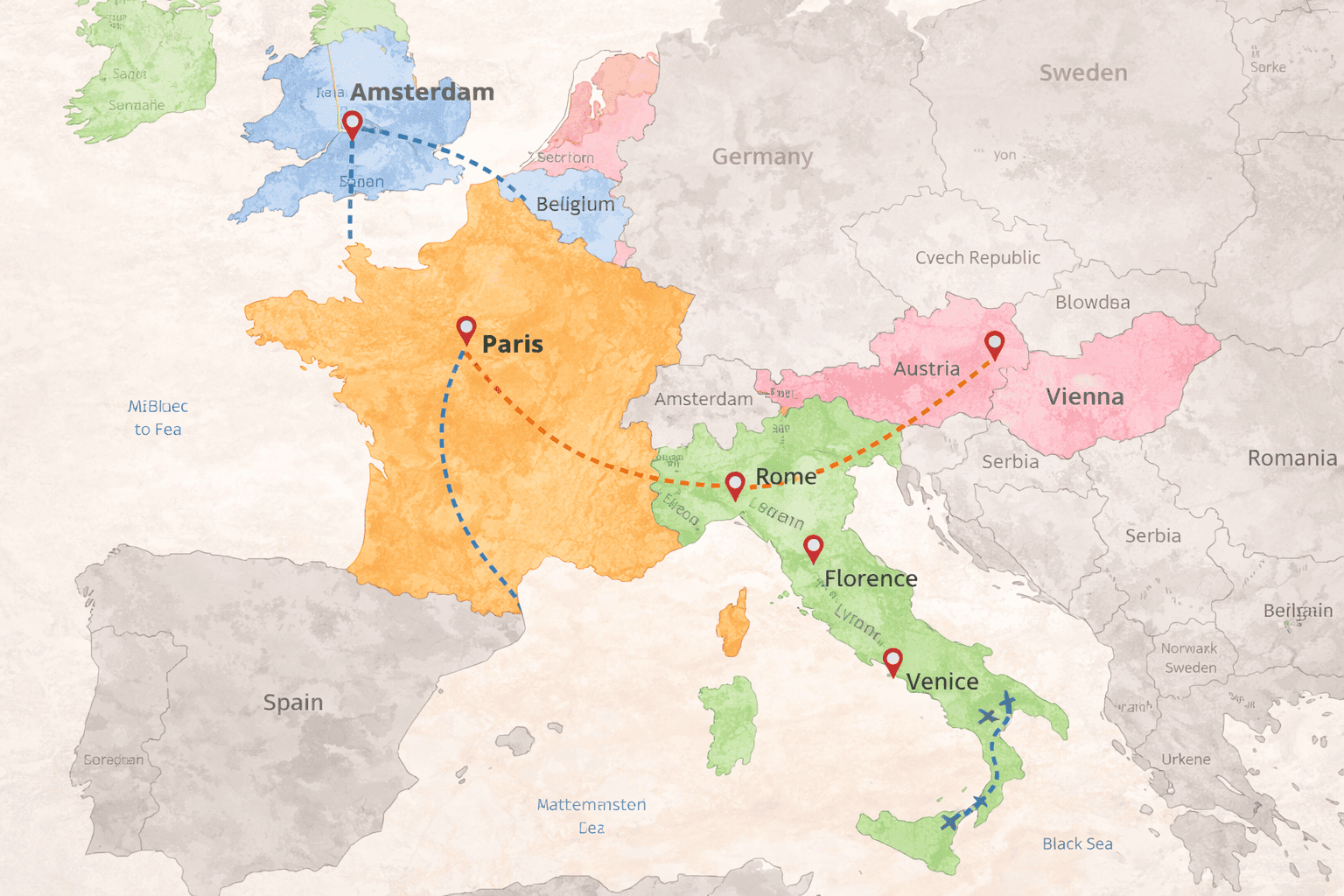
SIMPLE ROUTE EXAMPLE
Route Style
Example
Linear
Paris → Lyon → Rome
Regional
Amsterdam → Bruges → Paris
Single Country
Rome → Florence → Venice
👉 Fewer travel days = more actual vacation
Step 5: Decide How You’ll Get Around
Transportation is where overwhelm really kicks in.
So let’s simplify it:
Your Main Options
Trains → Fast, scenic, central stations
Flights → Good for long distances
Private transfers → Easy, more expensive
Cruises → No packing/unpacking (huge win)
Rail travel is one of the most popular ways to move between cities in Europe, and planning routes in advance can make the entire trip significantly smoother.
If the idea of figuring all this out sounds… not fun, that’s exactly why some trips fall into the category of trips that are better with a travel agent(especially multi-country Europe itineraries).
Trains are often the easiest and most scenic way to travel between European cities.
Step 6: Book the Right Things First
You don’t need to book everything at once.
But you DO need to prioritize.
It’s also important to make sure your travel documents are in order before booking, especially for international trips.
Two newer EU rules matter for 2027 trips. The Entry/Exit System has been fully running since April 10, 2026, so expect to have your fingerprints and photo taken the first time you cross into the Schengen area. And ETIAS, a €20 online travel authorization for visa-free visitors like Americans, is coming but isn’t live yet. The EU has said it will announce the start date months ahead, so check it before you book.
Book First:
✔ Flights ✔ Key accommodations ✔ Major transportation
Book Next:
✔ Tours ✔ Activities ✔ Dining reservations
Leave room for flexibility, but don’t leave everything to chance.
Some of the best moments in Europe aren’t planned. They’re discovered.
Step 8: Budget Realistically
Europe can be:
affordable
luxurious
wildly expensive
Sometimes all in the same day.
What to Budget For:
Flights
Hotels
Transportation
Food + drinks
Experiences
Unexpected extras
Insider Tip
People often underestimate:
daily spending
transportation costs
“just one more gelato” expenses
Step 9: Should You Plan It Yourself or Get Help?
Let’s be honest.
You can plan a Europe trip yourself.
But the real question is:
Do you want to?
DIY Planning Works If:
You enjoy research
You have time
You like control
Getting Help Makes Sense If:
You’re overwhelmed
You want a smoother experience
You don’t want to miss details
And no, it doesn’t necessarily cost more. This breakdown of do travel agents cost more clears up that misconception.
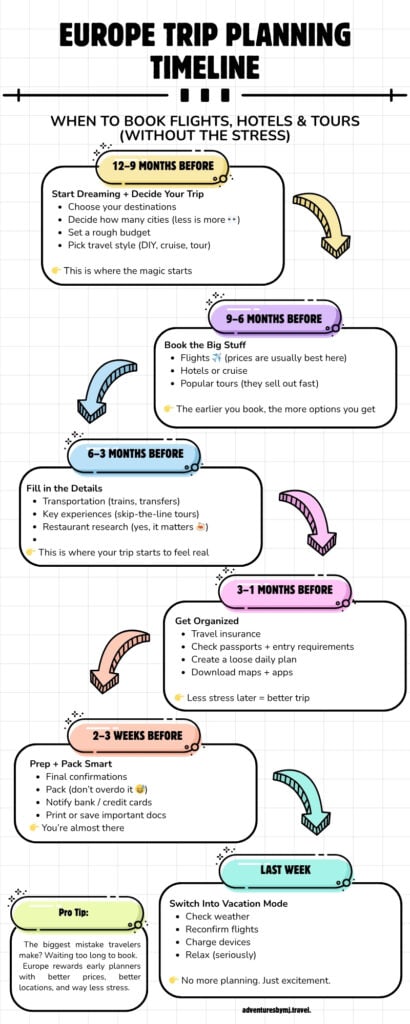
Europe Trip Planning Timeline (Helpful Visual)
Timeline
What to Do
9–12 months out
Choose destinations + travel style
6–9 months
Book flights + accommodations
3–6 months
Book trains, tours, key activities
1–3 months
Finalize details + documents
Planning ahead = less stress + better options
Planning ahead helps you secure better options and avoid last-minute stress.
Step 10: Keep It Simple (This Is the Secret)
If you take nothing else from this post, take this:
The best Europe trips are not the most packed.
They are the most intentional.
You don’t need:
5 countries
20 tours
a minute-by-minute schedule
You need:
✔ a clear plan ✔ realistic expectations ✔ room to enjoy it
Quick Voice Search Answers: Planning a Europe Trip
Where do I start when planning a trip to Europe?
Start with how you want the trip to feel, slow and scenic or fast and full of highlights, then pick two or three countries that fit. Flights, hotels and trains come after that.
How do I plan a European vacation on my own?
Pick your dates and a route that moves in one direction, then book flights and your first and last hotels. Add trains and tours three to six months out, and check passport and entry rules before you pay for anything.
How can I see several European countries without feeling rushed?
Give each stop at least two or three nights and move in one direction. Take trains between nearby cities so a travel day still leaves you an afternoon to explore.
When is the best time to visit Europe in 2027?
May, June, September and early October give most travelers the best mix of weather, prices and crowds. July and August are the busiest and most expensive months, especially around the Mediterranean. Our guide to the best time to travel to Europe goes month by month.
Do Americans need a visa for Europe in 2027?
Not for short trips. U.S. citizens can stay in the Schengen area for up to 90 days in any 180-day period without a visa, but plan on the new ETIAS authorization once the EU sets its start date.
FAQs: Planning a Trip to Europe
How far in advance should I plan a trip to Europe?
Ideally, you should start planning 9–12 months in advance, especially for peak travel seasons. This allows you to secure better pricing, availability, and preferred accommodations. Last-minute planning is possible, but your options may be limited.
What is the best way to travel between cities in Europe?
Trains are often the easiest and most efficient option for travel between major cities. They are fast, scenic, and typically arrive in central locations. Flights are better for longer distances, while cruises simplify logistics entirely.
Is it better to visit multiple countries or stay in one?
It depends on your travel style, but fewer destinations usually result in a more enjoyable trip. Staying in one country or region allows you to explore more deeply without feeling rushed. Multi-country trips can work if planned carefully and spaced out.
How many days do you need for a Europe trip?
A good Europe trip typically ranges from 7 to 14 days. Shorter trips should focus on one region, while longer trips can include multiple destinations. The key is balancing travel time with actual experience time.
Is Europe expensive to travel to?
Europe can be expensive, but it doesn’t have to be. Costs vary widely depending on your destinations, travel style, and timing. Planning ahead and prioritizing your spending can help you stay within budget.
Should I use a travel agent for Europe?
If your trip includes multiple destinations, complex logistics, or special experiences, using a travel agent can simplify the process significantly. They can also help avoid common mistakes and optimize your itinerary. For many travelers, the time saved alone is worth it.
A well-planned trip lets you focus less on logistics and more on the experience.
Final Thoughts
Planning a trip to Europe doesn’t have to feel overwhelming.
It only feels that way when you try to do everything at once.
If you slow it down…
✔ choose fewer places ✔ plan with intention ✔ give yourself breathing room
You’ll end up with a trip that actually feels like a vacation.
Grab my free Europe Trip Planner — it walks you through how to choose your route, when to go, and how to avoid decision overload before you book anything. [Download the free planner →]
A Simple Next Step
If you’re in the “this sounds amazing but also… where do I even start?” phase, you’re not alone.
Sometimes the hardest part of planning a Europe trip isn’t choosing where to go. It’s narrowing it down in a way that actually makes sense.
If you want a second set of eyes on your ideas, I’m always happy to help you simplify things, connect the dots, and turn it into a trip that feels exciting instead of overwhelming.
Written by Sue Nelson, Travel Advisor | Adventures by MJ | Updated for 2027
Affiliate Disclosure: This post may contain affiliate links. If you make a purchase through one of these links, we may earn a commission at no additional cost to you. We only recommend products and services we believe may be helpful to travelers.
Hi, I'm Sue. I plan cruises, all-inclusive resorts, and slow multi-country trips through Europe, and I'm a member of the Travel Leaders Network. Twenty years in senior HR leadership before this, which mostly taught me how to read what people actually want. I live in Grain Valley, Missouri with my husband and business partner Mike.