European River Cruise vs Hotel Barge: Which Is Right for Slow, Luxury Travel?
Two of Europe's most luxurious ways to travel the water — and they couldn't be more different. This guide breaks down the honest differences between a European hotel barge and a river cruise: intimacy vs. itinerary, one region deeply vs. multiple countries efficiently, fully all-inclusive vs. semi-inclusive, and private charter vs. scheduled sailing. If you've ever wondered whether there's something more immersive than river cruising, the answer is yes, and this post will tell you exactly who it's right for.
Last updated: June 6, 2026 :: Reviewed by Sue Nelson, Travel Advisor
Quick Answer: A European hotel barge is the right choice if you want maximum intimacy, deeply immersive slow travel in one region, and an experience that feels more like a private floating country house than a cruise ship. A river cruise is the right choice if you want to cover multiple cities and countries, prefer more onboard amenities and fellow travelers, and want more flexibility in pricing and departure dates. Both deliver luxury European water travel. What separates them is pace, privacy, and how many places you actually want to see in a week.
Key Takeaways: European Hotel Barge vs River Cruise
Hotel barges carry 6 to 22 guests; European river cruise ships carry 100 to 200
Barges stay in one region for the week (think: all of Burgundy, slowly); river cruises cover hundreds of miles across multiple countries
Most hotel barges are fully all-inclusive: meals, wines, excursions, and bikes are in the fare
Private charter barges are available for families, friend groups, and milestone celebrations
River cruises offer more price points, more departure dates, and more city-to-city variety
Both experiences suit luxury travelers who have graduated from big-ship ocean cruising and are looking for something more
This post is for you if: You’re a luxury traveler who has done (or is seriously considering) European water travel and wants an honest comparison between a hotel barge and a river cruise, not a sales pitch for either. If you’re still deciding whether to go to Europe at all, start with Your First River Cruise first.
You know those travel decisions where you’ve narrowed it down to two absolutely lovely options and the problem is you can’t afford to make the wrong choice? This is one of those. The european hotel barge vs river cruise question sits somewhere between “how do I want to spend a week in Europe” and “what kind of traveler am I, actually.” Both deliver slow, scenic, low-unpacking luxury travel across some of the most beautiful waterways on the continent. But they are genuinely different products, and knowing which one fits you could be the difference between a perfectly nice vacation and one you’re still talking about fifteen years from now.
I’ve booked both for clients. I’ve also sat across from people on discovery calls who were absolutely certain they wanted a river cruise right up until I explained that hotel barges exist. So let’s sort this out properly.
Thinking about a river cruise? Grab my free River Cruise Guide — the lines actually worth booking, how to pick your river and season, and the questions to ask before you put down a deposit. [Download the free guide →]
What a European River Cruise Actually Is (And Isn’t)
The Basics of River Cruising
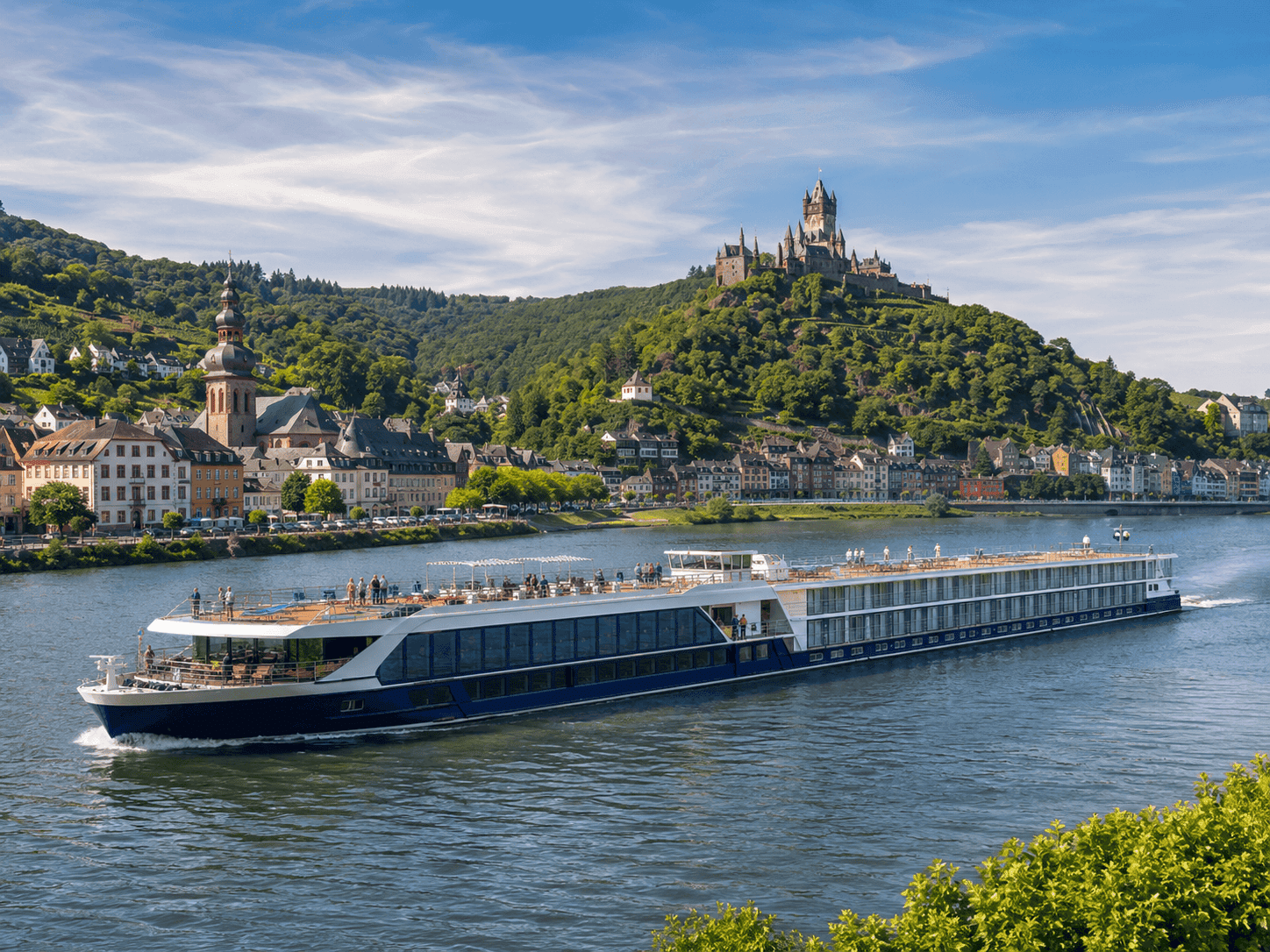
If you’ve done any research into European river cruising, you already know the main players. Lines like Viking, AmaWaterways, Scenic, Avalon, and Tauck run purpose-built river ships along Europe’s marquee waterways: the Rhine, Danube, Main, Seine, Rhone, Moselle, and Douro. Ships carry between 100 and 200 guests, and itineraries typically span one to two weeks covering multiple countries.
River cruise ships carry 100 to 200 passengers and cover multiple countries in a single sailing. Waking up to a new city every morning is the whole point.
What’s included varies by line, but most premium river cruises cover accommodations, meals, beer and wine at mealtimes, Wi-Fi, port taxes, and one guided shore excursion per port. Higher-end lines layer in specialty dining, complimentary bicycles, and wellness programming. (For a deep dive into how the top river cruise lines compare, here’s my honest Viking vs AmaWaterways breakdown.)
What you’re really paying for with a river cruise is variety: a new city every morning, a curated excursion every afternoon, and the full infrastructure of a small but real ship around you. According to the Cruise Lines International Association’s State of the Cruise Industry Report, river cruising is one of the fastest-growing segments in global travel, with passenger numbers rising year over year. That demand is not accidental. River cruising solves a real problem for travelers who want Europe without the twelve-hotel-in-twelve-days suitcase marathon.
What River Cruising Is Not
River cruises are not slow travel in the truest sense of the phrase. They are efficient scenic travel: beautifully organized, logistically painless, and designed so that you wake up in a new destination every single morning with the hard work already done. That is a real and legitimate appeal, and it’s why prime sailings sell out nine to twelve months ahead.
But if you’ve done a river cruise before and you’ve noticed that you’re moving a bit fast through places you’d like to have stayed longer, you’re not alone. That observation is often the first signal that a hotel barge might actually be what you’re looking for next.
River Cruising by the Numbers
38.3 million cruise passengers expected in 2026 (CLIA, 2026)
Premium and luxury river cruise segments growing faster than the broader category
Prime sailings on top lines sell out 9–12 months ahead
What a European Hotel Barge Actually Is (And Isn’t)
The Basics of Hotel Barge Travel
A hotel barge is something genuinely different.
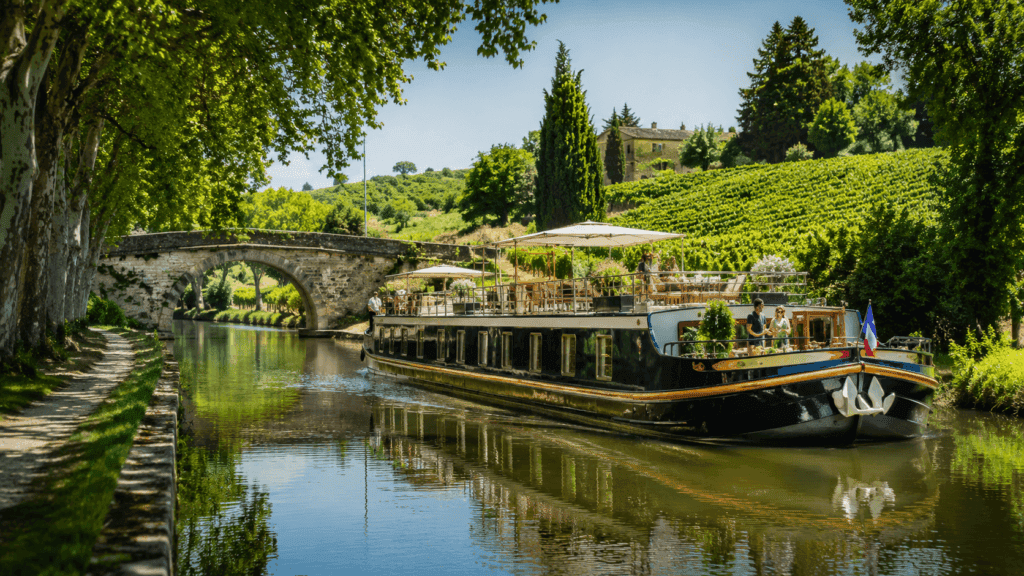
Picture a converted canal barge, somewhere between 100 and 200 feet long, carrying between 6 and 22 guests through the waterways of Burgundy, Provence, Alsace, the Canal du Midi, or the Loire Valley. There is a captain (who also happens to have excellent taste in regional restaurants). There is a private chef. There is a crew of typically three to six people managing a vessel with fewer guests than some Manhattan apartments have residents.
Hotel barges typically carry 6 to 22 guests, with a crew-to-guest ratio that makes the experience feel genuinely private, not just small-ship.
The pace is genuinely slow. A hotel barge might travel fifteen to twenty miles in a day, not because the canal won’t allow faster, but because stopping at the lock, waiting while the water fills, and stepping off to walk the towpath while the boat catches up is actually the point. You cycle ahead through vineyards. You stop at a village market and buy cheese and a baguette. Lunch is back on board: three courses, regional wine, absolutely nowhere to be. This is what most people picture when they imagine a small barge cruise in France.
European Waterways, which has operated hotel barges since 1972, is one of the most established names in the category and a good reference point for what the experience looks like at a high standard. Barge Lady Cruises works as a specialist booking service representing dozens of independent barges and fleets across Europe, and is the best single resource I know for understanding the full range of options.
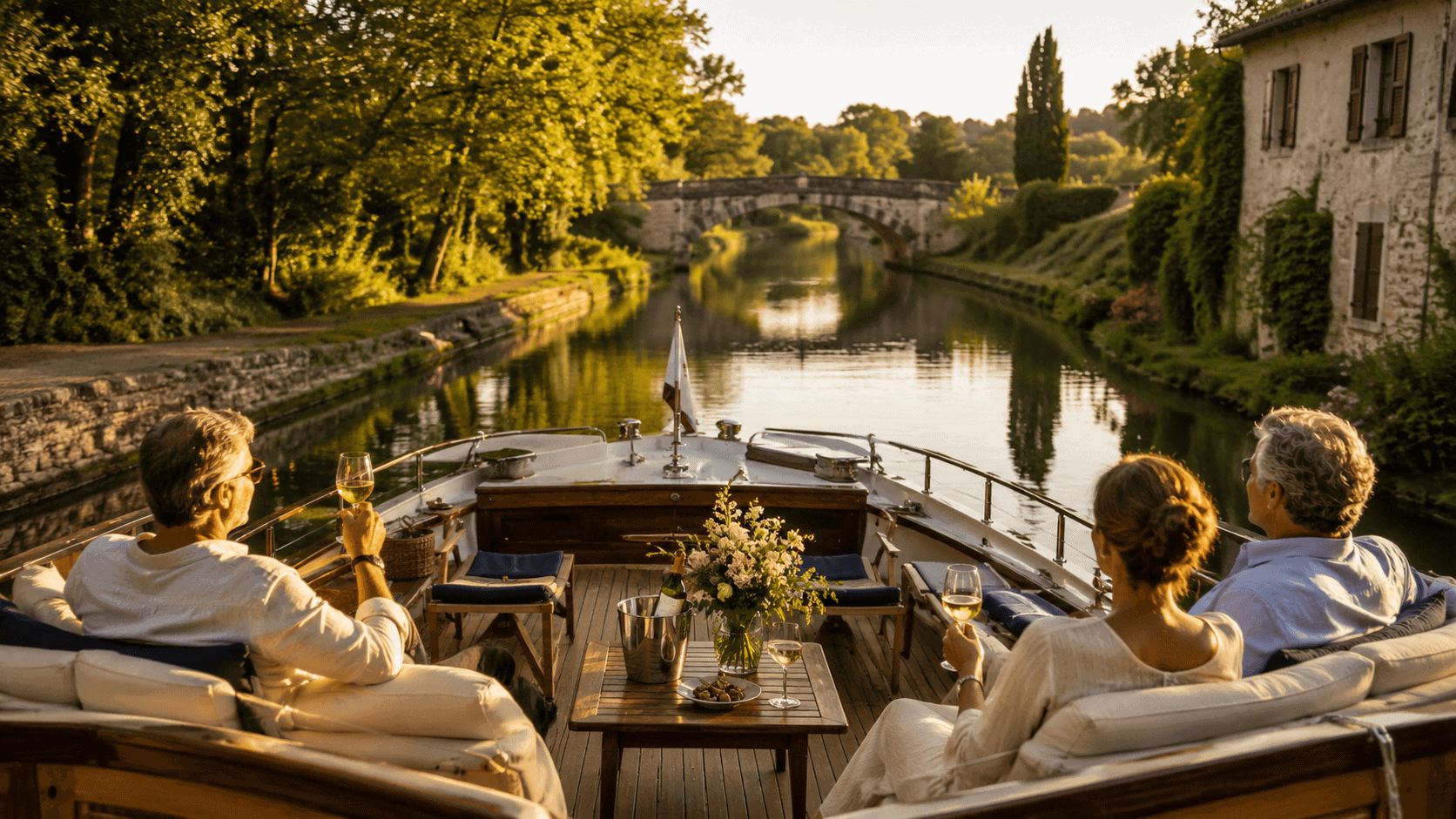
For the true luxury end of the spectrum, Belmond’s Afloat in France collection brings hotel standards to the water: bespoke excursions, sommelier-curated wine programming, and the kind of white-glove service you’d expect from a five-star property, except the property is moving through Burgundy at four miles per hour and you’re watching herons from the sun deck.
What Hotel Barge Travel Is Not
A hotel barge is not for travelers who want to cover ground. You are not seeing multiple countries. You are not waking up in a new city every morning. If your reference point for a successful trip involves checking off a list of famous sites, the barge is going to feel like a very beautiful form of staying in one place.
Also worth knowing: most hotel barges have no casino, no Broadway-style entertainment, no shopping arcade. The evening entertainment is dinner, conversation, and whatever is out the window. Some travelers hear this and exhale with relief. Those are the right travelers for a barge.
Hotel Barge by the Numbers
European Waterways has operated hotel barges since 1972
Most barges: 6–22 guests, crew-to-guest ratio of 1:2 or better
Peak season France (June, September): book 12–18 months ahead
Voice Search Quick Answers: European Barge vs River Cruise
What is a hotel barge in Europe?
A hotel barge is a small, converted canal or river barge that carries between 6 and 22 guests through one specific European region, with a private chef, captain, and crew included. It moves slowly through scenic waterways, stopping for wine tastings, market visits, and cycling excursions. The experience is closer to a private floating villa than a cruise ship.
How does a hotel barge compare to a river cruise?
A hotel barge is smaller, more intimate, and more regionally focused than a river cruise. River cruise ships carry 100 to 200 passengers and travel through multiple countries in a week. A hotel barge might spend the entire week in Burgundy while a river cruise covers the Danube from Budapest to Nuremberg. Both are luxury water travel. The barge is slower and goes deeper into one place.
Where do hotel barges operate in Europe?
France is the center of the hotel barge world, with routes through Burgundy, Provence, Alsace, the Canal du Midi, and the Loire Valley. Barges also operate in the Netherlands, Belgium, Scotland, and England. France remains the gold standard for the experience, and Burgundy in particular is the region most associated with the classic barge trip.
How much does a European hotel barge cost?
For a shared cabin on a scheduled sailing, expect to pay between $3,000 and $7,000 per person for a week, typically all-inclusive. Private charter of an entire barge runs from $25,000 to well over $100,000 per week depending on the vessel, region, and season.
Is a hotel barge good for a private group?
Hotel barges are genuinely ideal for private groups. Families, friend groups, and milestone celebrations (significant anniversaries, major birthdays, corporate retreats) frequently charter entire vessels for a week. You get the full boat, crew, chef, and a customized itinerary built around your specific group.
What is the most luxurious way to cruise European waterways?
Both hotel barges and ultra-luxury river cruise lines deliver genuinely exceptional European water travel. A private charter hotel barge with a dedicated chef, sommelier, and crew of six for twelve guests is arguably the most intimate luxury experience available on European waterways. For travelers who want luxury with more geographic coverage, lines like Belmond, Scenic, and Tauck offer premium river cruise experiences across multiple countries.
The Intimacy Question (Where Barges Win Decisively)
Here’s the most important thing I can tell you about hotel barges: the intimacy is not incidental to the product. It is the product.
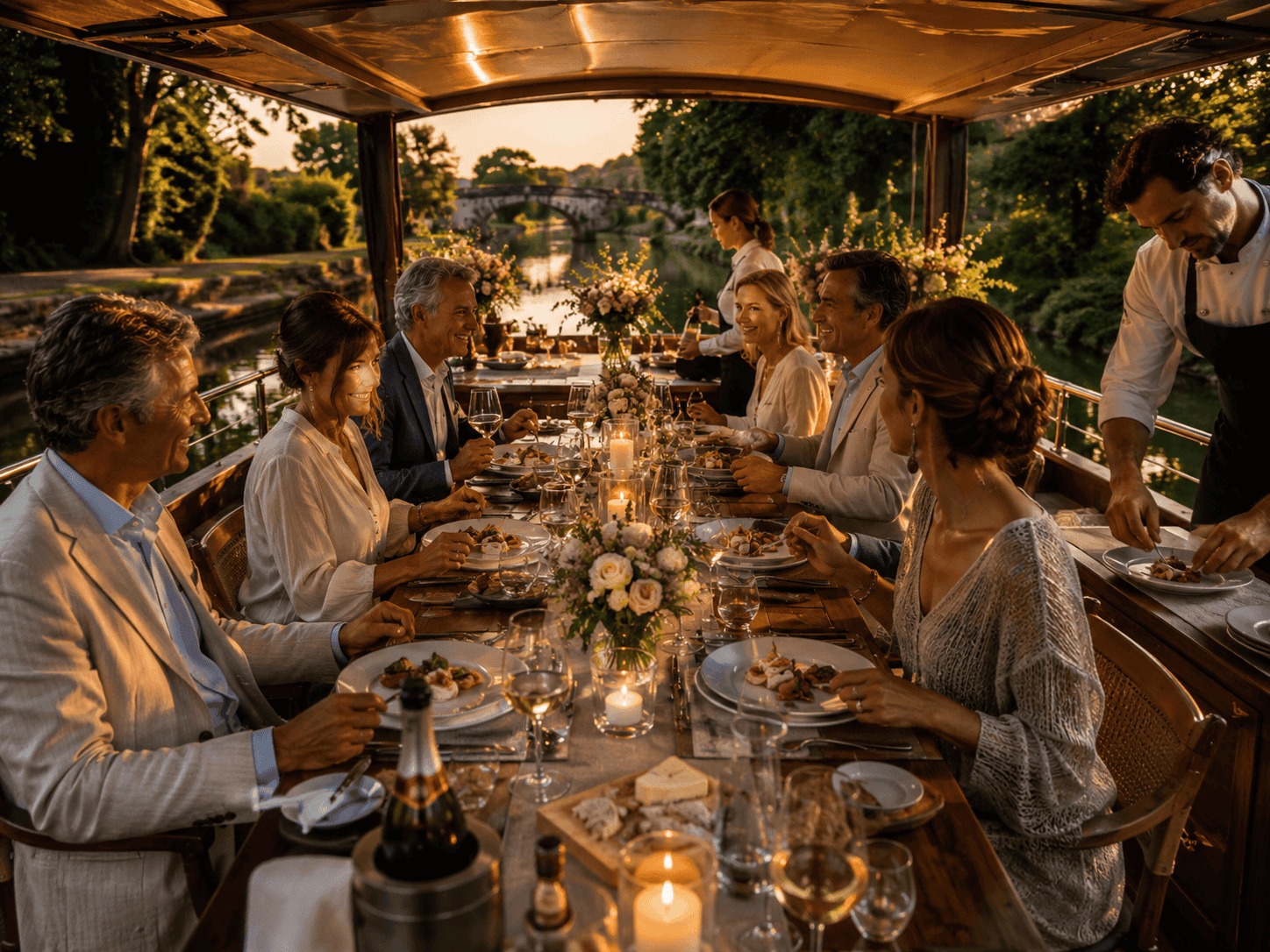
On a typical river cruise ship, you’re one of 150 people. Dinner is lovely, the table next to yours is perfectly pleasant, and the dining room does an impressive job of feeding everyone well at roughly the same time. On a hotel barge carrying 12 guests, dinner is everyone at one table. The chef is explaining what came from the market this morning. The couple next to you turns out to be the most interesting people you’ve met in years. That’s the experience past barge guests come home raving about, and it is structurally impossible to replicate at scale.
For milestone trips specifically, the private charter option transforms the barge into something closer to a mobile house party. You book the entire vessel, bring your own people, and the crew spends the week making your particular group absurdly comfortable. I’ve had clients do this for 25th anniversaries and report it was the single best trip of their marriage. That is a high bar. It gets cleared regularly.
River cruises can deliver genuine warmth too. Small tables at specialty restaurants and shared excursion groups form real friendships. But the scale is categorically different, and if maximum privacy and intimacy are what you’re optimizing for, the barge is the only answer.
The Itinerary Question (Where River Cruises Win Decisively)
On a seven-night European river cruise, you might wake up in Budapest, dock in Bratislava by evening, cross into Austria for stops at Melk and Krems, and finish in Nuremberg or Vilshofen. Multiple countries. Multiple UNESCO World Heritage Sites. One curated excursion each day. The ship handles logistics. You handle being curious.
On a seven-night hotel barge in Burgundy, you don’t leave Burgundy. You go deeper into it. You visit vineyards that don’t have tour groups because the canal doesn’t appear on most tourist maps. You meet a winemaker because your captain called ahead. You drive to a Michelin-starred restaurant in a nearby village because the chef has a longstanding relationship there. You don’t cover ground. You absorb it.
Neither approach is objectively better. They require different answers to one fundamental question: what do you want your vacation to feel like?
If you’re newer to European travel, want to experience as much geography as possible, and love the logic of a new city each morning, river cruising is the more intuitive choice. Here’s what to expect on your first European river cruise if you’re just starting to research.
If you’ve been to Europe multiple times, know which regions genuinely captivate you, and are done with the fourteen-cities-in-twelve-days circuit, the barge offers something river cruises structurally cannot: depth over breadth.
Food, Wine, and What’s Actually Included
One of the most consistent things I hear from past barge guests is surprise at the quality of the food. Not because they didn’t expect it to be good, but because they didn’t expect it to be that good, prepared for eight people, on a boat, every night, for a week.
Hotel barges are almost universally fully all-inclusive: meals, regional wines chosen to match what’s on the plate, local cheeses, bicycles for riding alongside the canal, shore excursions, and port charges. There are no bills to sign during the week. No excursion surcharges to calculate. The price you paid covers essentially the entire experience.
Most hotel barges source ingredients from local markets each morning. The chef cooks for your group only: dietary preferences, regional specialties, and whatever looked best at the market that day.
River cruises are largely semi-inclusive. Beer and wine at mealtimes, one shore excursion per port, meals in the main dining room: all typically included at premium lines. Specialty restaurants, upgraded excursions, premium beverages, and spa treatments are generally available for additional cost. The inclusions are genuinely good at the top lines. They are also clearly structured to allow for upgrades in a way that barge pricing does not.
At the top end of the luxury barge France market, Belmond’s Afloat collection is unrivaled.
From a pure all-in-value standpoint, the barge wins the comparison. You’re not opening a tab anywhere. What you paid is what the week costs.
Pricing: What These Actually Cost
Hotel barges are expensive. The math is straightforward: when you have twelve guests instead of 150, you’re dividing fixed operating costs by twelve. The crew-to-guest ratio on a barge (often one crew member per two guests, or better) exceeds anything found on a river ship.
For a scheduled sailing with shared cabins, expect $3,000 to $7,000 per person per week, all-inclusive, with luxury vessels and peak season pushing that higher. Private charter of an entire barge starts around $25,000 to $30,000 per week for a smaller vessel accommodating six guests and climbs well past $100,000 for a larger premium barge in high season. Split across a full group of 10 to 12, the per-person number becomes considerably more approachable than the headline suggests.
Premium river cruises (Viking, AmaWaterways, Scenic) typically run $2,000 to $5,000 per person per week for a standard cabin. Top-category suites on ultra-luxury river lines can push well beyond that. According to the Cruise Lines International Association, the premium and luxury river cruise segments continue to outpace the broader category in year-over-year growth, which means pricing is not heading downward anytime soon.
The practical takeaway: for a solo traveler or couple, river cruising is significantly more accessible. For a group that can fill or nearly fill a barge, the per-person gap narrows to the point where the comparison becomes genuinely interesting.
European Hotel Barge vs River Cruise: Side-by-Side
A comparison for luxury travelers who want to know exactly what they’re choosing between
Hotel Barge
River Cruise
Win = advantage in this category
Hotel Barge
River Cruise
Guest Count
6 – 22 guests Win
100 – 200 passengers
Crew-to-Guest Ratio
Often 1:2 or better Win
Typically 1:4 to 1:6
Geographic Reach
One region, deep immersion
Multiple countries, many cities Win
Typical Route Length
15 – 30 miles per day
50 – 150+ miles per day
Where It Sails
France (Burgundy, Provence, Canal du Midi, Loire, Alsace), Netherlands, Belgium, Scotland
Rhine, Danube, Seine, Rhone, Douro, Moselle, Main; multiple countries
Semi-inclusive; upgrades & specialty dining often extra
Dining
Private chef, regionally sourced, everyone at one table Win
Restaurant(s) on board; top lines include specialty dining
Wine Included
Regional wines with every meal, curated by chef Win
Beer & wine at mealtimes included at most premium lines
Shore Excursions
Curated, included, often private Win
1 per port included; additional excursions at extra cost
Bicycles on Board
Standard equipment, always included Win
Varies by line (AmaWaterways includes them; many others don’t)
Privacy Level
Very high — small group, cohesive experience Win
Moderate — 100–200 guests, dining variety, more autonomy
Private Charter Option
Yes — entire vessel for your group Win
No — group cabins only, on ship’s schedule
Onboard Amenities
Sun deck, lounge, bikes; no spa or entertainment venues
Spa, fitness, multiple dining venues, entertainment, bar Win
Starting Price (per person/week)
$3,000 – $7,000+ all-inclusive
$2,000 – $5,000+ semi-inclusive Win
Private Charter From
$25,000 – $100,000+/week (full vessel)
Not available
Departure Date Flexibility
Limited; fewer sailings per season
High; major lines offer weekly departures year-round Win
Best For
Deep immersion, milestone trips, private groups, repeat Europe travelers Win
First-time European travelers, couples & solos, multi-country coverage Win
Book How Far Ahead
12 – 18 months for peak season
9 – 12 months for prime sailings
Advisor’s Pick: For most of my clients who are considering both options, I recommend starting with a river cruise if this is your first time in Europe — and booking a hotel barge for the second or third trip, when you know which region you want to go deeper into. The barge is almost always the more memorable trip. The river cruise is almost always the smarter first trip. — Sue Nelson, Travel Advisor, Adventures by MJ
Real Questions to Ask Before You Book Either One
Do you want to see one region or many countries?
This is the single clearest sorting question in the comparison. If your answer is “I want to really know a place,” the barge is your product. If your answer is “I want to see Budapest and Nuremberg and Vienna and Bratislava,” the river cruise is your product.
How much social intimacy do you want with fellow travelers?
Sharing a table with ten people every night for a week is wonderful when those ten people are wonderful. It is a lot when they are not. River cruises offer more dining variety and more choice about how much time you spend with other guests. Hotel barges, especially smaller ones, create an environment where you are genuinely a temporary household with strangers. Most guests find this delightful. It is worth thinking about honestly before booking.
Are you traveling with a group?
Private charter barges exist precisely for groups who want a shared, bespoke experience. If you can gather 8 to 20 people for a milestone trip, the private charter barge is one of the most genuinely special group travel options in the luxury category. River cruises can accommodate groups but on the ship’s fixed schedule and format, not yours.
Is cycling part of the appeal?
Hotel barges keep bicycles on board as standard equipment. Riding ahead along the towpath and waiting for the barge at the next lock is one of those small experiences that people mention unprompted for years afterward. Several river cruise lines carry bikes too, particularly AmaWaterways. But the barge cycling experience, riding solo through the French countryside with a canal on one side and a vineyard on the other, is genuinely hard to replicate.
Hotel Barge or European River Cruise? Which One Is Right for You
Answer these questions to find your match
Have you traveled to Europe before?
YesYou’ve seen the main highlights. You’re ready to go deeper into one place.
No / First TimeYou want to see multiple countries and cities in one trip.
▼
Do you prefer depth (one region, slowly) or breadth (many cities, efficiently)?
Depth — One RegionA week in Burgundy sounds like heaven. Slow mornings, cycling, long lunches.
Breadth — Many CitiesA new city every morning. Budapest, Vienna, Nuremberg. New horizon, please.
▼
How important is privacy and intimacy to you?
Very ImportantFewer than 20 guests. Everyone at one dinner table. Something that feels genuinely personal.
Somewhat ImportantYou want premium and comfortable, but 150 guests feels totally fine. More people, more variety.
▼
Are you traveling with a group for a milestone occasion?
Yes — Group / MilestoneAnniversary, birthday, family reunion, or close friend trip. You want the whole boat for your group.
No — Solo, Couple, or Small GroupJust you, a partner, or a small group joining an existing scheduled sailing.
▼
What kind of dining experience matters most to you?
Private Chef, Regional CuisineMarket-fresh ingredients, one chef who knows your names, everyone at one table every night.
Restaurant(s) On BoardMultiple dining venues, specialty restaurant options, a more traditional restaurant experience.
⚓
Lean toward
A European Hotel Barge
6 – 22 guests; fully all-inclusive
Private chef, regional wines every night
Bikes, lock stops, towpath walks
France: Burgundy, Provence, Canal du Midi
Private charter option for your whole group
12 – 18 months ahead for peak season
🚢
Lean toward
A European River Cruise
100 – 200 guests; multiple dining options
New city every morning
Rhine, Danube, Seine, Douro + more
More departure dates and price points
Onboard spa, entertainment, bar
Book 9 – 12 months ahead for prime sailings
Still not sure? Most travelers who’ve done one river cruise and loved it graduate to a hotel barge eventually. Many barge guests come back and add a river cruise for the coverage. There’s no wrong answer here, only the one that fits the version of this trip you’re imagining. A 20-minute conversation usually makes it obvious.
So Which One Should You Book?
Here’s the guidance I give clients on the discovery call.
Choose a hotel barge if you:
Have been to Europe before and want to go deeper into one region rather than wider across the continent
Are celebrating something significant and want the trip to feel private and genuinely bespoke
Are traveling with a group and the idea of a private charter appeals
Want fully all-inclusive with essentially zero financial decisions during the week
Have a specific connection to France, particularly Burgundy, Provence, or Alsace, and want to be actually in it rather than passing through
For travelers for whom a european barge cruise has always sounded quietly appealing
Choose a river cruise if you:
Are on your first or second European trip and want to experience multiple countries
Are a solo traveler or couple who prefers not to be in close quarters with strangers for a week
Want more departure date flexibility and a wider range of price options
Value onboard amenities (spa, entertainment, larger social pool) as part of the experience
Want the security of a well-established line with a large fleet, consistent standards, and easy rebooking
And if you have done river cruising before and have been quietly wondering whether there is something more intimate, more immersive, and more genuinely different available, the answer is yes. The barge is it.
FAQs: European Hotel Barge vs River Cruise
What is the main difference between a hotel barge and a river cruise ship?
A hotel barge carries 6 to 22 guests through one specific European region over a week, with a private chef, captain, and dedicated crew providing a fully all-inclusive, intimate experience. A river cruise ship carries 100 to 200 passengers through multiple cities and countries. The barge is slower and more immersive; the river cruise covers more ground and comes with more onboard infrastructure, from spas to entertainment venues to a wider range of dining options.
Are European hotel barges fully all-inclusive?
Most hotel barges are fully all-inclusive, meaning meals, regional wines, bicycles, guided shore excursions, and port charges are all built into the fare. There are very few additional charges during the week beyond personal purchases like souvenirs. River cruises at premium lines include meals, one excursion per port, and drinks at mealtimes, but specialty restaurants, premium beverages, and upgraded excursions are usually available at additional cost.
What are the best regions in Europe for a hotel barge trip?
France is the undisputed center of the hotel barge world. Burgundy is the most popular region, combining Romanesque architecture, world-class vineyards, and beautifully maintained canal infrastructure. Provence, Alsace, the Canal du Midi (which connects the Atlantic to the Mediterranean), and the Loire Valley are all excellent. Beyond France, the Netherlands, Belgium, Scotland, and England’s Norfolk Broads offer distinct and lovely barge experiences, each with their own regional character.
Can I book a hotel barge as a solo traveler?
Yes, though it requires a bit more planning than booking solo on a river cruise. Some scheduled group sailings on hotel barges include single cabin options, though availability is limited and single supplements apply. Working with a specialist like Barge Lady Cruises is the most efficient way to identify which vessels and departure dates work well for solo guests. It is also worth noting that solo guests on smaller barges often report that the intimate communal atmosphere of a barge group is one of the better solo travel experiences available.
How far ahead do I need to book a European hotel barge?
For peak season sailings in France (May through October, with June, July, and September being the most sought-after months), booking 12 to 18 months ahead is strongly advisable. Private charters for specific dates, particularly for milestone celebrations with fixed travel windows, should be secured even earlier. Popular Burgundy sailings during harvest season (late September through October) are regularly sold out 18 months in advance. Barges have a small number of cabins by definition, and there is no equivalent of a “last-minute river cruise deal” waiting at the other end.
Is a hotel barge worth the higher cost compared to a river cruise?
For the right traveler, genuinely yes. The intimacy, all-inclusive pricing, private chef experience, and depth of regional immersion are categorically different from anything a river cruise offers. For travelers who want to see multiple countries, prefer more social variety, or are traveling solo or as a couple working within a tighter budget, the premium may not align with what they’ll actually use. The question to ask yourself is not “is it worth the money” but “does this match how I actually want to spend a week.”
What is a private charter barge and who is it right for?
A private charter means you book the entire barge, bringing your own group for the week. The vessel, crew, chef, and daily itinerary are all yours. Private charters work particularly well for milestone celebrations (25th anniversaries, 60th birthdays, family reunions), close friend groups who travel together regularly, and corporate incentive trips where the experience itself is the event. Most vessels can be privately chartered for 6 to 22 guests depending on the barge.
What is the best way to research and book a European hotel barge?
Working with a specialist is worth it in this category in a way that applies less to mainstream river cruising. The quality, character, and condition of individual barges varies significantly, and knowing which vessels are genuinely excellent requires either personal experience or a trusted specialist relationship. Barge Lady Cruises is a well-regarded booking service with deep knowledge of the independent barge market. European Waterways is one of the largest operators and a reliable reference point. A general travel advisor who has never booked a barge is unlikely to serve you as well as someone who has.
Before You Book Either One
I work with clients on slow luxury European water travel throughout the year, which means I’ve helped people sort through this exact decision, and occasionally talked them into doing both on consecutive trips (which is a perfectly reasonable life choice and I will not apologize for enabling it). If you’re sitting with this comparison and want a genuine conversation about which experience fits the version of this trip you’re imagining, I’m happy to take twenty minutes with you.
No pressure. No upsell. Just a conversation, and if it’s a fit, a beautifully planned trip.
Schedule a complimentary consultation and let’s figure out whether your European week belongs on a canal in Burgundy or a river between Budapest and Nuremberg. Both are excellent answers.
Thinking about a river cruise? Grab my free River Cruise Guide — the lines actually worth booking, how to pick your river and season, and the questions to ask before you put down a deposit. [Download the free guide →]
Final Thoughts
The European hotel barge vs river cruise question does not have a universal right answer, and any article crowning one the permanent winner has probably not booked either. These are excellent products for different travelers at different moments in their travel lives.
If you want to cover ground, river cruising does it beautifully, and the best lines do it exceptionally well.
If you want to cover depth, a hotel barge in the French countryside will give you a week that doesn’t quite resemble anything else you’ve done.
And if you’ve ever watched a narrow boat ease slowly into a stone lock, heard the gates close with a solid thunk, and felt some part of your brain go entirely quiet, you already know which one you’re booking.
Affiliate Disclosure: This post may contain affiliate links. If you make a purchase through one of these links, we may earn a commission at no additional cost to you. We only recommend products and services we believe may be helpful to travelers.
Hi, I'm Sue. I plan cruises, all-inclusive resorts, and slow multi-country trips through Europe, and I'm a member of the Travel Leaders Network. Twenty years in senior HR leadership before this, which mostly taught me how to read what people actually want. I live in Grain Valley, Missouri with my husband and business partner Mike.