Is a Guided Italy Tour Worth It? What a Travel Advisor Actually Thinks
Is a guided Italy tour worth it, or should you go it alone? I break down real costs ($292 vs. $234 a day), the ZTL camera trap that fines you weeks after you're home, Venice's new entry fee, and which tour company actually fits your travel style.
Last updated: July 11, 2026 :: Reviewed by Sue Nelson, Travel Advisor
A guided Italy tour is worth it if you want the logistics handled, don’t want to drive in a country where cameras silently fine you for entering the wrong street, and would rather spend your energy on the Sistine Chapel than on parking. It’s less worth it if you’re on a tight budget, crave total flexibility, or are only visiting one or two cities connected by Italy’s excellent high-speed trains. The honest answer, as usual, depends on the traveler, not the trip.
Key Takeaways: Is a Guided Italy Tour Worth It
Guided Italy tours average $292 per day, while independent travel averages $234 per day, according to real traveler data from Budget Your Trip
Driving in Italy comes with a hidden cost most people don’t budget for: ZTL camera fines that arrive on your credit card weeks after you’ve gone home
Venice now charges day-trippers €5 to €10 to enter on 60 peak days in 2026, with fines up to €300 for skipping the pass
Italy’s high-speed rail network (Trenitalia and Italo) connects most major cities directly, which makes independent city-hopping far easier than in many other countries
The best Italy tour companies span a real range: Intrepid for budget small-group, Rick Steves for mid-range cultural depth, Tauck for luxury, and Context Travel for expert-led day tours if you’re going independent
A hybrid trip (independent travel plus a few expert-led day tours) is often the smartest middle ground, and I recommend it more than either extreme
Every year I get some version of the same question from a client staring down their first Italy trip: is a guided Italy tour worth it, or am I better off booking flights, a few hotels, and figuring it out myself? It’s a fair question, and it deserves a better answer than “it depends,” even though it does, in fact, depend.
Here’s what actually changes the math for Italy specifically, versus somewhere like a Caribbean resort or a straightforward city break. Italy has real logistical teeth: restricted driving zones that fine you by mail, a rail system good enough to make guides optional in some regions, and, as of 2026, an actual entry fee for one of its most famous cities. None of that existed in quite this form even five years ago. This is really an Italy vacation planning question as much as a tour-type question. So let’s go through it properly, with real numbers and real company names, not travel-brochure vagueness.
Is a guided Italy tour worth it? Yes, if you value convenience over cost and don’t want to navigate Italy’s driving restrictions yourself. A guided tour handles hotels, transportation, and daily logistics, which matters most for first-time visitors and multi-region itineraries.
How much does a guided tour of Italy cost? Guided Italy tours average $292 per day per person, according to Budget Your Trip’s analysis of 840 tours. Budget options run closer to $238 per day, while premium and food-focused tours can exceed $500 per day.
Is it cheaper to travel Italy independently or on a tour? Independent travel averages $234 per day compared to $292 per day for guided tours, a smaller gap than most people expect. The bigger difference is what’s included, since tour pricing bundles hotels, most meals, and transportation into one number.
Do I need a guided tour to drive in Italy? Not necessarily, but Italy’s ZTL (limited traffic zone) cameras fine drivers who enter restricted historic centers, even accidentally. If you’re not confident navigating unfamiliar road rules and camera-enforced zones, sticking to trains or a guide removes that risk entirely.
What is the best way to see Italy without a car? Italy’s high-speed rail network, run by Trenitalia and Italo, connects most major cities directly and reliably. Rome, Florence, Venice, Milan, and Naples are all reachable by train in two to four hours, making a car largely unnecessary for a classic Italy itinerary.
What “Guided Italy Tour” Actually Means
“Guided tour” gets used as a catchall, but the options are genuinely different products, and picking the wrong one is how people end up disappointed.
Small-Group Escorted Tours
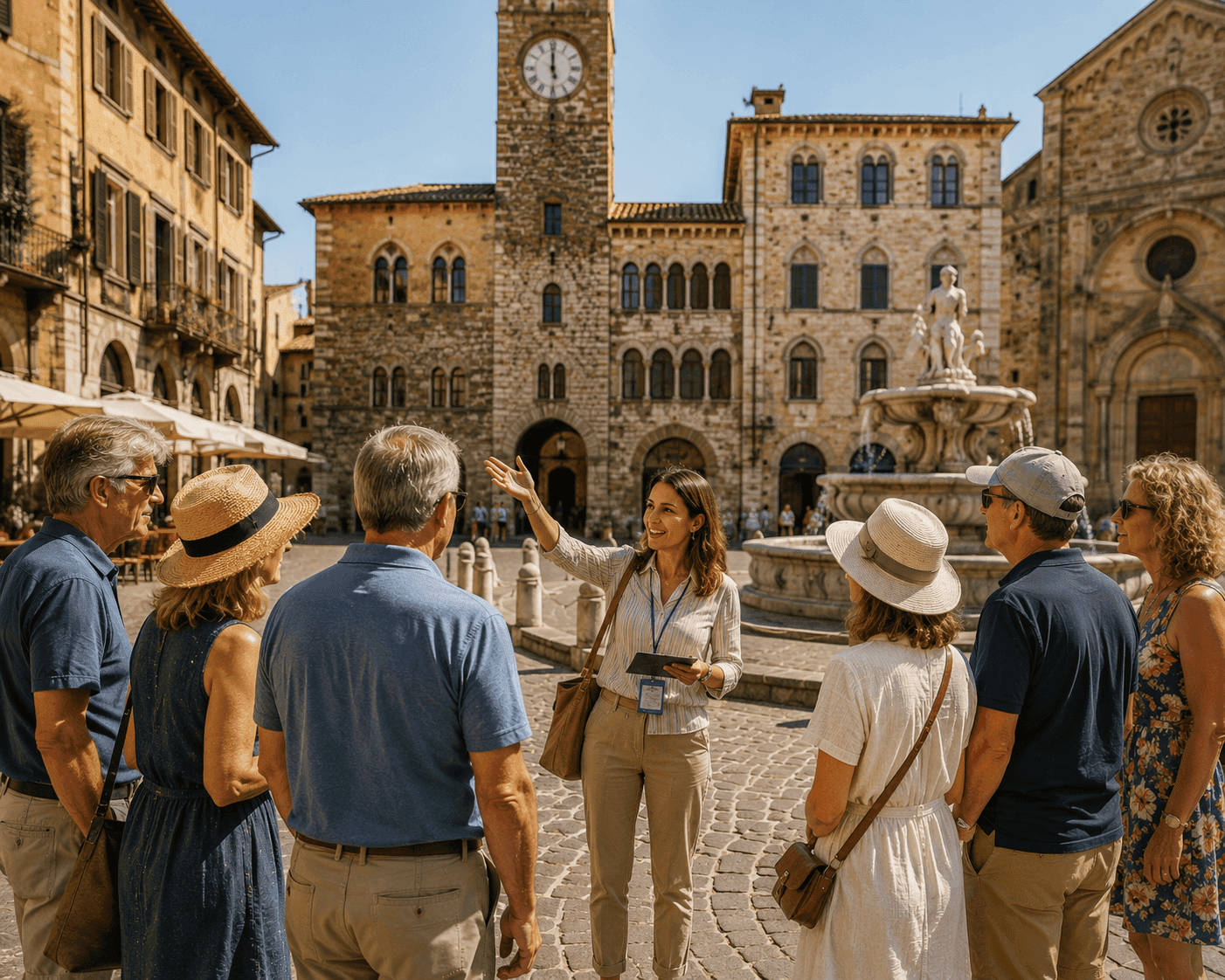
This is the classic model: a bus, a tour director, a fixed itinerary, and a group of anywhere from 10 to 30 travelers moving through the country together. Meals, hotels, and most sightseeing are included. Rick Steves, Trafalgar, and Insight Vacations all operate in this space, with meaningful differences in pace and price between them. If you’re also weighing a river cruise against a land-based guided tour elsewhere in Europe, our River Cruise vs. Guided Land Tour in Europe breakdown covers that decision in depth
A well-run small-group tour keeps you moving without ever feeling herded, at least when the group size stays under 30.
Premium and Luxury Escorted Tours
Same basic structure, better hotels, smaller groups, and a noticeably higher price tag. Tauck is the clearest example here, with departures that run into the five figures per person for a two-week itinerary.
Private Guided Tours
You and your own guide (and possibly your own driver), with an itinerary built around your preferences instead of a fixed group schedule. This is the most flexible and most expensive version of “guided,” since you’re not splitting the guide’s fee with 25 strangers.
Day-Tour Hybrid
You book your own flights, hotels, and trains, but hire expert local guides for specific days or sites: a half-day in the Vatican Museums, a food tour in Bologna, a wine day in Chianti. Context Travel and Walks of Italy both specialize in this model, and it’s the option I steer a lot of independent-minded clients toward.
The Real Case for a Guided Italy Tour
Someone Else Deals With the Driving
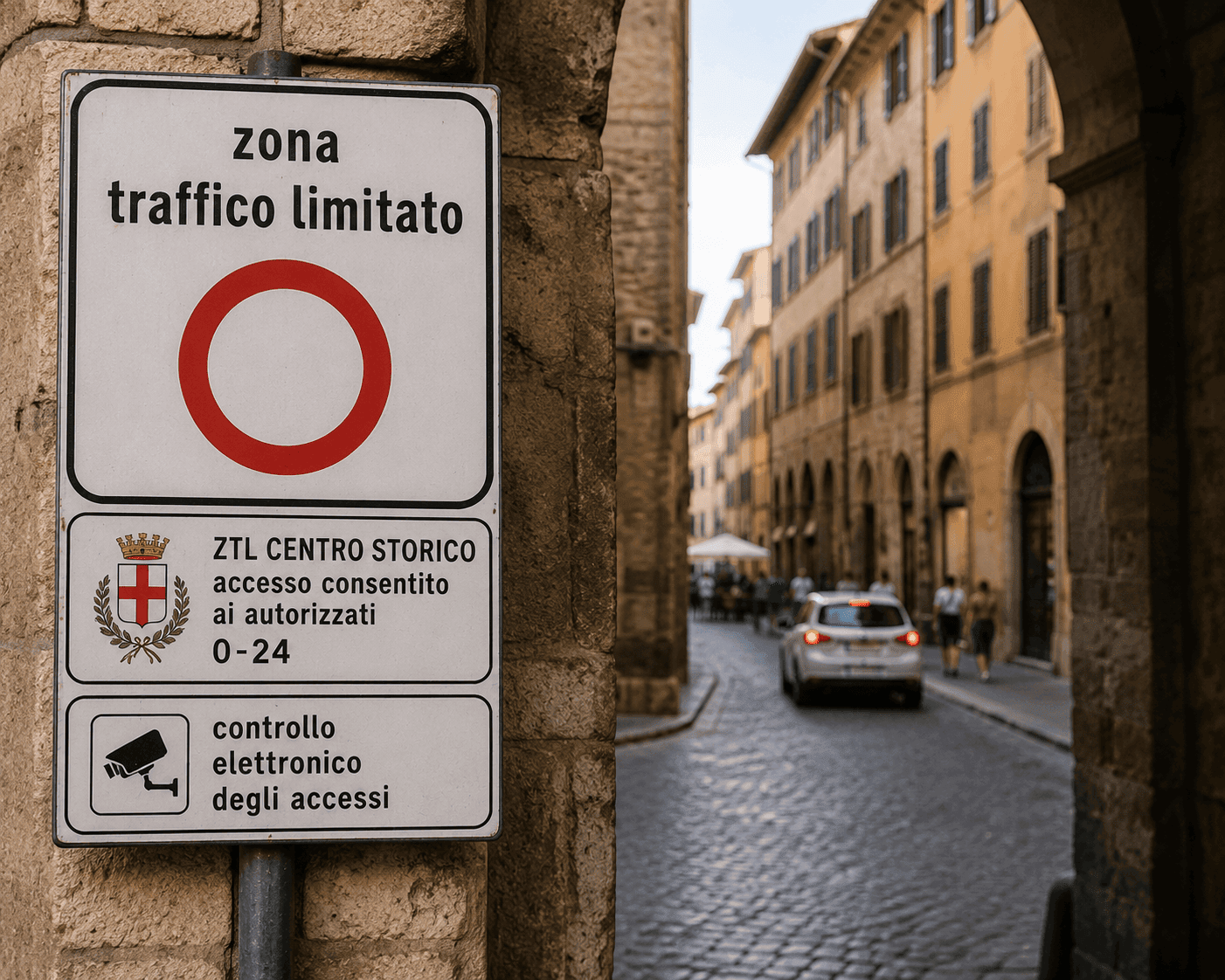
This is the argument I make most often, and it’s not an exaggeration. Italy’s historic centers are protected by ZTL (Zona a Traffico Limitato) zones, restricted areas where only residents and authorized vehicles are permitted. According to the U.S. Embassy in Italy, cameras record your license plate at the boundary, and a violation costs €100 to €300, charged to your credit card weeks after you’ve already flown home. Google Maps will sometimes route you straight through one. On a guided tour, this problem simply does not exist, because you’re not the one driving.
This sign is easy to miss and expensive to ignore. ZTL cameras don’t give warnings.
The Language and Logistics Layer Disappears
You don’t need to figure out which train platform in Roma Termini, whether a restaurant takes reservations, or how to explain a hotel booking issue in Italian at 11 p.m. A good tour director has already solved these problems a hundred times over.
You Get Access You Wouldn’t Get Alone
Skip-the-line entries to the Vatican Museums, a private courtyard in a Florentine palazzo, a winery visit that isn’t open to walk-in tourists. Established tour operators have relationships that individual travelers don’t, and this is where the itinerary quality genuinely earns its keep.
The Budget Is Locked In Before You Leave
One price covers hotels, most meals, transportation between cities, and guided activities. For travelers who hate surprise costs more than they hate a slightly higher upfront number, this predictability is worth real money on its own.
The Real Case for Independent Travel in Italy
The Cost Gap Is Real, Just Smaller Than People Assume
Independent travel in Italy averages $234 per day compared to $292 per day for a guided tour, according to Budget Your Trip’s data from real traveler budgets. That’s roughly a 20 percent difference, not the 50 percent gap a lot of people expect. The savings show up more clearly at the budget end, where independent travelers spending closer to $93 per day can undercut even the cheapest organized tours by a wide margin.
You Set the Pace, Not a Bus Schedule
Want to spend four hours in one museum and skip the next stop entirely? Independent travel lets you do that without apologizing to a group. This matters enormously for travelers who find fixed itineraries exhausting rather than relaxing.
Italy’s Trains Make This Easier Than You’d Think
This is the detail that changes the calculation for Italy specifically, compared to a country with weaker rail infrastructure. Trenitalia and Italo both run high-speed service along the same core corridor: Turin, Milan, Bologna, Florence, Rome, Naples, with a branch line up to Venice. Competition between the two operators keeps prices reasonable and service frequent. You can genuinely get from Rome to Florence in about 90 minutes without a car, a guide, or a group.
Rome to Florence in about 90 minutes, no rental car, no ZTL risk, no guide required.
No Group Fatigue
Every tour director has a story about the one traveler who ran twenty minutes late every single morning. Independent travel means you’re only ever waiting on yourself.
Still weighing a guided tour against planning it yourself? Before you decide either way, answer the seven questions in my free Slow Europe Planner. They’ll tell you more about what kind of Italy trip you actually want than any tour brochure will. Download the free planner →
Italy Tour vs. Independent Travel: What It Actually Costs.
Guided Italy Tour vs. Independent Travel: Head-to-Head
By Sue Nelson, Travel Advisor • Adventures by MJ
Category
Guided Tour
Independent Travel
Average Cost / Day
$292 per person
$234 per person
What’s Included
Hotels, most meals, transport between cities, guide
Nothing bundled — you book each piece separately
Driving Required
No
Optional — ZTL camera fines are a real risk if you self-drive
Language Barrier
Handled by your tour director
You navigate it yourself (manageable in tourist areas)
The chart above breaks down the categories that actually matter, but the short version is this: guided tours cost more per day, but that number includes far more of your total trip. Independent travel costs less per day, but every line item (hotel, dinner, train ticket, museum entry) is a separate decision and a separate charge. Neither structure is wrong. They’re just different products solving different problems, and the “which is cheaper” question only makes sense once you’ve decided which trade-off you’re willing to make.
Best Italy Tour Companies by Travel Style
Not every tour company is chasing the same traveler, and treating them as interchangeable is how people end up on the wrong trip.
Rick Steves: Best Mid-Range Cultural Depth
Groups run 24 to 28 travelers, which the company markets, accurately, as about half the size of a typical big-bus tour. Land-only pricing for a full Italy itinerary generally lands between $3,745 and $6,000 depending on length and season. This is the pick for travelers who want cultural substance without luxury pricing.
Tauck: Best for Luxury and Smaller Groups
Standard small-group departures average 24 guests, with “Even Smaller Group” options averaging 15. Pricing reflects it, ranging from roughly $7,890 for an eight-day Southern Italy itinerary to $14,750 for a two-week Classic Italy tour. Every guide is handpicked, hotels are upper-tier, and this is the company for clients who want the trip handled at the highest level.
Intrepid Travel: Best Budget Small-Group Option
Groups average 10 to 12 travelers, occasionally up to 16, with a noticeably lower price point. Recent last-minute listings showed an eight-day Highlights of Italy trip from around $1,808 and a fourteen-day Best of Italy itinerary from around $3,829, though standard advance pricing typically runs higher. This is the strongest fit for younger and budget-conscious travelers who still want a group structure.
This is the kind of detour a fixed group itinerary rarely has room for.
Context Travel: Best for the Hybrid Traveler
Not a multi-city tour company, but expert-led day and half-day tours in Rome, Florence, Venice, Bologna, Naples, and Sicily, capped at six to ten guests. If you’re planning to travel independently but want a genuine expert for a few key days (the Colosseum underground, the Uffizi, a market walk in Bologna), this is where I send clients who want the best of both worlds.
Which Italy Travel Style Actually Fits You
Adventures by MJ • Travel Advisor
Which Italy Travel Style Fits You?
2026 Edition • Guided, Independent & Hybrid
Find your travel style → find your Italy plan
🌍
You Are…
A first-timer covering Rome, Florence, and Venice in one trip
Rick Steves Small-Group Tour
Mid-range price, real cultural depth, groups of 24–28. Logistics and driving are someone else’s problem.
🥂
You Are…
A traveler who wants the best hotels and doesn’t want to compromise
Tauck Luxury Tour
Small or even smaller group departures, top-tier hotels, handpicked expert guides. Priced accordingly.
🎒
You Are…
Budget-conscious and comfortable with a small group
Intrepid Travel
Groups of 10–16, simpler accommodations, the lowest guided price point on this list.
🚆
You Are…
Sticking to one or two cities and comfortable booking your own way
Independent + High-Speed Rail
Trenitalia and Italo connect Rome, Florence, Venice, Milan, and Naples directly. No car needed.
🗺️
You Are…
Independent-minded but want an expert for the days that matter most
Hybrid: Context Travel Day Tours
Book your own trip, then add expert-led day tours capped at 6–10 guests for the Vatican, the Uffizi, or a local market.
🚗
You Are…
A returning visitor who already knows the ropes and wants rural Tuscany or Puglia
Fully Independent, Rental Car Optional
Rural regions are where a car actually helps. Stick to non-ZTL routes and you’ll be fine; a GPS app that flags restricted zones is worth the download.
When to Book for 2027 Italy Travel
Guided tours: Book 9–12 months out for best availability
Peak season (May–Sept): Book 6–9 months out
Shoulder season (Apr, Oct): Book 3–5 months out
Trains & day tours: Book 1–2 months out
⚠️Safety note: Italy is rated Level 2 “Exercise Increased Caution” by the U.S. State Department as of 2026. Standard precautions apply; always carry real travel insurance and register your trip.
Style is the right frame. These seven questions are how I get at it with clients, and you can answer them yourself.
The morning question, which predicts more about your trip than your destination does
“What would ruin it for you?” and why the answer matters more than your wish list
The pace question, asked honestly, without judgment
How to use your answers, including how to use them without me
Send me the seven questions
The Thoughtfully Curated Europe Planner
Most people plan Europe trips backward. These 7 questions fix that.
Thank you!
Check your inbox for your Slow Europe Planner.
The 2026 Wildcard: Venice Fees, ZTL Cameras, and Why “Just Wing It” Got Harder
Italy has gotten meaningfully less forgiving of unplanned, figure-it-out-as-you-go travel over the last few years, and 2026 is the year this really shows up.
Venice Now Charges an Entry Fee
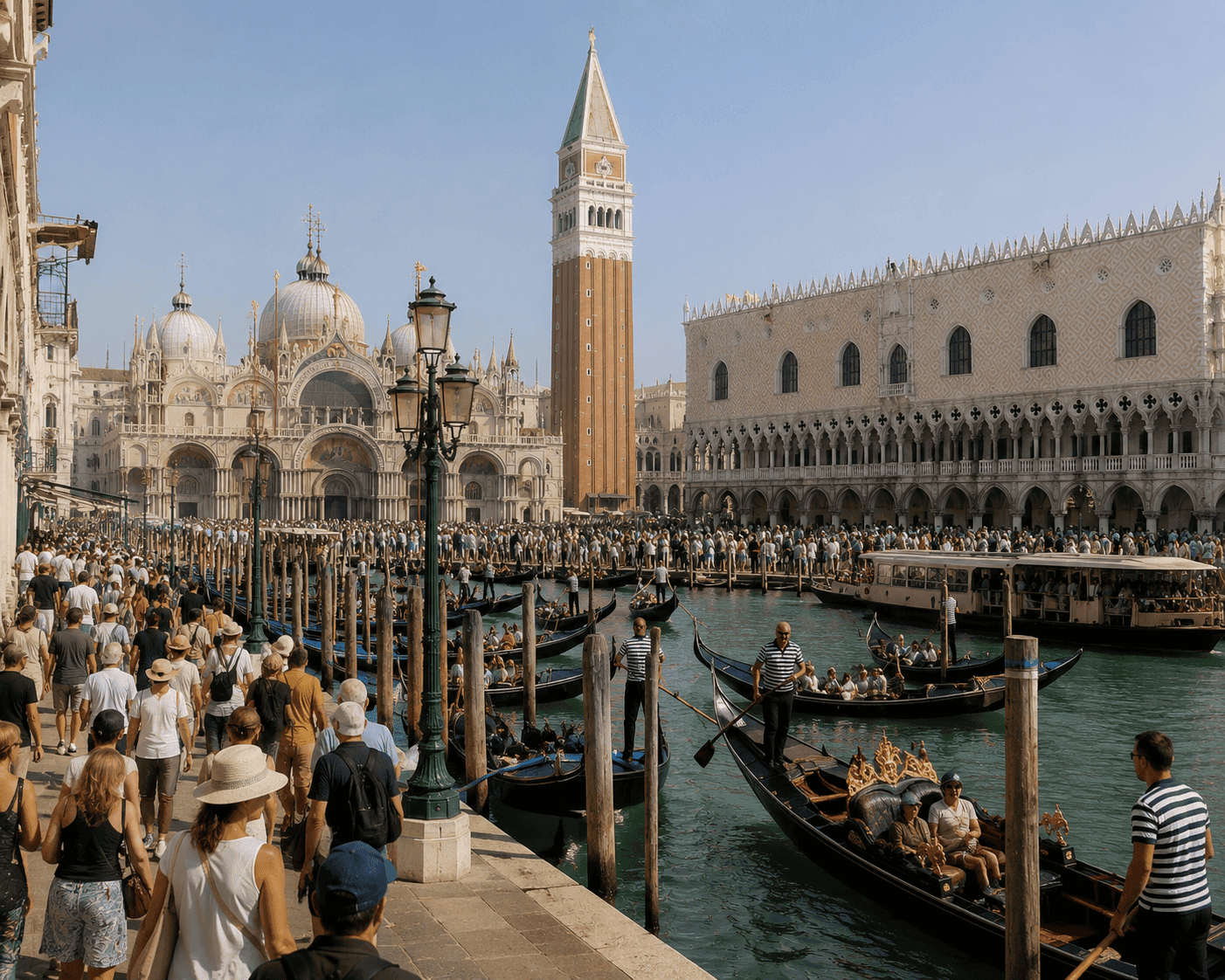
Starting in 2026, day-trippers visiting Venice during 60 designated peak days between April and July must reserve a spot and pay €5, or €10 if booking late, according to Lonely Planet’s coverage of the expanded program. The pass is a QR code checked at access points and during random spot checks, with fines up to €300 for skipping it. Overnight guests, residents, workers, and students are exempt, so this mostly affects same-day visitors arriving by train or bus.
Sixty days a year, this view now comes with a QR code check.
The ZTL Problem Isn’t Going Away
If anything, enforcement has gotten more consistent, not less. Automated cameras don’t need a police officer present, and violations are billed retroactively, sometimes weeks after your trip has ended. This is a genuinely easy mistake to make and a genuinely annoying one to discover after the fact.
The State Department Advisory Is Worth a Quick Look
Italy currently sits at Level 2, “Exercise Increased Caution,” according to the U.S. State Department, a level raised from Level 1 in 2025 due to terrorism and civil unrest risk. This isn’t a reason to cancel a trip. It is a reason to register your travel, buy real travel insurance, and stay generally aware, whether you’re traveling with a group or on your own.
None of this makes Italy harder to enjoy. It does make “no plan at all” a slightly riskier plan than it used to be, which nudges the calculation, at least a little, toward more structure.
So Is a Guided Italy Tour Actually Worth It?
Here’s my honest answer after planning more Italy trips than I can count: for a first-time visitor covering multiple regions, a guided tour is usually worth it, specifically because of the driving and language layer, not because independent travel is somehow inferior. For a returning visitor focused on one or two cities well connected by train, independent travel is usually the smarter and cheaper choice.
And for a lot of my clients, the actual answer is neither extreme. Book your own flights and hotels, ride the trains, and hire an expert guide for the two or three days where local knowledge genuinely changes the experience: the day you’re in the Vatican, the day you’re tasting your way through a food market, the day you want someone who actually knows which Cinque Terre trail isn’t overrun. That hybrid model gets you the flexibility of independent travel and the insider access of a guided one, without paying for either extreme’s full package.
If you’re still weighing regional pacing, our October Puglia vs. June Tuscany breakdown is a useful next read, especially if you’re trying to decide how much ground to cover in one trip, and if you’re wondering whether now is even the right moment to book, Is Now the Right Time to Book Summer 2026 Travel is worth a read.
What’s Worth Packing for Your Italy Trip
A few things that earn their space in the bag, whether you’re on a bus with a guide or navigating Roma Termini solo.
A universal power adapter with USB-C is non-negotiable in Italy, where outlets run on the European standard and your hotel almost certainly won’t have a spare charger to lend you.
A crossbody anti-theft bag matters more in Rome, Florence, and Venice than in most U.S. cities, simply because of how dense the tourist foot traffic gets around major sites.
Comfortable, broken-in walking shoes are the single most important packing decision for an Italy trip, guided or not, since cobblestones in Rome and Florence are unforgiving on anything you haven’t already worn for miles.
A portable luggage scale saves you from the surprise overweight fee at check-in, which is a particularly rough way to start a trip you’ve been looking forward to for a year.
A Word on Working With a Travel Advisor
Nothing in this post requires a travel advisor to execute. You can book a Rick Steves tour directly, buy your own train tickets, and hire a Context Travel guide on your own for a Tuesday afternoon in the Uffizi. If you’re not sure you even need an advisor for this trip, When Not to Use a Travel Agent walks through exactly when booking direct makes more sense.
What an advisor actually adds is judgment: knowing which tour company fits which traveler, which hotel in Florence is quiet enough to sleep in, and which “skip-the-line” ticket is worth the markup versus which one is a waste of money. I’ve watched clients almost book the wrong tour for their travel style more than once, not because the tour was bad, just because it wasn’t built for them.
If you’d like a second opinion on a tour you’re considering, or you want help building that hybrid independent-plus-day-tours itinerary, schedule a free 20-minute consult here. No pitch, no pressure. Just an honest read on whether the plan actually fits the trip you’re picturing.
FAQs: Is a Guided Italy Tour Worth It?
Is a guided Italy tour worth it for a first-time visitor?
For most first-time visitors covering multiple regions, yes, mainly because it removes the driving and language logistics that trip up new travelers most often. If your first trip is focused on one or two well-connected cities, independent travel is equally workable and typically cheaper.
What’s the actual difference between a guided tour and independent travel in Italy?
A guided tour bundles hotels, most meals, transportation, and a fixed itinerary into one price with a tour director managing logistics. Independent travel means booking each piece yourself and setting your own pace, with no one else’s schedule to accommodate.
How many days do I need for a first trip to Italy?
Most travel advisors, myself included, recommend 10 to 14 days for a first Italy trip covering Rome, Florence, and Venice without feeling rushed. Shorter trips work fine if you commit to fewer cities rather than trying to compress the same itinerary into less time.
Is Rick Steves or Tauck better for an Italy tour?
Rick Steves suits travelers who want cultural depth at a mid-range price, while Tauck suits those prioritizing luxury hotels and smaller groups at a higher cost. Neither is objectively better; they’re built for different budgets and different comfort expectations.
Is renting a car in Italy worth the hassle?
For city-focused itineraries, generally no, since ZTL camera fines and parking scarcity make driving more stressful than helpful in Rome, Florence, and Venice. A car becomes genuinely useful in rural regions like Tuscany, Umbria, or Puglia, where public transit is thinner.
Can I combine a guided tour with independent travel in one trip?
Yes, and it’s one of the most underused strategies for an Italy trip. Book your own flights and hotels, use the trains between cities, and add expert-led day tours through companies like Context Travel for the sites where local knowledge matters most.
Do guided Italy tours include airfare?
Most escorted tours, including Rick Steves and Tauck, are priced land-only and do not include international flights. Always confirm what’s included before comparing prices between operators, since bundled-flight tours and land-only tours aren’t directly comparable numbers.
Is Italy safe to visit in 2026?
Yes, Italy remains a heavily visited, well-developed destination, though the U.S. State Department currently lists it at Level 2, “Exercise Increased Caution,” due to terrorism and civil unrest risk. Standard precautions, travel registration, and real travel insurance are sensible for any trip, guided or independent.
Do I need a guided tour to visit the Vatican or Colosseum?
Only for the Vatican Museums, and it’s a real yes there: the collection is large enough that a guide meaningfully changes the experience. The Colosseum and Roman Forum are more walkable solo, since the sites speak for themselves without much interpretation needed.
What’s the best time of year for a first Italy trip, guided or independent?
Shoulder season, specifically April to May or September to October, gives you mild weather and real crowd relief in Rome, Florence, and Venice. Guided tours run their fullest schedules in these windows too, so book 9 to 12 months out if you want a specific departure date.
Final Thoughts
There’s no universal right answer to whether a guided Italy tour is worth it, and I’d be skeptical of anyone who tells you there is. What I can tell you, after planning this exact trip more times than I can count, is that the decision usually comes down to two honest questions: how much do you want handled for you, and how many regions are you trying to cover.
Cover a lot of ground with people who’ve never navigated an Italian ZTL zone before? Book the guided tour. Sticking to a couple of train-connected cities and comfortable making your own dinner reservations? Go independent, and maybe add a guide for a day or two where it counts.
Either way, book the trip. Rome has been standing for a couple thousand years and it isn’t going anywhere, but the good Airbnb in Trastevere might.
Still weighing a guided tour against planning it yourself? Before you decide either way, answer the seven questions in my free Slow Europe Planner. They’ll tell you more about what kind of Italy trip you actually want than any tour brochure will. Download the free planner →
By Sue Nelson | Adventures by MJ | Updated July 11, 2026
Affiliate Disclosure: This post may contain affiliate links. If you make a purchase through one of these links, we may earn a commission at no additional cost to you. We only recommend products and services we believe may be helpful to travelers.
Hi, I'm Sue. I plan cruises, all-inclusive resorts, and slow multi-country trips through Europe, and I'm a member of the Travel Leaders Network. Twenty years in senior HR leadership before this, which mostly taught me how to read what people actually want. I live in Grain Valley, Missouri with my husband and business partner Mike.