Do Cruise Prices Drop Closer to Sailing? (What Actually Happens)
Do cruise prices drop closer to sailing, or is waiting a risky move? Here’s what actually happens to cruise pricing, when deals appear, and why booking early often gives you better options, pricing, and peace of mind.
Sometimes, but not reliably. While last-minute deals can happen, cruise prices more often increase as availability decreases, especially for popular sailings, cabins, and travel dates.
Key Takeaways: Do Cruise Prices Drop?
Cruise prices usually climb as a sailing fills up. The cheapest cabins in each category tend to sell first.
For most people the sweet spot is 12 to 18 months out, when cabin choice and early-booking perks are at their best.
Price drops do happen, mostly on sailings that aren’t selling well, and usually in the cabins nobody was fighting over.
Final payment is usually due 75 to 120 days before you sail. Watch that date, because a lower fare usually has to be claimed before it.
If your fare drops after you book, ask for the difference. Royal Caribbean, for one, will adjust your fare and refund the difference before final payment under its Best Price Guarantee.
A last-minute cruise deal can vanish once you price the flights to the port.
What Does “Do Cruise Prices Drop” Really Mean?
When people ask if cruise prices drop, they’re usually wondering whether waiting closer to the departure date will result in a lower fare.
In reality, cruise pricing is based on supply and demand. Prices may drop in rare cases, but they more often increase as cabins sell out and availability decreases.
Quick Voice Search Answers: Do Cruise Prices Drop?
What is cruise repricing?
Repricing means getting your fare lowered to the current price after you have already booked, and it usually has to happen before final payment. Not every promotion or booking qualifies, so ask your advisor to check each time the price moves.
Do cruises get cheaper closer to the sail date?
Usually not. Fares tend to climb as a ship fills and the cheap cabins go first. The exception is a sailing that isn’t selling, which can drop in the last few months.
Do cruise prices drop 90 days out?
Sometimes, and there is a reason for it. Ninety days is right around final payment on many cruises, so cabins from people who cancel instead of paying go back on sale, and a slow-selling sailing may get cheaper.
How often do cruise prices change?
Often, sometimes from one day to the next. Cruise lines adjust fares based on how each sailing is selling, so the price you saw last week may not be the price today.
When do cruise prices drop?
Mostly when a sailing isn’t selling. That tends to happen in hurricane season and shoulder season, and right after final payment, when cancelled cabins come back on sale.
How Cruise Pricing Actually Works
Cruise pricing is not like booking flights or hotels.
You might be used to:
flights dropping randomly
hotels offering last-minute discounts
Cruises?
They operate on inventory + demand
Industry organizations like the cruise industry association note that cruise pricing is heavily driven by demand and inventory, which is why prices tend to increase as cabins sell out.
If you’re planning ahead, it’s also worth getting your essentials in order, this RFID passport holder keeps everything secure and easy to access while traveling.
Think of It Like This:
Cruise ships have:
A fixed number of cabins
Different categories (inside, balcony, suites)
Limited sailings per itinerary
As cabins sell:
Prices usually go up, not down
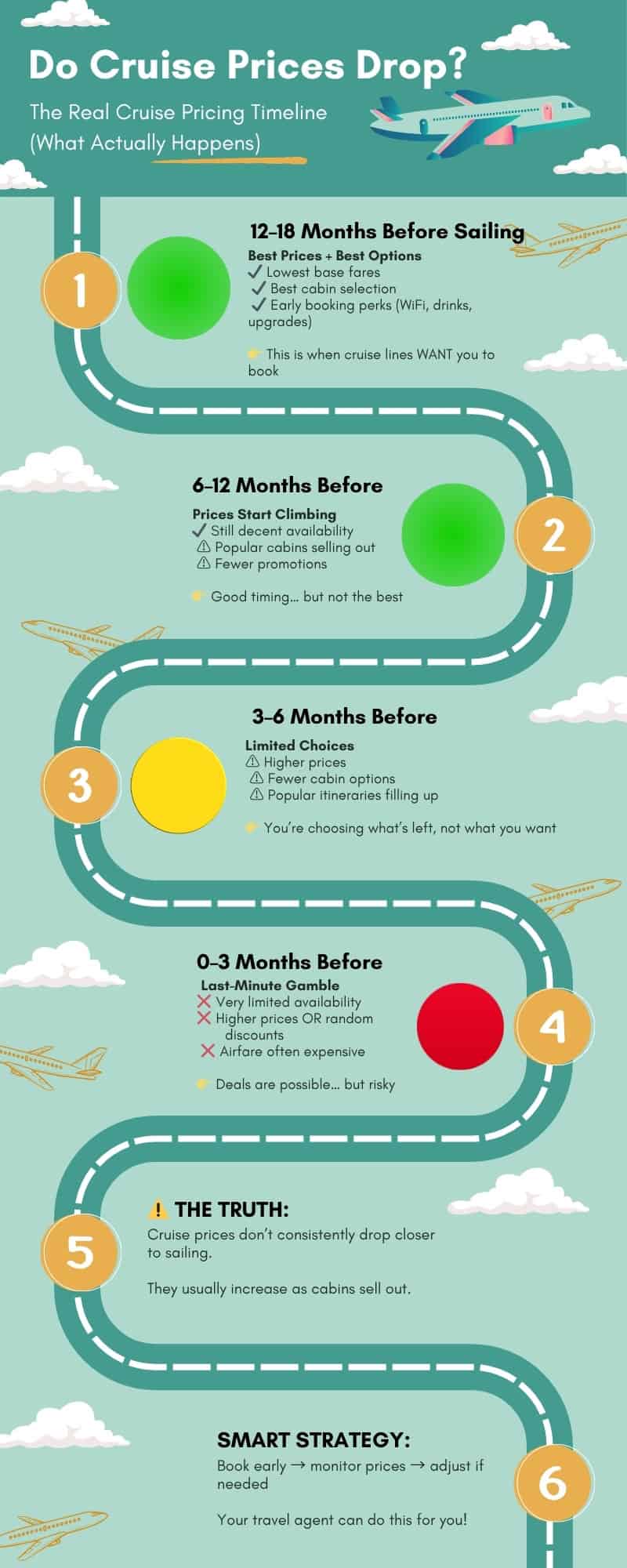
The Cruise Pricing Timeline (What Really Happens)
Here’s the real pattern:
Booking Timing
Price Trend
Cabin Availability
Risk Level
12–18 months
Lowest
Best selection
Low
6–12 months
Rising
Good
Low–Moderate
3–6 months
Higher
Limited
Moderate
0–3 months
Unpredictable
Very limited
High
So When Should You Book a Cruise for the Best Price?
For most travelers, the best time to book a cruise is 12 to 18 months in advance.
This is when cruise lines release their lowest base fares, offer early booking incentives, and provide the widest selection of cabins and itineraries.
If you wait, you may still find deals, but you’ll often be choosing from limited options rather than getting the best value.
Cruise prices typically start lower and rise as availability decreases—waiting rarely guarantees savings.
The Truth Most People Miss
The “cheapest” time is usually early, not late
Because:
Cruise lines reward early bookings
Promotions are front-loaded
Inventory shrinks over time
When Prices Might Drop
Let’s be fair—this does happen.
But it’s very specific.
1. Unsold Inventory
If a sailing isn’t filling up:
Cruise lines may discount remaining cabins
BUT…
These are usually:
undesirable cabins
awkward locations
less popular dates
2. Off-Season or Less Popular Itineraries
If you’re sailing:
hurricane season
shoulder season
less in-demand routes
You might find deals closer to departure.
3. Extremely Flexible Travelers
If you’re okay with:
any date
any cabin
any itinerary
Then yes, you might score something last-minute.
But that’s not most people.
Choosing the right itinerary also plays a big role, and this breakdown of the best Caribbean cruise itinerariescan help you narrow down your options.
Who Should Wait vs Who Should Book Early?
Waiting might work for you if:
You’re flexible on dates and destinations
You don’t care about cabin location
You’re comfortable taking risks
Booking early is better if:
You want a specific cabin or itinerary
You’re traveling during peak seasons
You prefer less stress and more choice
Do Cruise Prices Usually Go Up or Down? (The Reality)
Here’s what I see over and over:
1. Prices Go Up
Especially for:
balconies
suites
popular itineraries
2. Best Cabins Disappear
You’re left choosing:
what’s available
not what you wanted
3. Stress Goes Up Too
Because now you’re:
scrambling
compromising
refreshing tabs like it’s your job
What Most Travelers Don’t Realize About Cruise Pricing
Here’s where things get interesting, and where a lot of travelers get tripped up.
A Quick Real-World Example
I’ve seen travelers wait for prices to drop on popular Caribbean sailings, only to find that not only did prices increase, but the cabin types they wanted were completely gone.
By the time they booked, they paid more and had fewer options.
This happens far more often than last-minute deals actually appearing.
Cruise pricing isn’t random. It’s driven by demand, inventory, and booking patterns. As more cabins are reserved, prices typically increase, not decrease.
Industry data supports this trend, showing that rising demand across the cruise industry contributes to fewer last-minute deals and more pricing pressure closer to sailing.
If you’ve ever waited thinking prices would drop, only to see your options shrink instead… you’re definitely not alone.
Between researching, booking, and travel days, your phone ends up doing a lot, a portable phone chargeris one of those small things that makes a big difference.
Before You Book, Don’t Skip This
At this point, you can probably see how easy it is to wait too long, and how quickly availability can change.
But timing isn’t the only thing that impacts your cruise.
There are a few details most travelers don’t think about until after they book… and they can quietly affect both your experience and your total cost.
I put together a simple checklist to help you avoid those mistakes before you commit.
Since cruise cabins can vary in size, packing efficiently matters more than you think, these compression packing cubes make it much easier to stay organized without overpacking.
The best cabins are often the first to go—waiting can limit your options quickly.
Cruise Lines Want You to Book Early
This is important.
Cruise lines:
✔ want predictable occupancy ✔ release early promos ✔ incentivize early commitment
That’s why you’ll see:
early booking bonuses
included perks (drinks, WiFi, excursions)
lower deposits
Waiting usually means losing those perks
What About Last-Minute Deals?
Let’s talk about the unicorn.
Yes, they exist.
But they usually come with trade-offs:
limited cabin choices
inconvenient dates
non-ideal itineraries
higher airfare
And airfare alone can wipe out any “savings”
Last-minute deals do exist—but they often come with trade-offs.
Why Waiting for Cruise Prices to Drop Can Cost You More
This is where people get caught.
They wait for a cruise deal… Then flights are:
expensive
inconvenient
limited
Suddenly that “deal” isn’t a deal anymore
Broader travel trends also show increasing demand across the industry, which can impact both cruise pricing and airfare availability.
One small detail that’s easy to overlook while focusing on pricing is a travel power adapter, but you’ll definitely need it once you’re onboard or in port.
The Smart Booking Strategy
Here’s what actually works:
Book Early + Monitor Prices
Most cruise lines allow:
price adjustments before final payment
So you can:
✔ lock in your cabin ✔ secure your itinerary ✔ still benefit if price drops
Best of both worlds
Final Payment Deadlines by Cruise Line
Final payment is usually due 75 to 120 days before you sail, and it is the date that matters most for price drops, because most lines only let you claim a lower fare before it.
Cruise line
Final payment due before sailing
Royal Caribbean
75 days (up to 4 nights), 90 days (5 to 14 nights), 120 days (15+ nights)
Carnival
76 days (5 days or less), 91 days (6+ days)
Norwegian
120 days
Princess
90 days (up to 13 days), 120 days (longer cruises)
Celebrity
90 days
Holland America
90 days (most cruises of 13 days or less), 120 days (all others)
MSC
75 days (4 nights or less), 90 days (5 to 14 nights), 110 days (15+ nights)
Cruise cabins don’t always have irons, so a small wrinkle release spray for travel can save you from looking like your suitcase won the fight.
Booking early helps ensure you get the experience you’re actually excited about.
If you’re planning a cruise, understanding pricing is just one piece of the puzzle. Choosing the right cruise, avoiding common booking mistakes, and protecting your trip all play a role in getting the best overall value.
Biggest risk of waiting → limited options + higher costs
FAQs
Do cruise prices drop at the last minute?
Sometimes, but it’s not guaranteed. Last-minute deals usually apply to less desirable cabins or itineraries. Most popular cruises increase in price as availability decreases.
What is the cheapest time to book a cruise?
The cheapest time is often when itineraries are first released, typically 12–18 months in advance. Early promotions and better availability make this the most reliable time to secure value.
Can I get a better deal by waiting?
You might, but it’s a gamble. Waiting can lead to fewer options, higher prices, and limited cabin selection. For most travelers, booking early is the safer choice.
Do cruise prices go down after final payment?
Occasionally, but it’s rare. By that point, availability is limited, and price drops—if they happen—usually apply to remaining inventory.
Should I book a cruise as soon as it opens?
If you have specific dates, cabins, or itineraries in mind, yes. Booking early gives you the best chance at securing exactly what you want.
Are cruise prices negotiable?
Not directly, but value can vary. Travel advisors often have access to perks, onboard credits, or promotions that aren’t always visible online.
Do cruise prices go up the closer you get to the sailing date?
In most cases, yes. As cabins sell out and availability decreases, cruise prices tend to increase rather than decrease, especially for popular itineraries and cabin types.
The best trips aren’t just about price—they’re about getting the experience right.
Final Thoughts
If you’re hoping for a magical last-minute deal…
It might happen
But it’s not a strategy
If you want:
✔ the cabin you actually want ✔ the itinerary you’re excited about ✔ a smooth, low-stress planning experience
👉 Booking early wins almost every time.
The idea that cruise prices always drop at the last minute sounds appealing, but it’s not how pricing typically works.
If you want the best combination of price, choice, and experience, booking early and staying flexible with pricing adjustments is the strategy that consistently wins.
A Simple Next Step
If you’re looking at cruises and trying to decide whether to book now or wait, it can help to talk it through with someone who sees pricing trends every day.
No pressure, no sales pitch. Just clarity so you can make the right call before prices (or options) change on you 😉
Prices do drop, and most passengers never think to ask for the difference back. Mike asks.
Written by Sue Nelson, Travel Advisor | Adventures by MJ | Updated for 2027
Affiliate Disclosure: This post may contain affiliate links. If you make a purchase through one of these links, we may earn a commission at no additional cost to you. We only recommend products and services we believe may be helpful to travelers.
Hi, I'm Sue. I plan cruises, all-inclusive resorts, and slow multi-country trips through Europe, and I'm a member of the Travel Leaders Network. Twenty years in senior HR leadership before this, which mostly taught me how to read what people actually want. I live in Grain Valley, Missouri with my husband and business partner Mike.