Can I Make Payments on My Vacation? How Vacation Payment Plans Work
Almost nobody realizes vacation payment plans already exist. Most cruises, tours and resort packages only ask for a deposit up front, then let you pay the balance in installments with no interest and no credit check. Here is how deposits, final payment deadlines and buy now pay later financing actually differ, plus the one date that can cancel your booking if you miss it.
Last updated: October 10, 2026 :: Written by Sue Nelson, Travel Advisor | Adventures by MJ
Yes, you can almost always make payments on a vacation. Most cruises, resort packages and tours only require a deposit up front, and you can pay the balance in as many installments as you like until the final payment date. There is no interest and no credit check, because you are paying down a reservation rather than borrowing money. Separate financing through services like Affirm or Flex Pay also exists, but it works very differently and can carry interest.
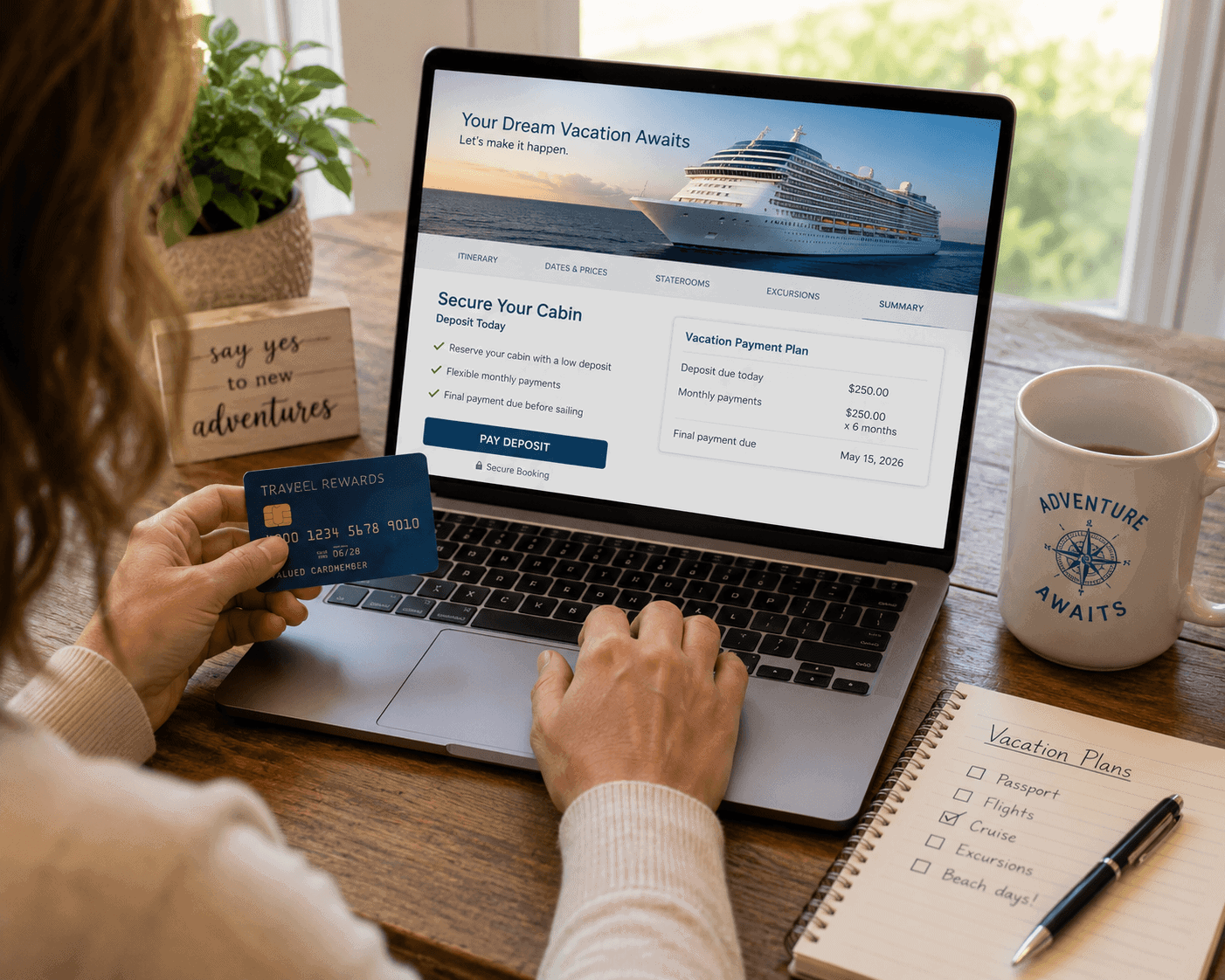
Vacation payment plans usually mean a deposit now and the balance spread out until a final payment deadline, not a loan.
At the big mainstream lines, standard cabin deposits mostly run $100 to $500 per person, based on the line-by-line figures in The Points Guy’s cruise deposit guide.
For individual bookings, Royal Caribbean requires final payment 75 days before sailing for 1 to 4 night cruises, 90 days for 5 to 14 night cruises and 120 days for 15 nights or longer.
Interest-free installment payments toward a booking are different from buy now pay later financing, which can carry interest and, as the CFPB has reported, late fees.
I will set up a payment schedule for you at no extra charge and send reminders before each due date, and many advisors do the same.
Book earlier and your payments get smaller, because you are dividing the same total across more months.
Miss the final payment deadline and the booking can cancel, so the calendar matters more than the math.
Why Everyone Asks This Question Wrong
Here is the thing about vacation payment plans. Almost nobody knows they already exist, so people ask me the question in a nervous whisper, like they are requesting a favor. “Is there any way I could maybe pay for this over time?”
Friend. Yes. That is simply how travel is sold.
The travel industry has been running on deposits and installments since long before anyone put a “pay in 4” button on a checkout page. Cruise lines, tour operators and all-inclusive resorts all take a deposit to hold your reservation, then wait patiently for the rest until a set deadline. What confuses people is that the industry uses two completely different systems and calls them roughly the same thing. One is a schedule. The other is a loan. Knowing which one you are signing up for is the entire point of this post.
Yes, most cruises, tours and resort packages let you pay a deposit now and the rest in installments before a final payment deadline.
How do vacation payment plans work?
You put down a deposit to lock the price and the cabin, then pay whatever you want, whenever you want, until the final payment date. Your advisor or the supplier tracks the balance. Nothing is due monthly unless you set it up that way.
How much deposit do you need to book a vacation?
Cruise deposits typically run $100 to $500 per person for a standard cabin, and all-inclusive resort packages often start near $200 per booking. Suites, world cruises and holiday sailings ask for more, sometimes a percentage of the total rather than a flat amount.
Do travel agents offer payment plans?
Yes, and setting one up costs you nothing extra. An advisor takes your deposit, builds a payment schedule around your paydays and reminds you before the final payment date. The supplier still holds the money, not the agent.
Can you book a vacation and pay later with no interest?
Yes, if you are paying installments directly toward the booking rather than borrowing. Interest only enters the picture when you use a lender like Affirm, Klarna or Flex Pay to cover the cost up front. Those are loans with terms, and terms deserve reading.
What Vacation Payment Plans Actually Mean
The phrase covers four very different arrangements. They get lumped together constantly, which is how people end up paying 22% APR on something they could have paid off in five interest-free chunks.
The supplier payment schedule, which is what most people actually want
This is the classic setup. You book, you pay a deposit, the price and cabin are locked, and the balance sits there until the final payment deadline. Between now and then you can pay $50 or $500 or the whole thing, on no particular schedule, as many times as you want. Most cruise lines and tour operators allow unlimited payments. No interest, no credit check, no application. If you book eleven months out and your final payment lands three months before sailing, that is eight months of flexibility for a $250 deposit.
Buy now pay later financing
This is a loan. A lender pays the travel supplier the full amount now, and you repay the lender in fixed monthly installments. JetBlue Vacations’ Flex Pay option, offered through Upgrade’s lending partners, states plainly that “APRs range from 0% to 36%” and that your actual terms depend on your credit score and other factors. It also confirms there are no late fees or prepayment penalties, and the minimum purchase is $150. Royal Caribbean lets guests finance through Affirm with both interest-free and simple-interest options, according to The Points Guy. The 0% offers are real. They are also not universal, and the 36% end of that range exists for a reason.
Vacation layaway
Layaway is the older phrasing and it still shows up on independent agency sites. Functionally it is the supplier payment schedule with a friendlier name and sometimes a small administrative fee. Nothing wrong with it. Just ask whether the fee is refundable if you cancel before final payment, because the answer varies by agency.
The sinking fund, which is really just you being organized
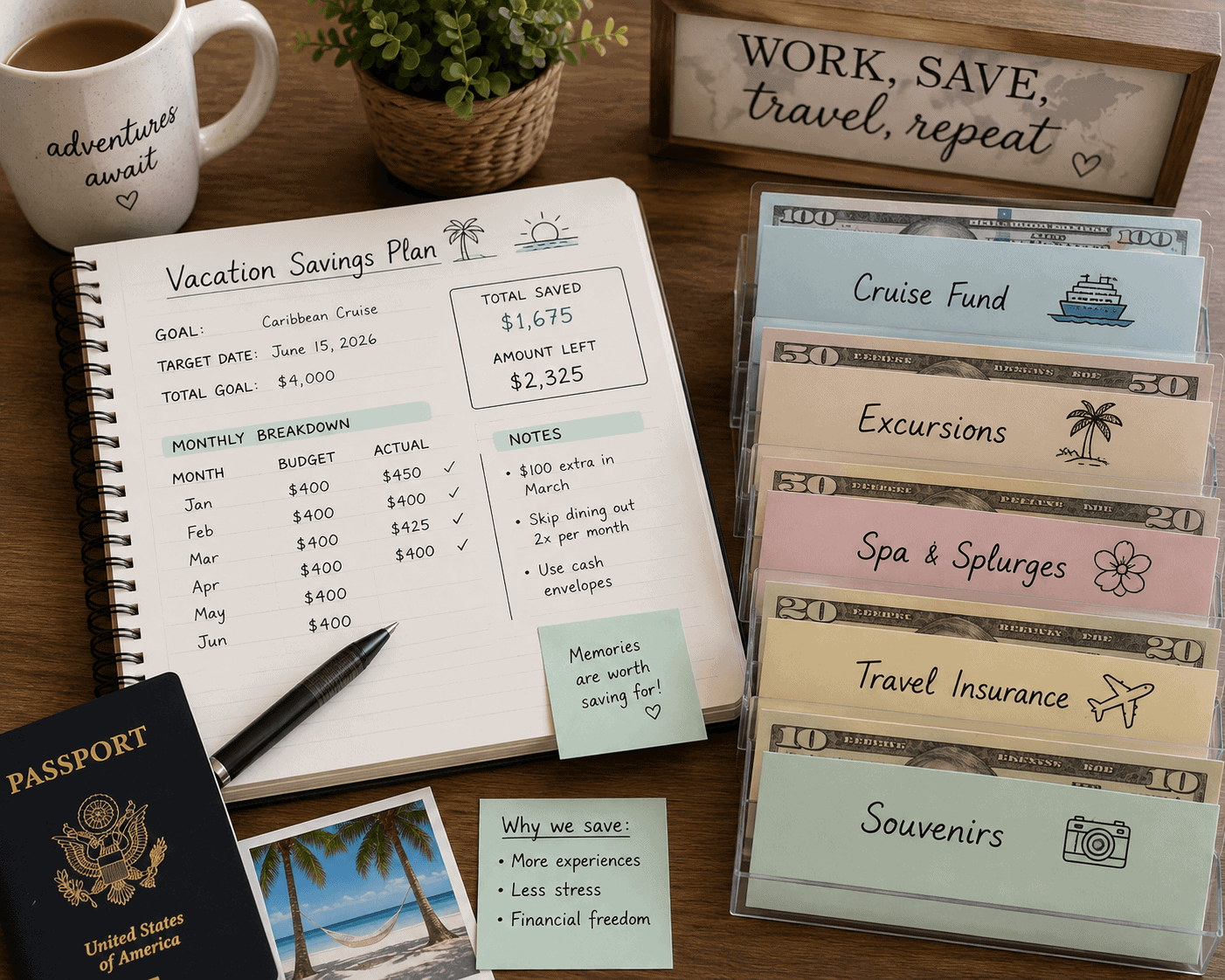
No supplier involved. You pick a trip, divide the cost by the number of months until you want to travel, and move that amount into a separate savings account automatically. Then you book with cash. This is the cheapest possible way to do it and the only one that earns you interest instead of charging it. It also requires the most discipline, which is why the other three exist.
How a Cruise Payment Plan Works, Step by Step
Cruise lines have the cleanest version of this system, so it makes a useful model even if you are booking a resort.
Step one: the deposit locks your price
Your deposit does more work than people realize. It holds the specific cabin, in the specific category, at the specific price on the day you book. Cruise fares move constantly based on how full the ship is. If prices rise after you book, your locked rate is yours. That alone is an argument for booking early, and it is a big part of why booking a cruise well ahead of sailing tends to beat waiting for a deal.
Step two: pay whatever you want, whenever you want
This is the flexible middle stretch. Tax refund arrives in March? Throw $800 at it. Slow month in June? Skip it entirely. Nothing bad happens. The supplier is not tracking your rhythm, only the final deadline. Most lines let you make payments online, by phone or through your advisor.
Step three: the final payment deadline is the only date that matters
Miss this one and the reservation can cancel automatically, with your deposit subject to the line’s cancellation policy. Royal Caribbean’s published policy requires final payment 75 days before sailing for 1 to 4 night cruises, 90 days for 5 to 14 night cruises, and 120 days for cruises of 15 nights or longer. Holiday sailings follow the same schedule. Other lines run 75 to 120 days out, with world cruises pushing to 180.
Step four: what happens after you are paid off
Once the balance hits zero the booking is finalized and documents typically release about 30 days before sailing. Everything you buy after that point, drink packages, excursions, specialty dining, gets billed separately. Budget for it now so future you is not surprised.
Refundable vs Non-Refundable Deposits: The Choice Nobody Explains at Booking
Somewhere in the booking process you will be shown two prices for what looks like the identical cabin, and one of them is noticeably cheaper. That is not a glitch and it is not a promotion. It is the refundable versus non-refundable deposit choice, and it is the single most consequential decision most people click past without reading.
The non-refundable option costs less, sometimes meaningfully less. According to Royal Caribbean Blog’s breakdown of non-refundable deposits, the cruise line will take hundreds of dollars off your fare compared to the refundable version if you agree to the terms. Tempting math, especially when you are looking at four people in two cabins. The catch is in the name. Cancel a non-refundable booking and the deposit does not come back to you as money. Whatever value remains after fees converts to a future cruise credit, which is lovely if you were always going to sail with that line again and considerably less lovely if you were not.
Then there is the part almost nobody notices until it costs them. Royal Caribbean charges a $100 per guest change fee on non-refundable deposit bookings every time you move the ship or the sail date, and Royal Caribbean Blog notes there is no limit on how many times that fee can be incurred. Change your dates twice for a family of four and you have spent $800 undoing your own plans. The discount you were so pleased with in March has quietly evaporated by August. One helpful exception: changing cabin category on the same sailing, upgrading or downgrading, generally does not trigger the fee.
So which do you take? Ask yourself one question, honestly. How likely is it that these exact dates hold? If you are booking around a school calendar you cannot control, a job with unpredictable travel, an aging parent, or anyone in the group who is still saying “probably,” pay for the refundable deposit and treat the difference as what it is, which is insurance. If your dates are locked, your people are committed and the ship is the one you actually want, the non-refundable fare is real savings and you should take it.
One more thing worth saying plainly. Deposit rules vary by cruise line, by ship, by cabin category and by promotion, and they change. Royal Caribbean’s terms are cited here because they are clearly published, not because every line works this way. Before you commit, ask which deposit type you are being quoted, what the change fee is, and whether a cancellation returns cash or credit. Any advisor worth their commission will answer all three without you having to push.
Cruise Deposit and Final Payment Deadlines at a Glance
Cruise Deposits & Final Payment Deadlines by Line
Standard cabin deposits per person. Confirm current terms for your specific sailing before booking.
Cruise Line
Typical Deposit (Standard Cabin)
Suite / Long Voyage Deposit
Payment Type
Carnival
$100 to $400 pp
Varies by length & destination
No interest
Royal Caribbean
$100 to $500 pp
10% for suites
No interest
Norwegian
$100 to $250 pp
10% for Haven suites
No interest
Celebrity
$100 to $900 pp
Scales with length & cabin
No interest
Princess
$100 to $400 pp
30% for world cruises
No interest
MSC
$99 to $300 pp
15% for world cruises
No interest
Holland America
$350 to $2,900 pp
Varies widely by sailing
No interest
When Final Payment Is Due
75
days before sailing
1 to 4 night cruises
90
days before sailing
5 to 14 night cruises
120
days before sailing
15 nights or longer
30-90
days before travel
All-inclusive resort packages (varies by brand)
Cruise deadlines shown reflect Royal Caribbean’s published final payment schedule. Other lines generally fall between 75 and 120 days, with world cruises up to 180 days.
How Much Deposit Do You Need to Book a Vacation?
According to The Points Guy’s guide to cruise payment plans and deposits, standard cabin deposits run roughly like this (the guide was last updated in February 2025, so confirm before you book): Carnival $100 to $400 per person, Norwegian $100 to $250 for standard cabins and 10% for Haven suites, Royal Caribbean $100 to $500 with 10% for suites, Celebrity $100 to $900 depending on length and cabin, MSC $99 to $300, Princess $100 to $400, and Holland America $350 to $2,900 depending on the sailing. World cruises and long luxury itineraries move to percentages, sometimes 15% to 30% of the total.
Translation for the household budget: a family of four can often hold a Caribbean cruise for somewhere between $400 and $1,000 total. That is a smaller commitment than most people assume, and it is why multigenerational trips are more achievable than they look on paper. Everyone puts down their own deposit and pays their own balance.
All Inclusive Vacation Payment Plan: How Resorts Handle It
Resort packages work on the same bones with slightly different numbers. Deposits are often flat per room rather than per person, commonly $200 to $400, and final payment lands anywhere between 30 and 90 days before travel depending on the brand. Disney packages want it 30 days out. Sandals bookings made through an advisor want it 90 days out. That spread is the catch. A cruise booked a year out gives you nine months of payments, and a resort package can give you anywhere between nine and eleven, so check your own deadline before you build a budget around it.
One more wrinkle. Resort package prices are frequently tied to a promotion with an expiration date, and some promotions require full payment earlier to keep the discount. Ask about that specifically. It is the single most common surprise I see in all-inclusive bookings.
Can You Make Payments on Flights and Theme Park Trips?
Short version: parks yes, flights basically no, and the difference explains a lot about why buy now pay later shows up where it does.
Flights
Airlines want the whole fare at booking. There is no deposit, no balance, no final payment date, because your ticket is not a reservation being held for you in the way a cabin is. The closest thing to flexibility is the Department of Transportation’s 24-hour reservation requirement, which says that for tickets bought at least seven days before departure, airlines must either let you cancel for a full refund within 24 hours or hold the fare without paying for 24 hours. Useful, but 24 hours is not a payment plan. That gap is a big reason financing shows up so often on airfare.
Theme parks
Disney and Universal work far more like cruise lines, which surprises people. Per Disney’s own 2026 package terms, a Walt Disney World vacation package booked 31 or more days out requires a $200 deposit per reservation at booking, with payment in full due 30 days before arrival. No interest, no credit check, no application. Book inside 30 days and the whole thing is due immediately, which is one more argument for planning ahead.
The practical move for a park trip is to split it. Put the package on a payment plan now and lock your room and tickets, then buy flights separately closer in when airfare has settled. Two different purchases, two different rulebooks, and only one of them needs financing.
Book Now Pay Later Vacations vs. a Travel Agent Payment Plan
Here is the comparison that actually decides things. Use the three labels below when you evaluate any payment option, because “flexible payments” on a landing page tells you nothing about cost.
No interest
Supplier installment payments toward a booking. Advisor-managed payment schedules. Automatic savings transfers into your own account. These cost you nothing beyond the trip price.
Interest possible
Buy now pay later financing through Affirm, Klarna, Uplift or Flex Pay. Credit card payments carried past the statement date. Some of these run at 0%, and 0% is genuinely great when you qualify. Confirm the rate in writing before you accept, because the offer you see at checkout is personalized.
Ask first
Layaway programs with administrative fees. Group bookings where one person’s late payment affects the whole block. Any plan that promises “no credit check” plus monthly payments, which usually means the cost is buried somewhere else. Get the terms in writing, then decide.
Adventures by MJ
Which Vacation Payment Path Fits You?
Four ways to pay for a trip over time, and what each one actually costs you.
1
Supplier Payment Schedule
No interest
How it worksDeposit holds your price. Pay the balance in any amount, any time, until the final payment date.
Typical deposit$100 to $500 per person on a cruise
Best forAlmost everyone booking 6+ months out
Watch out forThe final payment deadline. Miss it and the booking can cancel.
2
Buy Now, Pay Later Financing
Interest possible
How it worksA lender pays the supplier in full. You repay the lender in fixed monthly installments.
Typical costFlex Pay lists APRs between 0% and 36%, based on your credit profile
Best forLast-minute trips, or a confirmed 0% offer you qualify for
Watch out forStacking loans across flights, hotel and excursions on different lenders
3
Vacation Layaway
Ask first
How it worksAn agency holds the trip while you pay it down on a set schedule.
Typical costUsually free, sometimes a small administrative fee
Best forTravelers who want structure and firm due dates
Watch out forWhether the fee is refundable if you cancel before final payment
4
Your Own Sinking Fund
No interest
How it worksAuto-transfer a set amount into a separate savings account, then book with cash.
Typical costNothing. It earns interest instead of charging it.
Best forTrips more than a year out with flexible dates
Watch out forPrices rising while you save. A deposit would have locked the fare.
The Only Math That Matters
Take the trip total, subtract the deposit, divide by the months until final payment. A $4,800 cruise with a $500 deposit is about $478 a month with nine months until final payment, and about $287 a month with fifteen months to go. Same trip. Same total. Booking earlier is the discount.
Sources: Royal Caribbean final payment schedule policy; The Points Guy cruise deposit guide, updated February 2025; JetBlue Vacations Flex Pay terms; CFPB buy now, pay later lending study. Terms vary by supplier, ship, resort and sailing date.
I am not anti-financing. I am anti-surprise. The data is worth a look before you tap accept.
The CFPB’s study of buy now pay later lending found that five surveyed firms originated 180 million loans totaling over $24 billion in 2021, close to a tenfold increase from 2019. The same study reported that 10.5% of unique users were charged at least one late fee in 2021, up from 7.8% in 2020. In 2022 the Bureau also noted that most BNPL lenders did not report to the major credit bureaus. That is starting to change, since Affirm now reports its loans to Experian, but a lender approving your travel loan may still miss some of the BNPL balances you are already carrying.
Providers are not interchangeable, which is the part the checkout button never tells you. They differ on rate, on late fee policy, on whether they touch your credit, and on which travel brands actually accept them. Here is how the four you are most likely to meet stack up, with the ordinary supplier payment schedule sitting at the top as the thing to measure all of them against.
Affirm vs Klarna vs Flex Pay vs Afterpay for Travel
Buy Now, Pay Later for Travel: Provider Comparison (2026)
Terms checked against provider pages, plus NerdWallet for Klarna, on August 15, 2026, with Flex Pay and Afterpay rechecked on October 10, 2026. Rates are personalized, so confirm your actual offer in writing before you accept it.
Provider
Typical APR Range
Late Fees
Credit Check
Travel Brands That Accept It
Best For
Supplier Payment ScheduleNot financing. Your baseline.
None
None. Interim payments have no due dates.
No
Nearly every cruise line, tour operator and all-inclusive resort
Anyone booking well ahead of final payment, which is 75 to 120 days out on most cruises. Compare every option below against this one.
AffirmWidest travel coverage
0% to 36%Pay in 4 option is 0% APR
No late fees
Yes. Eligibility check, rate based on credit
Expedia, Hotels.com and Vrbo (exclusive US BNPL for lodging and packages since January 2026), plus Priceline, Booking.com, Royal Caribbean, American Airlines, Viator, Avis
Booking through an online travel agency, or financing a cruise directly with Royal Caribbean
Flex PayFormerly Uplift, now by Upgrade
0% to 36%Based on credit and purchase details
No late or prepayment fees
Yes. Rate set from consumer credit information
Carnival, Southwest, United, Air Canada, Wyndham, Sandals, Universal Orlando, Epic Pass, JetBlue Vacations
Booking direct with a cruise line, airline or resort rather than through a third-party site
KlarnaThree different plan types
0% on Pay in 4 and Pay in 30 0% to 35.99% on Pay Over Time, 6 to 24 months
Up to $7 per missed payment, capped at 25% of the purchase amount
Soft pull, which does not affect your score
Accepted by selected cruise lines and travel retailers. Coverage is thinner than Affirm or Flex Pay.
Smaller travel purchases such as excursions, gear or a single hotel stay
AfterpayRetail-first, limited in travel
0% on Pay in 4 at partner brands Up to 36% on loans carrying a finance fee
Up to $8 per missed Pay in 4 installment, capped at 25% of the order value.
Eligibility criteria apply. Must be 18 or older and a US resident.
Very limited direct travel presence
Trip extras rather than the trip itself. Not built for a $5,000 booking.
Read this before you tap accept
Every rate above is personalized. The 0% offers are real and genuinely useful when you qualify, but the top of each range exists for a reason. Get your actual APR, your total repayment amount and your payment dates in writing before you agree to anything. Then compare that total against simply putting down a deposit and paying the balance interest-free.
Sources: Affirm how-it-works and travel pages; Affirm and Expedia Group partnership announcement, January 30, 2026; Upgrade Flex Pay product page; JetBlue Vacations Flex Pay terms; NerdWallet Klarna review; Afterpay US how-it-works page. Provider terms change frequently. Verify current rates and fees directly with the lender.
The pattern worth noticing: the two providers with the deepest travel reach, Affirm and Flex Pay, both top out at 36%. That is not a coincidence and it is not a scare tactic. It is simply the ceiling, and where you land inside that range is decided by your credit file, not by the trip.
The credit reporting gap is the part that matters for vacations specifically. Travel purchases are large, they are emotional, and they are easy to stack. A cruise on one lender plus flights on another plus excursions on a third is three monthly payments that never show up on a single statement together.
Compare that to the supplier schedule, where the worst case scenario is that you lose a deposit. Meaningfully different risk profiles.
Monthly Payment Vacation Packages: The Fine Print Nobody Reads
Price changes after you book
Once your deposit is down on a cruise or a package, your fare is locked. If the price drops before final payment, some lines will honor the lower rate or issue onboard credit, and some will not. This is genuinely one of the more useful things an advisor does, because we are watching for those drops on your behalf. More on what a travel agent actually does if you are curious.
What happens if you miss a payment
On a supplier schedule, interim payments have no due dates, so there is nothing to miss until final payment. Blow through that deadline and the booking can auto-cancel, and whether you get your deposit back depends on the line’s cancellation policy at that point in the calendar. On a BNPL loan, missing a payment is a missed loan payment with whatever consequences the lender’s terms specify.
Travel insurance timing
Buy your travel protection early, ideally within the window that starts at your initial deposit rather than at final payment. Many pre-existing condition waivers and cancel-for-any-reason upgrades are only available if you buy within roughly 10 to 21 days of that first deposit. Waiting until you are paid in full is the way I most often see people give up the best coverage.
Automatic payments
Most suppliers and advisors can set up recurring auto-payments on your booking. If you know yourself well enough to know a reminder email will get archived unread, turn this on.
Vacation Payment Plan Calculator: What Your Trip Costs Per Month
Free Tool
Vacation Payment Plan Calculator
Enter your trip total, your deposit, and how many months you have until final payment. No email required, nothing stored.
$
$
months
Your monthly payment
$478
Balance after deposit: $4,300 spread across 9 months
What booking earlier would do
+3 months
$358
$119 less per month
+6 months
$287
$191 less per month
+12 months
$205
$273 less per month
Same trip, same total price. Booking earlier does not lower the cost, it lowers the monthly bite. Interest-free, because payments go straight toward the booking.
Estimates only. Deposit amounts, final payment deadlines and promotion terms vary by cruise line, resort, cabin category and sailing date.
The math on vacation payment plans is not complicated, but making yourself do it is. A few low-tech things genuinely help, and I am linking these because they work, not because they are exciting.
Cash envelope budgeting system if you are a tactile saver and want the vacation money physically separate from the grocery money.
Travel document organizer for keeping deposit receipts, payment confirmations and final payment dates in one place instead of five email folders.
Simplest method I know: take the trip total, subtract the deposit, divide by the number of months until final payment, and set up an automatic transfer for that amount on payday. A $4,800 cruise with a $500 deposit and nine months until final payment works out to roughly $478 a month. With fifteen months to go, it drops to about $287. Same trip, same total, very different monthly feeling.
Do Travel Agents Offer Payment Plans?
Yes, and this is the part people find suspicious, so let me be direct about how it works.
When you book through an advisor, your money goes to the cruise line, tour operator or resort. Not to me. I set up the payment schedule inside your reservation, watch the deadlines, and send reminders before anything is due. If a promotion is about to expire or a price drops, I flag it. There is no fee for any of that on most bookings, which surprises people who assume the payment plan is where the agency makes its money. It is not. Suppliers pay advisors a commission out of their own margin. Your price is the same either way, a topic I get into properly in do travel agents cost more.
Where it earns its keep is group travel. Ten cabins, ten families, ten different pay cadences and one shared final payment deadline is a spreadsheet nobody wants to own. That coordination is most of what a cruise-focused advisor does in the months between deposit and departure.
Frequently Asked Questions About Vacation Payment Plans
Can I make payments on my vacation without a credit check?
Yes. Paying installments directly toward a booking involves no credit check because you are not borrowing anything. The supplier holds your reservation while you pay it down. Credit checks only apply to third-party financing like Affirm, Klarna or Flex Pay, which are loans.
Can you make payments on a cruise after you book?
Yes, and most lines allow unlimited payments of any size. You can pay online, by phone or through your travel advisor at any point between your deposit and the final payment deadline. There are no minimum monthly amounts on a standard cruise booking. The only firm date is final payment.
How much deposit do I need for an all inclusive vacation payment plan?
All-inclusive resort packages commonly require $200 to $400 per room, though it varies by resort and promotion. Some luxury properties and peak holiday weeks ask for more, occasionally a percentage of the total. Final payment on resort packages lands anywhere between 30 and 90 days before travel depending on the brand, so check yours.
What happens if I miss the final payment on a vacation?
The booking can cancel automatically and your deposit is subject to the supplier's cancellation policy at that point. Some lines convert the deposit to a future cruise credit, others keep it entirely. Set a calendar reminder two weeks before the deadline. This is genuinely the only date worth stressing about.
Is book now pay later worth it for a vacation?
It can be, if you qualify for a 0% offer and you are confident about the monthly payment. Flex Pay lists APRs between 0% and 36%, depending on your credit profile and other factors. If the rate is not 0%, compare it against simply booking with a deposit and paying installments interest-free.
Can I book a vacation with a small deposit and pay monthly?
Yes, and that combination is the most common way people book big trips. A deposit of $100 to $500 per person holds a cruise, and you set your own monthly pace from there. Booking further out gives you more months, which makes each payment smaller.
Do vacation payment plans cost more than paying in full?
Not when you are paying installments directly toward the booking. The trip price is identical whether you pay it all at once or across nine months. Costs only appear with financing that charges interest or layaway programs that add an administrative fee. Ask which type you are being offered.
Can multiple people split payments on one vacation booking?
Often yes, especially on cruises where each guest can pay their own portion of the cabin. Group bookings usually let every family manage their own balance under a shared reservation block. Confirm this before booking, since a few tour operators require a single payer per reservation.
Final Thoughts
The most expensive thing about vacation payment plans is not interest. It is the eighteen months people spend assuming they cannot afford a trip that would have cost them $250 to hold and a few hundred a month to pay off.
Book earlier and every number gets friendlier. Your deposit is the same, your fare is locked, and your monthly payment shrinks because you gave yourself more months to work with. Waiting does the opposite in every direction at once.
If you want a second set of eyes on the math, or you just want someone to build the schedule and nag you gently before the final payment date, that is a conversation I am happy to have. No pressure, no obligation, and no charge for asking what a trip would actually cost you per month.
Payment schedules, deposit amounts, promotions and cancellation policies vary by supplier, ship, resort, cabin category and sailing date, and they change. Confirm the current terms for your specific booking before you commit.
Updated October 10, 2026: refreshed buy now pay later terms, resort payment deadlines and the monthly payment examples. Earlier update, August 15, 2026: added deposit figures for seven cruise lines, CFPB buy now pay later data from its 2022 study, and a monthly payment calculator.
Written by Sue Nelson, Travel Advisor | Adventures by MJ | Updated for 2027
Affiliate Disclosure: This post may contain affiliate links. If you make a purchase through one of these links, we may earn a commission at no additional cost to you. We only recommend products and services we believe may be helpful to travelers.
Hi, I'm Sue. I plan cruises, all-inclusive resorts, and slow multi-country trips through Europe. I'm a certified Hawaii travel specialist, and I book through host agency Outside Agents as a member of the Travel Leaders Network. Twenty years in senior HR leadership before this, which mostly taught me how to read what people actually want. I live in Grain Valley, Missouri with my husband and business partner Mike.