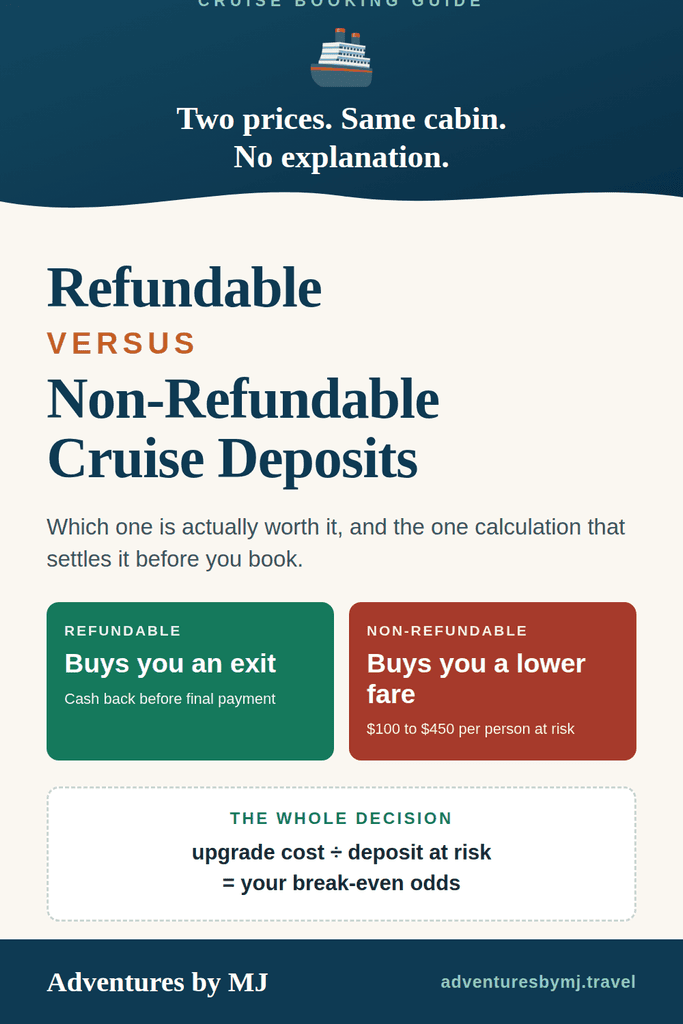
Refundable vs. Non-Refundable Cruise Deposits: Which Is Actually Worth It?
Two prices, same cabin, and almost no explanation. Here is what a non-refundable cruise deposit actually costs you, what happens to the money when plans change, and the one piece of arithmetic that tells you which fare to pick. Deposit rules for Royal Caribbean, Carnival, Norwegian, Princess and Celebrity, verified from each line's own published policy.
Last updated: August 22, 2026 :: Written by Sue Nelson, Travel Advisor | Adventures by MJ
A non-refundable cruise deposit is worth it when your dates are locked and the fare savings are larger than the deposit you would forfeit. A refundable deposit is worth it when someone else controls your calendar, when you are booking more than a year out, or when you are still shopping the price. The deciding number is simple: if the refundable upgrade costs less than your deposit multiplied by your honest odds of cancelling, buy the refundable one.
Key Takeaways: Refundable vs. Non-Refundable Cruise Deposits
A non-refundable deposit is not a small formality. On Royal Caribbean it runs $100 to $450 per person depending on cruise length, so a couple can have $900 sitting on the table before final payment.
“Non-refundable” rarely means the money vanishes. On most lines it converts to a future cruise credit after a change fee, which is a very different loss than a total one.
Royal Caribbean charges $100 per guest every time you move the ship or the sail date on a non-refundable booking, with no cap on how many times that fee can hit.
Carnival’s Early Saver deposit is non-refundable and converts to a future cruise credit minus $50 per person, good for 12 months.
Refundable deposits stop being refundable at final payment, which lands 75 to 120 days out depending on line and cruise length. After that, the two fare types behave identically.
The break-even math is a single division problem, and most travelers overestimate their own odds of cancelling.
Travel insurance and a refundable deposit solve different problems. Buying one does not make the other unnecessary.
If you have ever gotten to the deposit screen and found two prices for the same cabin, congratulations, you have met the refundable vs. non-refundable cruise deposit decision. It is one of the few moments in cruise booking where the line asks you to bet on your own future, and it does it in a dropdown menu with almost no explanation.
Most travelers pick whichever one is cheaper and hope for the best. That works about as often as you would expect.
Here is the thing worth understanding before you click: these two fare types are not really “safe” and “risky.” They are two different products with two different sets of rules about what happens when life gets in the way. One buys you a lower fare. The other buys you an exit. Knowing which one you actually need takes about four minutes and one piece of arithmetic.
Refundable vs. Non-Refundable Cruise Deposits at a Glance
The short version: a refundable deposit buys you an exit, a non-refundable deposit buys you a lower fare, and after final payment the two behave identically.
Refundable deposit
Upfront fare
Higher, commonly a few hundred dollars more per cabin
Lower, this is usually the advertised sale price
Cancel before final payment
Deposit returned as cash
Deposit forfeited, most lines reissue it as a future cruise credit
Change ship or sail date
Allowed, no line-imposed fee
Change fee applies, $100 per guest on Royal Caribbean with no cap
Change cabin on the same sailing
Allowed
Allowed, no fee on Royal Caribbean
Cancel after final payment
Cancellation penalty schedule applies
The same schedule applies
Price drop before final payment
Reprice usually available
Depends on the fare program, often restricted
Best for
Flexible dates, group bookings, anything booked over a year out
Locked dates, repeat cruisers, genuinely deep discounts
Sourced from each line’s published policy, verified August 22, 2026.
What a Cruise Deposit Actually Does
A deposit holds your specific cabin on a specific sailing at a specific price, and it is the cruise line’s protection against you disappearing.
When you put money down, the line pulls that cabin off the market. It stops selling it. If you walk away six months later, the line has to resell a cabin that has lost six months of marketing runway. The deposit is what covers that risk.
That is why the amount is bigger than people expect. This is not a $50 hold on a hotel room.
What the deposit itself costs
Deposits run $99 to $500 per person on the mainstream lines and scale with the length of the cruise, so a couple booking a week in the Caribbean is typically holding $400 to $600. For the full breakdown by line, including the two lines that publish no deposit schedule at all, see our guide to how much a cruise deposit costs on every major line.
Run the math on a couple booking a week in the Caribbean and you are looking at $500 held. On a two-week Mediterranean sailing, $900. That is real money, and it is the number that should be driving your decision, not the fare difference on the booking page.
When your deposit stops being refundable
Every deposit becomes non-refundable eventually. The fare type only decides how early that happens.
Final payment is the hard line. Royal Caribbean’s final payment scheduleputs it at 75 days out for 1 to 4 night cruises, 90 days for 5 to 14 nights, and 120 days for 15 nights and longer. Norwegian starts its penalty tiers earlier. Its published cancellation fee schedule begins charging 25% at 119 days out for Club Balcony Suites and below, and runs a steeper curve for Haven suites and Garden Villas.
Past final payment, a refundable deposit is no longer refundable. It has become part of a fare that is now subject to a cancellation penalty schedule, and those schedules climb fast. This is the single most misunderstood part of the whole system, and it is why “I bought refundable, I’m covered” is not a plan.
Quick Answers About Refundable and Non-Refundable Cruise Deposits
Do I get my cruise deposit back if I cancel?
Only if you booked a refundable deposit fare and you cancel before final payment. Non-refundable deposits are not returned as cash. Most lines convert them to a future cruise credit after deducting a change or administrative fee, though the rules differ by line.
How much more does a refundable cruise deposit cost me?
Cruise lines do not publish a fixed premium, because the refundable fare is simply a higher fare. In practice it commonly runs a few hundred dollars per cabin on a mainstream sailing. Compare the two totals on your own booking screen rather than assuming a percentage.
Can I switch my ship on a non-refundable deposit?
Yes, but it costs you. Royal Caribbean assesses a $100 per guest change fee for any change to ship or sail date on a non-refundable booking. Cabin upgrades and downgrades on the same sailing do not trigger the fee.
When does my cruise deposit stop being refundable?
At final payment, which falls 75 to 120 days before sailing depending on the line and the length of your cruise. After that date, cancellation penalties apply to the full fare, not just the deposit. Mark it on your calendar the day you book.
Is it worth paying extra for a refundable cruise deposit?
It is worth it if the upgrade costs less than your deposit multiplied by your realistic chance of cancelling. If your dates are firm and the savings exceed the deposit, the non-refundable fare usually wins. If your plans hinge on other people, pay for the flexibility.
How long do I have to pay off my cruise?
Final payment is usually due 75 to 120 days before you sail, depending on the line and the length of the cruise. Royal Caribbean asks for it at 90 days on a week-long sailing. Holland America and Norwegian both want it at 120 days. Your booking confirmation states your exact date, and that date is the one that matters.
What happens if I miss my cruise final payment?
The cruise line can cancel your booking and keep the deposit, and it applies the same cancellation penalty that would apply if you had cancelled yourself. Some lines allow a short grace period at the advisor’s request, but none of them owe you one. Set a calendar reminder for one week before the date.
Cruise Deposit Policies by Line: Royal Caribbean, Carnival, Norwegian, Princess, Celebrity and MSC
Deposit terms are set by fare program, not by cruise line, so two bookings on the same ship in the same cabin category can carry completely different rules.
Every claim in this table comes from the cruise line’s own published policy, verified August 22, 2026. Policies change, and they change without much fanfare, so confirm before you book.
Cruise line
Non-refundable deposit exists?
What happens if you cancel
Change fee
Royal Caribbean
Yes, on select fare programs
Deposit is forfeited; remaining value after the fee becomes a future cruise credit
$100 per guest per ship or date change, no cap on the number of changes
Carnival
Yes, this is Early Saver
Future cruise credit equal to the deposit minus $50 per person, valid 12 months
$50 per person deducted from the credit
Norwegian
Yes, on select promotions and the Air Choice program
Deposit forfeited under the applicable schedule
$150 name correction fee; date and gateway changes treated as cancellations
Princess
Yes, with a paid upgrade to refundable available
Deposit only, if you cancel before the penalty tiers begin
Varies by fare program
Celebrity
Yes, on select fare programs
“That deposit amount shall not be refunded at any time after it has been paid”
Change fees apply even inside the penalty-free window
The pattern worth noticing: only Celebrity’s published wording says flatly that the deposit is never refunded. Carnival tells you exactly what you get back and exactly what it costs. Royal Caribbean’s fee has no ceiling, which matters more than the fee itself.
What Your Cruise Money Is Worth, Day by Day
Published cancellation penalty tiers, drawn to scale from 120 days out to sailing day. Standard 6 to 14 night cruises, North American residents.
Deposit only at risk25% of fare50% of fare75% of fare100%, no refund
Swipe the timeline sideways to see all 120 days.
120906030Sail
Carnival6+ days
Deposit
50%
75%
100%
Royal Caribbean5+ nights
Deposit
25%
50%
75%
100%
Celebrity5 to 14 nights
Deposit
25%
50%
75%
100%
Princess1 to 13 days
Deposit
25%
50%
75%
100%
NorwegianClub Balcony & below
25%
50%
75%
100%
120906030Sail
Days before sailing
Two things this reveals: Norwegian’s penalties start roughly a month earlier than everyone else’s, so a 120 day booking window there is already inside the meter. And Carnival protects the full fare longest, holding at deposit-only until 56 days, but then jumps straight to 50% with no 25% step.
Sources: each line’s own published cancellation schedule, verified August 22, 2026. Tiers vary by cruise length, suite category, residency and fare program. Confirm your own booking terms before you cancel.
Adventures by MJ
The Break-Even Math: Is a Refundable Cruise Deposit Worth It?
Divide the refundable upgrade cost by your total deposit at risk. That gives you the cancellation probability at which the two options cost the same.
Say you and your spouse are booking a 7 night Caribbean sailing. The deposit is $250 per person, so $500 is at risk. The refundable fare costs $250 more than the non-refundable one.
$250 divided by $500 gives you 0.50. So the refundable fare only pays off if there is better than a 50% chance you cancel. Do you have a coin-flip chance of not going on this cruise? Almost certainly not. Book non-refundable.
Now flip it. Same $500 deposit, but the refundable upgrade is only $100. That is 0.20, so refundable wins if you have better than a one in five chance of cancelling. Booking 14 months out with a group of eight? One in five is optimistic. Pay for refundable.
Where people get this wrong
The three common errors are using the fare instead of the deposit as your denominator, forgetting the future cruise credit, and overestimating your own odds of cancelling.
Three ways, reliably.
They compare the upgrade to the total fare instead of the deposit. A $200 upgrade on a $4,000 cruise sounds trivial at 5%, but you are not protecting $4,000. Before final payment you are protecting the deposit and nothing else.
They forget the change fee. If your non-refundable deposit converts to a future cruise credit and you actually intend to sail with that line again, your real loss is the fee, not the deposit. On Carnival that is $50 per person. That changes the arithmetic dramatically.
They price their own risk with their heart. Everyone booking a cruise is certain they are going. If you are booking for a milestone birthday two years out, with elderly parents in the group, be honest with the number.
The Refundable Deposit Break-Even Table
How likely you have to be to cancel before paying for a refundable deposit actually saves you money. Find your deposit down the side, your refundable upgrade across the top.
refundable upgrade cost÷total deposit at risk=your break-even odds
Swipe the table sideways to see every column.
Deposit at risk both guests
+$100 upgrade
+$200 upgrade
+$300 upgrade
+$500 upgrade
+$800 upgrade
$200
50%
100%
Never
Never
Never
$500
20%
40%
60%
100%
Never
$900
11%
22%
33%
56%
89%
$1,400
7%
14%
21%
36%
57%
$1,800
6%
11%
17%
28%
44%
Under 20%: refundable is cheap insurance20 to 40%: judgment call40 to 70%: usually skip itOver 70%: almost never worth itNever: upgrade costs more than the deposit
How to read it
Two people, 7 night Caribbean sailing, $250 deposit each. That is $500 at risk. The refundable version of the same cabin costs $300 more. Your cell reads 60%, which means refundable only wins if you are more likely than not to cancel. Unless something real is looming, take the non-refundable fare.
One adjustment worth making: if your forfeited deposit comes back as a future cruise credit and you would sail that line again anyway, your true loss is only the change fee. Put that smaller number in the denominator instead, and the whole table shifts against paying for refundable.
Percentages are arithmetic, not predictions. Deposit figures reflect published per-person amounts for mainstream lines as of August 22, 2026. Upgrade pricing is set per sailing, so check both fares on your own booking screen.
Adventures by MJ
If the date on your calendar cannot move, a refundable deposit is an option you have already decided never to use.
School calendars, a wedding at sea, a chartered group sailing, a milestone anniversary already on the family calendar. If the date cannot move, you are paying for an option you will never use.
The savings beat the deposit
When the non-refundable fare saves you more than your entire deposit, you come out ahead even in the worst case.
This is the cleanest case. If the non-refundable fare saves you $700 on a booking where $500 is at risk, you are ahead even if the worst happens and you forfeit the whole deposit. That is rare, but it shows up in wave season and on newly opened itineraries.
You would rebook with that line anyway
A future cruise credit only counts as a loss if you never sail that line again.
A future cruise credit is only worthless if you never sail that line again. Repeat Royal Caribbean cruisers and Carnival regulars are effectively risking a fee, not a deposit. If you are still deciding between lines, our guide to choosing the right cruise cabin is a good place to start before you commit to anything.
When Refundable Earns Its Price
Somebody else controls your calendar
If you cannot confirm your own dates without checking with someone else first, buy the refundable deposit.
Work travel, a medical treatment schedule, a teenager whose sports season has not been published yet. If you cannot answer “can you go?” without texting three people first, buy the exit.
You are still shopping
A refundable deposit lets you hold a cabin at today’s price while you compare other lines sailing the same week.
Refundable deposits let you hold a cabin while you compare. This matters most on itineraries where the same week is sold by four different lines at four different price points. Our breakdown of Caribbean cruise itineraries walks through how much those routes actually differ.
You are booking far out, or with a group
The further out you book and the more people involved, the higher the odds that somebody’s plans change.
Group bookings are where non-refundable deposits get expensive fast, because one family’s change can cascade. If you are organizing a Caribbean group cruise, the flexibility is usually worth buying, and group rates often come with refundable terms attached anyway.
You are sailing during hurricane season
A rerouted itinerary is not a covered reason for a refund, so storm season flexibility has to come from your fare type rather than your insurance.
Not because a hurricane will cancel your cruise. Ships reroute, they rarely cancel. It matters because a rerouted itinerary is not a covered reason to get your money back, and some travelers would rather bail early than sail a substitute route. Our Caribbean hurricane season guide covers what actually happens when weather moves in.
Travel Insurance vs. a Refundable Deposit: What Each One Actually Covers
A refundable deposit protects you from changing your mind. Travel insurance protects you from something happening. Those are not the same coverage, and one does not replace the other.
Standard trip cancellation policies pay out for named reasons: illness, injury, a death in the family, jury duty, and a short list of others. “We decided not to go” is not on it. Cancel For Any Reason coverage does cover that, typically reimbursing 50% to 75% of what you lost, and it costs meaningfully more. Squaremouth’s 2026 cruise insurance data puts average cruise policy pricing well above what most travelers expect.
The practical read: insurance is the better buy after final payment, when the whole fare is exposed. A refundable deposit is the better buy before final payment, when only the deposit is. Buying both is not redundant, it is just expensive.
Can Anyone Force a Cruise Line to Refund Your Deposit?
No federal agency can make a cruise line return your deposit because you changed your mind.
The Federal Maritime Commission regulates cruise lines sailing from U.S. ports, and it says so directly: the FMC “cannot order a cruise line to make a refund to a passenger when a passenger decides not to travel.” What the agency does require runs in the other direction. Lines operating from U.S. ports with 50 or more berths must hold a bond or other financial surety “available to refund passenger deposits in the event of nonperformance,” according to the FMC’s cruise passenger assistance page.
Read that pairing carefully, because it is the whole argument for the refundable fare. You are protected if the cruise line fails to sail. You are not protected from your own change of plans. The only thing that covers the second scenario is the fare type you chose at booking, or a Cancel For Any Reason policy you bought on top of it.
If a line has genuinely failed to perform and will not make you whole, the FMC’s Office of Consumer Affairs and Dispute Resolution Services runs a voluntary complaint process for passengers who boarded at U.S. ports.
3 Cruise Deposit Mistakes That Cost People Real Money
Assuming “deposit” means “small”
Cruise deposits run $99 to $450 per person on mainstream lines, so a family of four can have well over $1,000 committed before final payment.
It does not. Check the actual per-person figure for your cruise length before you decide anything. A 12 night sailing for a family of four can put $1,800 at risk.
Letting final payment sneak up
Miss your final payment date and the cruise line can cancel the booking and keep the deposit, no matter which fare type you bought.
Miss it and the line can cancel your booking and keep the deposit, refundable or not. Put the date in your calendar the day you book, and set the reminder for a week early.
Believing a price drop will find you
Cruise lines do not automatically reprice your booking when the fare falls. Somebody has to ask.
It will not. Some fare programs allow a reprice before final payment and some do not, and non-refundable programs are usually the stingier ones. If you want somebody watching that for you, that is precisely what an advisor does, and it costs you nothing extra. Our post on whether travel agents cost more explains how that actually works.
Frequently Asked Questions
What is the difference between a refundable and non-refundable cruise deposit?
A refundable deposit can be returned as cash if you cancel before final payment. A non-refundable deposit cannot, and is typically converted to a future cruise credit after the line deducts a change or administrative fee. The non-refundable fare is priced lower in exchange for that restriction. Both become equally non-refundable once final payment passes.
Do all cruise lines charge the same deposit amount?
No, and the spread is wider than most travelers expect. Royal Caribbean publishes $100 per person for 1 to 5 night cruises, $250 for 6 to 9 nights, and $450 for 10 to 14 nights. Luxury and expedition lines often charge a percentage of the fare instead of a flat amount. Always check the figure on your own booking before choosing a fare type.
What happens to a non-refundable deposit after cancellation?
On most lines it becomes a future cruise credit rather than disappearing entirely. Carnival’s Early Saver converts the deposit to a credit minus $50 per person, valid for 12 months. Royal Caribbean applies a $100 per guest change fee and issues the remaining value as a future cruise credit. Celebrity’s published wording states the deposit is not refunded at any time.
Does travel insurance cover a forfeited cruise deposit?
Standard trip cancellation coverage reimburses your deposit only if you cancel for a covered reason such as illness or injury. Changing your mind is not covered. Cancel For Any Reason coverage does apply, but typically reimburses 50% to 75% of the loss and costs considerably more. Read the covered-reasons list before you assume you are protected.
Can a non-refundable deposit fare be repriced if the fare drops?
Sometimes, and it depends entirely on the fare program rather than the line. Some non-refundable programs allow a reprice or onboard credit before final payment, others explicitly do not. Carnival’s Early Saver is known for offering price protection, which is part of why travelers accept its non-refundable terms. Ask before you book rather than after.
Is Carnival Early Saver a non-refundable deposit fare?
Yes. Carnival’s published policy states the Early Saver deposit is non-refundable and that cancellations before final payment receive a future cruise credit equal to the deposit minus $50 per person. That credit is valid for 12 months. Early Saver also carries price-protection terms that many travelers consider the trade-off worth making.
Do refundable deposits stay refundable after final payment?
No. Once final payment is made, the booking moves into the cancellation penalty schedule and the fare type stops mattering. Royal Caribbean’s schedule for 5 night and longer cruises charges 25% from 89 to 75 days out and climbs to 100% inside 30 days. This is the point where travel insurance takes over from deposit flexibility.
Which cruise lines charge a change fee on non-refundable deposits?
Royal Caribbean charges $100 per guest for each change to ship or sail date, with no limit on the number of fees. Carnival deducts $50 per person from the future cruise credit. Norwegian charges $150 for a name correction and treats date or gateway changes as cancellations. Celebrity’s policy states change fees apply even during the otherwise penalty-free window.
Final Thoughts
The refundable vs. non-refundable cruise deposit question is not a personality test. It is not about whether you are cautious or adventurous. It is one division problem and one honest answer about how firm your dates really are.
If your calendar is locked and the savings are real, take the non-refundable fare and spend the difference on a specialty dining package. If your plans depend on other humans, pay for the exit and sleep better. And whichever you pick, write down your final payment date somewhere you will actually look, because that is the deadline that turns a manageable decision into an expensive one.
If you would rather not do the math alone, that is fair. We look at these two options on nearly every booking we handle, and the right answer changes with the sailing, the season and who is coming along. Send us a note with your dates and we will tell you which way we would go, and why. No pressure and no obligation, just a second opinion from someone who has read the fine print more times than is strictly healthy.
Written by Sue Nelson, Travel Advisor | Adventures by MJ |Updated for 2026
Sue Nelson is a travel advisor and the owner of Adventures by MJ, specializing in cruise and group travel. She books across Royal Caribbean, Norwegian, Carnival, Celebrity, Princess and MSC, and reads more cruise contract fine print than is strictly healthy.
Affiliate Disclosure: This post may contain affiliate links. If you make a purchase through one of these links, we may earn a commission at no additional cost to you. We only recommend products and services we believe may be helpful to travelers.
Hi, I'm Sue. I plan cruises, all-inclusive resorts, and slow multi-country trips through Europe. I'm a certified Hawaii travel specialist, and I book through host agency Outside Agents as a member of the Travel Leaders Network. Twenty years in senior HR leadership before this, which mostly taught me how to read what people actually want. I live in Grain Valley, Missouri with my husband and business partner Mike.