
Last updated: October 2, 2026 :: Written by Sue Nelson, Travel Advisor | Adventures by MJ
Quick Answer: Let the spiritual goal pick the trip. Choose a retreat for rest and teaching close to home (2 to 4 days, about $150 to $900 per person), a pilgrimage to walk biblical sites (8 to 12 days, about $3,500 to $7,500 with flights) or a mission trip for service (5 to 14 days, about $500 to $3,000). Start planning 4 to 18 months out depending on the type.
Somewhere right now, a ministry coordinator is staring at a Google Doc titled “GROUP TRIP IDEAS – PLEASE RESPOND” that has 22 comments, three confirmed chaperones, one person politely asking if they can bring their emotional support dog, and an absolute radio silence from the youth pastor she specifically needs to hear from.
First, bless you. Planning a church group trip is one of the most meaningful and one of the most logistically humbling things a ministry leader does. It is not a vacation you are putting together. It is a season of spiritual formation for a group of people you love, with all the permission slips, budget spreadsheets, and “wait, does anyone have a food allergy we forgot about?” moments that come with it.
Second, this is absolutely doable. Church group trips fall into three main categories, and once you know which one fits your congregation, the rest of the planning follows a pattern that thousands of ministry leaders have walked before you.
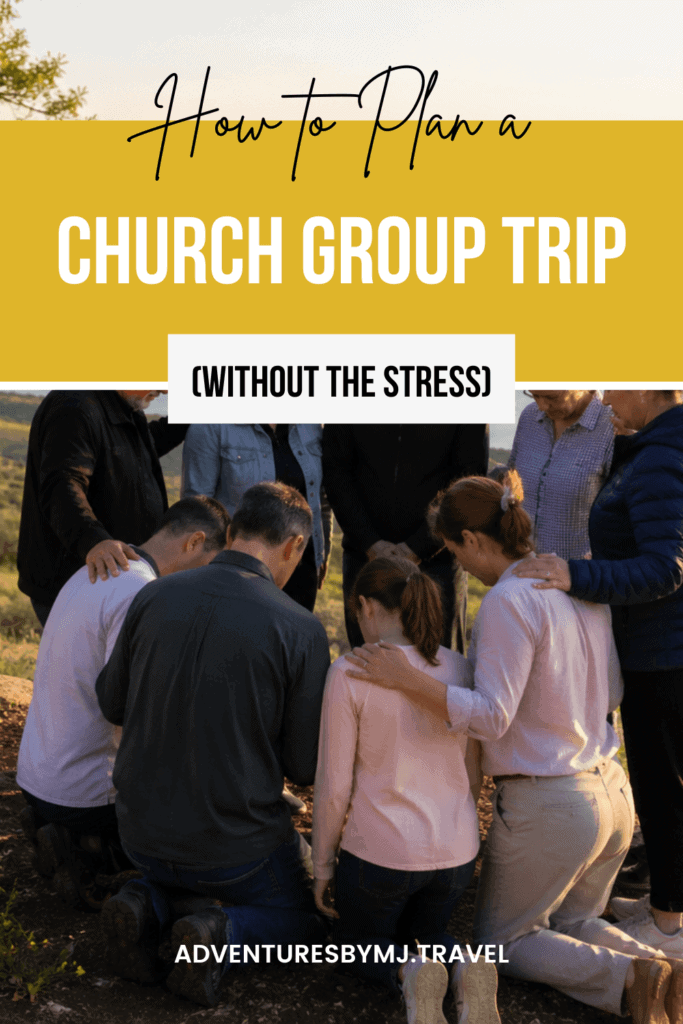
Pick the trip that fits the season your ministry is in.
Retreat
- PurposeRest · teaching · bonding
- Length2–4 days
- Cost$150–$900
- Group size10–150
- Book ahead4–6 months
- Best forFirst-timers, youth, leadership
Pilgrimage
- PurposeBiblical formation
- Length8–12 days
- Cost$3,500–$7,500
- Group size15–40
- Book ahead12–18 months
- Best forMature believers, seekers
Mission Trip
- PurposeService · partnership
- Length5–14 days
- Cost$500–$3,000
- Group size8–20
- Book ahead6–12 months
- Best forTeens, young adults, missions-minded
The Verdict
Retreats create space God can use. Pilgrimages turn Scripture into memory. Mission trips reshape how people see the world. Pick the one your people are ready for — and plan it with care, prayer, and a really good spreadsheet.
Key Takeaways: Church Group Trips
- Three main types of church group travel: retreats (reflection), pilgrimages (biblical sites), and mission trips (service).
- Typical costs per person in 2026: weekend retreat $150–$400; Holy Land pilgrimage $4,000–$7,500; international mission trip $1,500–$3,000.
- Ideal group size: 10–25 for retreats, 15–40 for pilgrimages, 8–20 for mission trips.
- Booking window: 4–6 months for retreats, 12–18 months for pilgrimages, 6–12 months for mission trips.
- The non-negotiables: background-checked chaperones, written parental consent for minors, adequate insurance, and a clear financial-accountability plan.
- The honest truth: The logistics are real, but the impact genuinely changes lives, both for the travelers and the people they serve.
Leading a group trip is a whole different level of planning. If you’re also managing a women’s group, mission team, or any other crew, our free Church Trip Planning Checklist is a surprisingly solid framework for any group that needs timelines, budget conversations, and ground rules that keep everyone happy. Grab it below.
Why Church Group Travel Is Its Own Beast
Short answer: A church group trip is not a regular group trip with Scripture added. It spans four generations, sacrificial budgets, church-calendar constraints, and travelers you pastor before, during, and after the trip. The stakes are higher, the care is deeper, and the planning requires a different framework entirely.
You’re balancing a congregation that likely spans four generations, a budget that spans “comfortable” to “this is a genuine sacrifice,” dietary accommodations that might include fasting traditions, a church calendar that blocks out Lent, Advent, and Holy Week, and a leadership team that needs to approve every major decision. On top of that, your travelers aren’t just “travelers”, they’re people you’ll pastor, teach, and pray with before, during, and after the trip. The stakes are higher. The care is deeper.
And yet, the right trip, well planned, is genuinely one of the most formative experiences a church can offer. People return different. Faith deepens. Friendships forge. The inside jokes from the bus ride home last for years.
Here’s how to pick the right trip for your congregation.
Option 1: The Church Retreat
A church retreat is a 2–4 day focused getaway, usually at a retreat center within driving distance, centered on teaching, worship, and connection. Costs typically run $150–$400 for a weekend and $400–$900 for a longer domestic retreat, with 10–150 participants.
What a Church Retreat Actually Looks Like
A church retreat is a short, focused getaway, typically 2–4 days at a retreat center, Christian camp, or intentional retreat property, centered on spiritual formation, teaching, worship, and connection. It might be a women’s retreat, men’s retreat, leadership retreat, youth retreat, couples retreat, or a whole-congregation retreat. Most happen within a few hours’ drive of the church, which keeps logistics and costs manageable.
For congregations that want a domestic retreat within easy driving distance, Missouri is a strong option, with retreat centers, Branson entertainment, and Ozark scenery well suited to a weekend getaway. Our guide to working with a Missouri group travel specialist breaks down costs, timing, and what to look for in a group-focused advisor.

For the broader conversation around how faith travel transforms believers, our companion piece Faith-Based Travel: Why Seeing the Bible Come to Life Changes Everything goes deeper on the “why” behind all of this.
Why Retreats Work So Beautifully
They’re approachable for first-timers. Retreats are often someone’s first church-group trip. The short timeline, the low cost, the domestic drive, all of it lowers the barrier to saying yes.
The spiritual density is high. A weekend pulled out of normal life, spent in worship, teaching, and real conversation, can do more for a person’s faith than six months of normal Sundays. This is the retreat’s superpower.
Group size is flexible. Retreats work beautifully with 10 people or 150. Scale up or down based on your ministry’s needs.
Retreat centers do the work for you. Most Christian retreat centers handle meals, lodging, meeting spaces, and often even sound/tech. You bring the people, the theme, and the speakers.
Budgets stay manageable. A weekend retreat typically runs $150–$400 per person all-in. A 3–5 day domestic retreat runs $400–$900.
The Honest Planning Challenges
Scheduling is harder than it looks. Families, youth sports, work schedules, and the church calendar collide in ways that make date selection a spiritual discipline of its own.
Scholarship funding is usually needed. Ensuring no one is turned away for financial reasons means building a scholarship fund into every retreat budget.
Chaperone-to-minor ratios matter for youth retreats. Most youth retreats require 1 background-checked chaperone for every 5–7 students, and same-gender cabins.
The “just one weekend” sell to spouses and employers is real. Help your travelers with clear communication templates they can forward to family and work.
Option 2: The Pilgrimage
Short answer: A Christian pilgrimage is an 8–12 day journey to biblical and historical sites, most often the Holy Land, Rome, Greece, or Turkey. Costs run $3,500–$7,500 per person including flights. Ideal group size is 15–40, and most pilgrimages book 12–18 months in advance because popular spring and fall dates sell out fastest.
What a Christian Pilgrimage Actually Looks Like
A pilgrimage is a faith-rooted journey to sites of biblical or historical Christian significance, most commonly the Holy Land (Israel, and increasingly Jordan), Rome and Italy, Greece (in the footsteps of Paul), Turkey (the Seven Churches of Revelation, including Ephesus), or the Camino de Santiago in Spain. Pilgrimages typically run 8–12 days, include daily devotionals or Bible teaching at the relevant sites, and are often led by a pastor with a local Christian guide.
Pilgrimages are the category that most frequently includes people who don’t normally travel with their church. When someone is ready to say yes to a Holy Land trip, something significant is stirring in them. Handle those yeses with care. For a deep comparison between land-based pilgrimages and faith-focused cruising, our Biblical Tours vs Christian Cruises breakdown is a helpful next read.
Why Pilgrimages Change People
Scripture becomes three-dimensional. Standing on the Mount of Beatitudes, walking the Via Dolorosa, sailing the Sea of Galilee; the Bible shifts from something you’ve read to something you’ve physically stood inside. Even lifelong Christians describe this as the most formative travel experience of their lives.
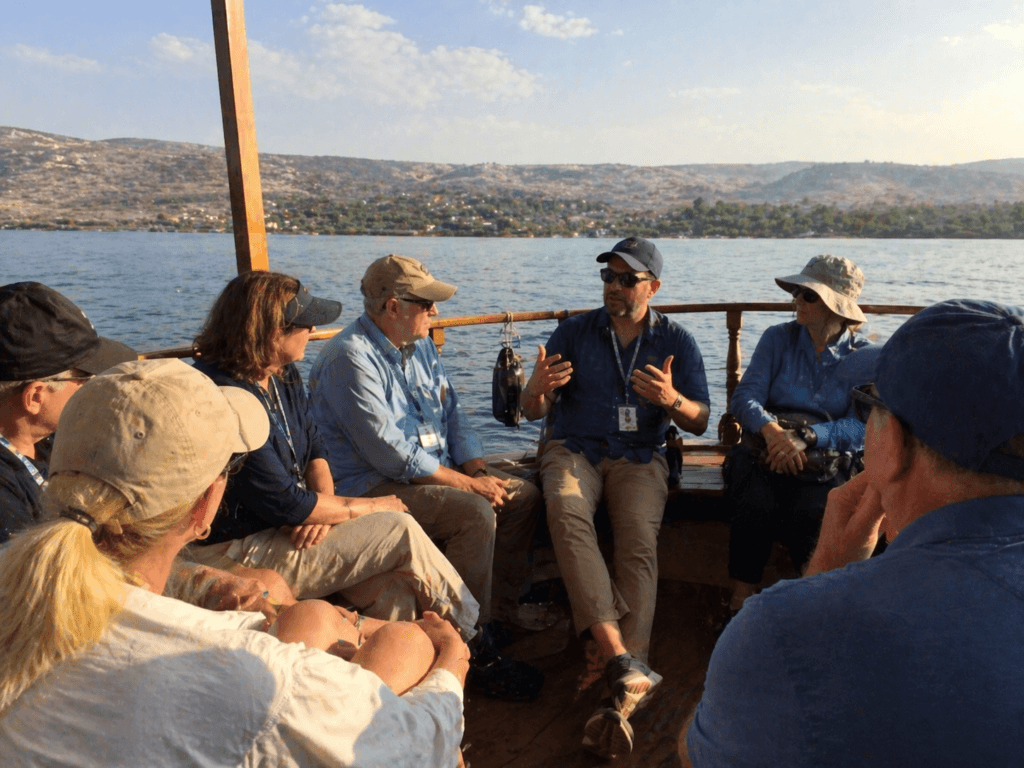
Teaching lands differently. A pastor who preaches the Sermon on the Mount from the Mount of Beatitudes is doing something no pulpit can replicate.
Community forges fast. Twelve days on buses, in hotels, and at meals together creates friendships that last decades. Small-group dynamics form organically.
Logistics are handled by specialists. Reputable faith-based tour operators handle hotels, buses, guides, site entries, meals, and often flights. Your role is pastoral leadership, not logistics management.
A good leather travel journal for pilgrimages is the single most-used piece of gear your travelers will bring home. Ask anyone who’s been.
The Honest Planning Realities
The cost is significant. Holy Land pilgrimages run $4,000–$7,500 per person for 10 days. European pilgrimages run $3,500–$6,500. Fundraising, early booking, and payment plans are usually part of the picture.
Security situations require attention. The Holy Land especially requires monitoring of current U.S. State Department travel advisories and flexibility with departure windows.
Pacing is physically demanding. Expect walking, uneven surfaces, stairs, heat, and long days. Mobility considerations matter. Honest conversations with older congregants are essential. A lightweight modest travel scarf solves the “shoulders covered at holy sites” rule without adding a single pound to anyone’s suitcase.
Doctrinal and denominational differences come up. Visits to churches, holy sites, and shrines touch on theology that may vary across your congregation. A thoughtful leader addresses this in pre-trip meetings rather than mid-pilgrimage.
Booking windows are long. Most Holy Land pilgrimages book 12–18 months in advance. Popular dates (spring, fall) sell out fastest.
Option 3: The Mission Trip
Short answer: A mission trip sends a church team to serve a specific ministry or community, typically for 5–14 days. Domestic trips run $500–$900 per person; international trips run $1,500–$3,000 including flights. Ideal group size is 8–20, and the healthiest mission trips prioritize long-term partnership with local churches over short-term voluntourism.
What a Mission Trip Actually Looks Like
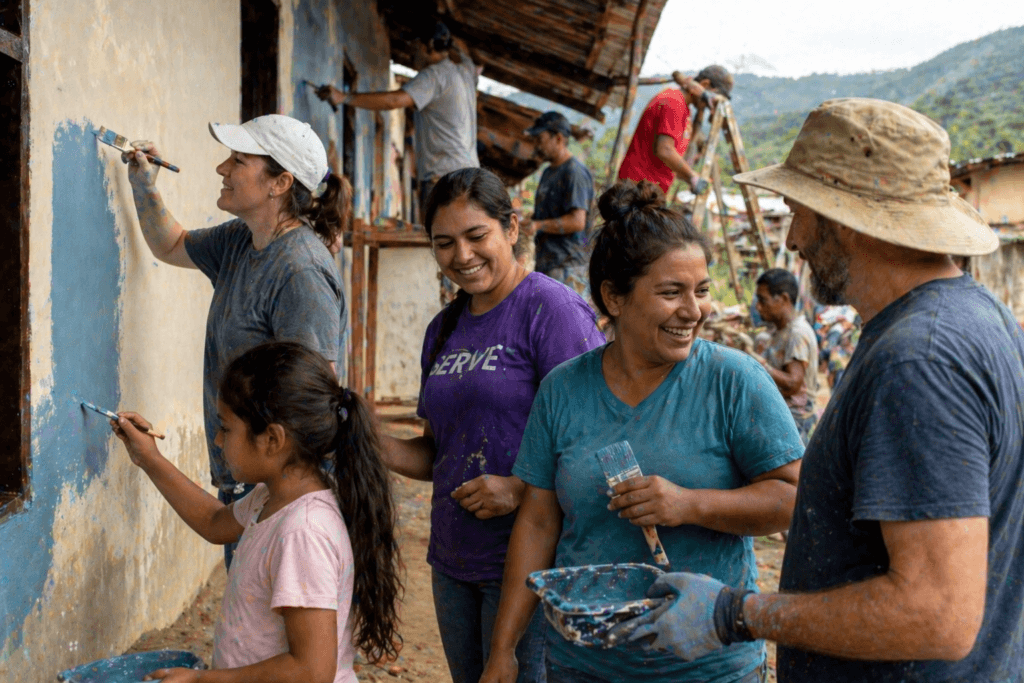
A mission trip sends a church team to serve a specific ministry, community, or project, domestically (Appalachia, inner-city ministries, disaster recovery, reservation partnerships) or internationally (Central America, the Caribbean, Africa, Asia). Mission trips range from 5-day domestic service weeks to multi-week international deployments. The focus is service: construction, VBS leadership, medical clinics, partnering with local churches, youth ministry support.
Mission trips are often the most transformational travel a person experiences in their life, but they require the most rigorous planning and the clearest ethical framework.
Why Mission Trips Matter So Deeply
Service reframes the traveler. The people you go to serve tend to minister to you more than the other way around. Every honest mission trip leader will tell you the same thing.
Partnership over parachuting. Healthy mission trips prioritize ongoing relationships with local churches and ministries, not one-off “we showed up” experiences. This is the modern mission-trip standard.
Young adults especially grow. Missions are one of the highest-ROI faith-formation experiences for teens and college-age travelers. Lives are redirected on these trips regularly.
Cross-cultural exposure builds lifelong believers. The worldview shift from a single mission trip often shapes how people read Scripture, give financially, and pray for the rest of their lives.
The Honest Realities
Ethical framework is everything. Partner with established, locally-led ministries. Avoid “voluntourism” that prioritizes the traveler’s experience over actual local impact. This distinction is not subtle; readers can tell the difference.
Fundraising is part of the process. Most mission trip participants raise part or all of their trip cost through support letters, church fundraising, or direct donations. Build a clear fundraising timeline into the plan.
Background checks and training are non-negotiable. All adult participants should be background-checked. Teams should do pre-trip cultural training, ministry orientation, and spiritual preparation.
Medical prep matters. International mission trips require vaccination consultations through the CDC’s Travelers’ Health resource, travel-specific prescriptions, and reliable travel-health insurance with emergency evacuation coverage.
A travel water bottle with built-in filter is standard kit for any international mission team; water safety matters, and single-use plastic adds up fast.
Planning a trip for 30+ people from your congregation is its own quiet kind of miracle, and the difference between a trip everyone remembers fondly and one that quietly burns out the planner is almost always organization on the front end. The Church Group Trip Planning Checklist is the spreadsheet-meets-sanity-saver I wish every group leader had: registration deadlines, deposit timelines, room assignments, dietary and accessibility questions, the fundraising milestones, and the conversations to have with your pastor before you announce a single date. Send me the checklist →
Church Group Trip Cost Comparison: Retreat vs Pilgrimage vs Mission
Short answer: In 2026, expect a weekend retreat to cost $150–$400 per person, a longer domestic retreat $400–$900, a domestic mission trip $500–$900, an international mission trip $1,500–$3,000, and a Holy Land pilgrimage $4,000–$7,500. Pilgrimages and international missions typically include flights; retreats and domestic missions don’t.
| Factor | Church Retreat | Christian Pilgrimage | Mission Trip |
|---|---|---|---|
| Typical length | 2–4 days | 8–12 days | 5–14 days |
| Per-person cost (2026) | $150–$900 | $3,500–$7,500 | $500–$3,000 |
| Ideal group size | 10–150 | 15–40 | 8–20 |
| Booking window | 4–6 months ahead | 12–18 months ahead | 6–12 months ahead |
| Focus | Reflection, teaching, bonding | Biblical sites, teaching | Service, partnership |
| Physical demand | Low | Moderate–High | Moderate–High |
| Fundraising required | Rarely | Sometimes | Usually |
| Best for | Youth, women’s, men’s, leadership | Mature believers, seekers | Teens, young adults, missions-minded |
| Chaperone ratio (youth) | 1:5–7 | 1:4–6 | 1:4–6 |
For a broader read on how group trips work mechanically, cabin assignments, budget transparency, group pricing, our Group Cruise vs All-Inclusive Resort piece covers the logistics side in detail.
The Universal Planning Playbook (Regardless of Trip Type)

Short answer: Every successful church group trip starts with the spiritual outcome, not the destination. Core non-negotiables include leadership buy-in, one designated trip leader plus a logistics co-leader, a proper budget with a 10–15% buffer, background-checked chaperones, written parental consent for minors, comprehensive travel insurance, and weekly communication in the final 90 days.
Start with the “why,” not the “where.” What is the spiritual outcome you’re aiming for? Rest? Teaching? Service? Let the outcome pick the trip, not the other way around.
Get your church leadership’s buy-in early. Before you sell the trip to the congregation, make sure your pastor, elders, or board has approved the scope, budget, and timeline.
Appoint one trip leader (plus a logistics right-hand). One person makes the final calls. A trusted co-leader handles registration, forms, and communication.
Build a proper budget, with a buffer. Budget for 10–15% over your best estimate. Group meals, transportation surprises, tips, and unexpected costs always happen.
Create scholarship capacity. Every church group trip should have at least a modest fund to ensure finances are never the reason someone can’t go.
Plan your permission slips and releases now. Minors need written parental consent. International trips need passport coordination, and routine passport processing takes 4 to 6 weeks plus mailing time, according to the State Department. Mission trips need medical releases. Start this on day one.
Communicate relentlessly. Weekly emails in the final three months. A pre-trip meeting 30 days out. A detailed packing list. A point-person for every question.
A packable travel daypack ends up being every traveler’s favorite gift-to-themselves, small, washable, and exactly the right size for a water bottle, Bible, and sunscreen.
Pray through the whole planning process. This one isn’t a planning tip, it’s the planning tip.
Let Us Handle the Logistics So You Can Lead
Here’s the thing about a church group trip: the spiritual leadership piece is your calling. The flight manifests, the cabin assignments, the passport chasing, the visa processing, the hotel contracts, the bus routing, the dietary logistics, the “can my grandmother share a room with my daughter?” updates, those are ours.
If your ministry has been praying about a retreat, a Holy Land pilgrimage, or a mission trip but the planning load feels impossible, we’d love to help shoulder it. We build custom faith-based group itineraries for churches across every size and tradition, no obligation, just a conversation. We’ve been planning church retreats, Holy Land pilgrimages and mission trips since 2023.
Request a custom faith-based group itinerary → We’ll do the heavy lifting. You get to focus on the people.
Key Points Recap: Church group trips fall into three types: retreats, pilgrimages, and mission trips. Retreats cost $150–$900 and book 4–6 months out. Pilgrimages cost $3,500–$7,500 and book 12–18 months out. Mission trips cost $500–$3,000 and book 6–12 months out. Pick the trip that fits the spiritual outcome you’re praying for.
Quick Voice Search Answers: Church Group Travel
What are the best accommodations for a church group?
For retreats, Christian retreat centers and camps are the easiest fit because they bundle lodging, meals and meeting space. For pilgrimages and city trips, book a hotel room block at a group rate, which often comes with a free or discounted room for the organizer.
How many chaperones do you need for a church youth trip?
Plan on one background-checked adult for every five to seven students, and never fewer than two adults on any outing. Many churches go tighter on international trips, closer to one adult for every four students.
What is a church retreat?
A church retreat is a 2- to 4-day getaway, usually at a retreat center within driving distance, built around worship, teaching and time together. Most weekend retreats cost $150 to $400 per person.
How much does a Holy Land pilgrimage cost?
Most 8- to 12-day Holy Land pilgrimages cost about $4,000 to $7,500 per person, usually with flights from the U.S. included. Check the State Department advisory for Israel and Jordan before you set dates.
Do church groups get discounts on travel?
Usually, yes. Hotels, cruise lines and tour operators offer group rates once you book enough rooms or travelers, and many add a free or reduced spot for the organizer.
FAQs: Planning a Church Group Trip
How much does a church group trip cost per person in 2026?
A weekend retreat typically costs $150–$400 per person, a longer domestic retreat runs $400–$900, a mission trip runs $500–$900 domestic or $1,500–$3,000 international, and a Holy Land pilgrimage runs $4,000–$7,500 per person, usually with flights included. When flights are not included, they can add $1,000–$2,500 per person depending on origin and season.
How far in advance should we start planning a church group trip?
Plan retreats 4–6 months out, mission trips 6–12 months out, and pilgrimages 12–18 months out. Longer windows give you time for fundraising, passport processing, deposits, and the inevitable “can I bring my aunt?” conversations. International trips especially benefit from early booking because group airfare and hotel blocks become harder to secure within six months of travel.
How do we handle fundraising for a church group trip?
Common approaches include individual support letters to friends and family (especially for mission trips), church-wide fundraisers like meals or service auctions, direct congregational scholarships, and payment plans spread across 6–12 months. Ensure your church’s financial accountability meets standards set by the Evangelical Council for Financial Accountability (ECFA) — donors and families appreciate transparent stewardship.
What insurance do church group trips need?
Every participant should have comprehensive travel insurance with medical and emergency evacuation coverage, particularly for international trips. The church itself should verify liability coverage with its insurer before the trip and confirm whether a rider is needed for group travel. For mission trips to remote areas, emergency evacuation coverage is non-negotiable, ordinary travel insurance may not cover it.
Every international church group leader eventually buys an RFID-blocking passport holder for families; it’s the fastest way to keep 15 passports organized across a 12-day pilgrimage.
How do we handle minors on a church group trip?
Require written parental consent, full medical release forms, and emergency contact information for every minor. Background-check every adult chaperone, and maintain strict chaperone-to-minor ratios (typically 1:5 to 1:7 depending on age and context). Two-adult rules (never one adult alone with one minor) should be standard policy across any church, and same-gender rooming is expected on overnight trips.
What’s the best destination for a first-time church pilgrimage?
Israel and the broader Holy Land is the most popular first pilgrimage because it’s where most biblical sites converge: Jerusalem, Bethlehem, the Sea of Galilee, the Jordan River, and more. Italy (especially Rome and the early-church sites) and Greece (in the footsteps of Paul) are strong alternatives if safety considerations or cost make Israel less accessible. Work with a reputable faith-based tour operator regardless of the destination.
How do we vet a church group travel company or tour operator?
Look for operators with specific faith-based experience, transparent pricing, strong references from other churches, clear cancellation and insurance policies, and local Christian guides on the ground. Ask for a sample itinerary, a list of recent church groups who can speak to their experience, and clarity on what’s included versus extra. A reputable travel agent who specializes in faith-based group travel can also vet operators on your behalf. Mike and I are Christians, and we’re certified in ethical travel.
How do we choose between a retreat, a pilgrimage, and a mission trip?
Start with the spiritual goal, not the destination. Choose a retreat for rest, teaching, and connection within your congregation; choose a pilgrimage for biblical and historical faith formation; choose a mission trip for service, partnership, and cross-cultural faith growth. Many churches rotate through all three across their ministry calendar, retreats annually, pilgrimages every 3–5 years, and mission trips annually or biannually.
Final Thoughts
A church group trip is one of the rare things in modern ministry life that still lives up to its promise. Retreats create space for God to do what busy Sundays rarely allow. Pilgrimages turn Scripture into lived memory. Mission trips reshape how people see the world, their money, their calling.
The planning is real. The permission slips are real. The spreadsheets are real. The person who hasn’t replied to your emails in three weeks is very, very real. But the weight of the logistics is not the point; the lives being shaped is.
Pick the trip that fits the season your ministry is in. Plan with care, lead with prayer, and trust that the details God wants handled will get handled. Most of the time, they do, often in ways that become their own testimony by the time the bus pulls back into the church parking lot.
Your people are waiting. Your trip is waiting. Start where you are, take the first step, and let the rest unfold.
Happy travels, and happy ministry. You’ve got this.
If anyone on your team is packing their first-ever travel-ready Bible, a compact study Bible is worth every square inch in a suitcase.
The planning is yours. The pricing doesn’t have to be. Here’s what a church group clears at the minimum.
- The passenger count that unlocks group pricing, and what it unlocks
- The free or reduced spot for whoever’s organizing, which is usually you
- Why group deposits are smaller than individual ones
- Who fields the cancellations, the questions and the last-minute changes, and why it doesn’t have to be you
Show me the perks
Related reading: Faith-Based Travel: Why Seeing the Bible Come to Life Changes Everything | Biblical Tours vs Christian Cruises | Group Cruise vs All-Inclusive Resort
Church groups run on room blocks, payment schedules and a rooming list that changes six times. We do all three.
Written by Sue Nelson, Travel Advisor | Adventures by MJ | Updated for 2027
Affiliate Disclosure: This post may contain affiliate links. If you make a purchase through one of these links, we may earn a commission at no additional cost to you. We only recommend products and services we believe may be helpful to travelers.
Related Posts