Last updated: September 11, 2026 :: Written by Sue Nelson, Travel Advisor | Adventures by MJ
You combine a European river cruise with a train trip by booking the cruise first, then building rail days onto whichever end starts or finishes in a city with a fast international station. Amsterdam, Basel, Budapest and Vienna all sit on main lines, so a Rhine or Danube sailing drops into a rail itinerary without a single extra flight. For most travelers, advance point-to-point tickets beat a rail pass here, because a cruise-plus-rail trip means three or four long journeys rather than a dozen short ones. Give yourself two nights in the embarkation city before you sail, not one.
Key Takeaways: Rail and River Cruise Europe
Book the river cruise dates first. Trains run every day. Your ship does not.
Add rail days on the end of the trip that touches a major station city, which usually means Amsterdam or Basel on the Rhine, Budapest or Vienna on the Danube.
Two nights before embarkation is the right buffer. One night leaves no room for a missed connection.
Advance point-to-point tickets usually cost less than a rail pass on this kind of trip, because you are taking a few long rides instead of many short ones.
Four companies package rail and river together for you. The rest of the time you are booking two trips and stitching them yourself, which is easier than it sounds.
Your luggage is your problem on a train. Nobody carries it up the platform stairs for you.
There is a particular kind of traveler who reads about a Rhine sailing and a Swiss rail journey in the same afternoon and thinks, well, why not both. If that is you, good news. A rail and river cruise Europe trip is one of the easier things to build, because river cruises already start and end in cities that European railways were designed around. The hard part is not the routing. It is the sequencing, and the fact that a river ship leaves without you while a train simply runs again in an hour.
I plan these for clients more often every year, and the mistakes are always the same three or four. So let’s get you past them.
A rail and river cruise trip is a single European itinerary that pairs a multi-day train journey with a river sailing, usually joined end to end in a city that serves as both a cruise embarkation port and a mainline rail hub.
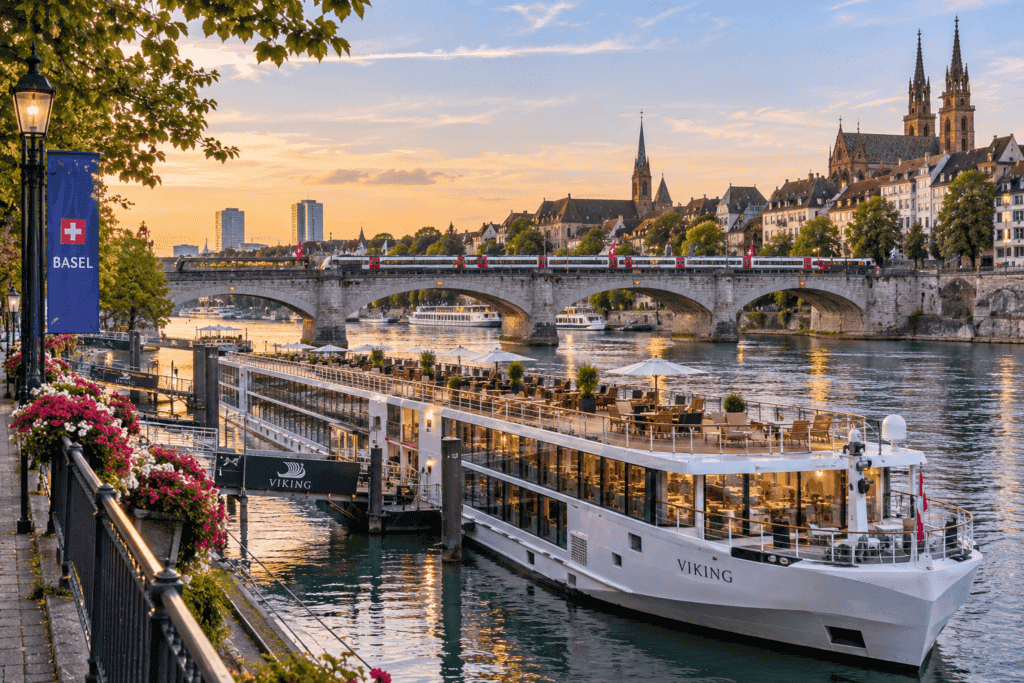
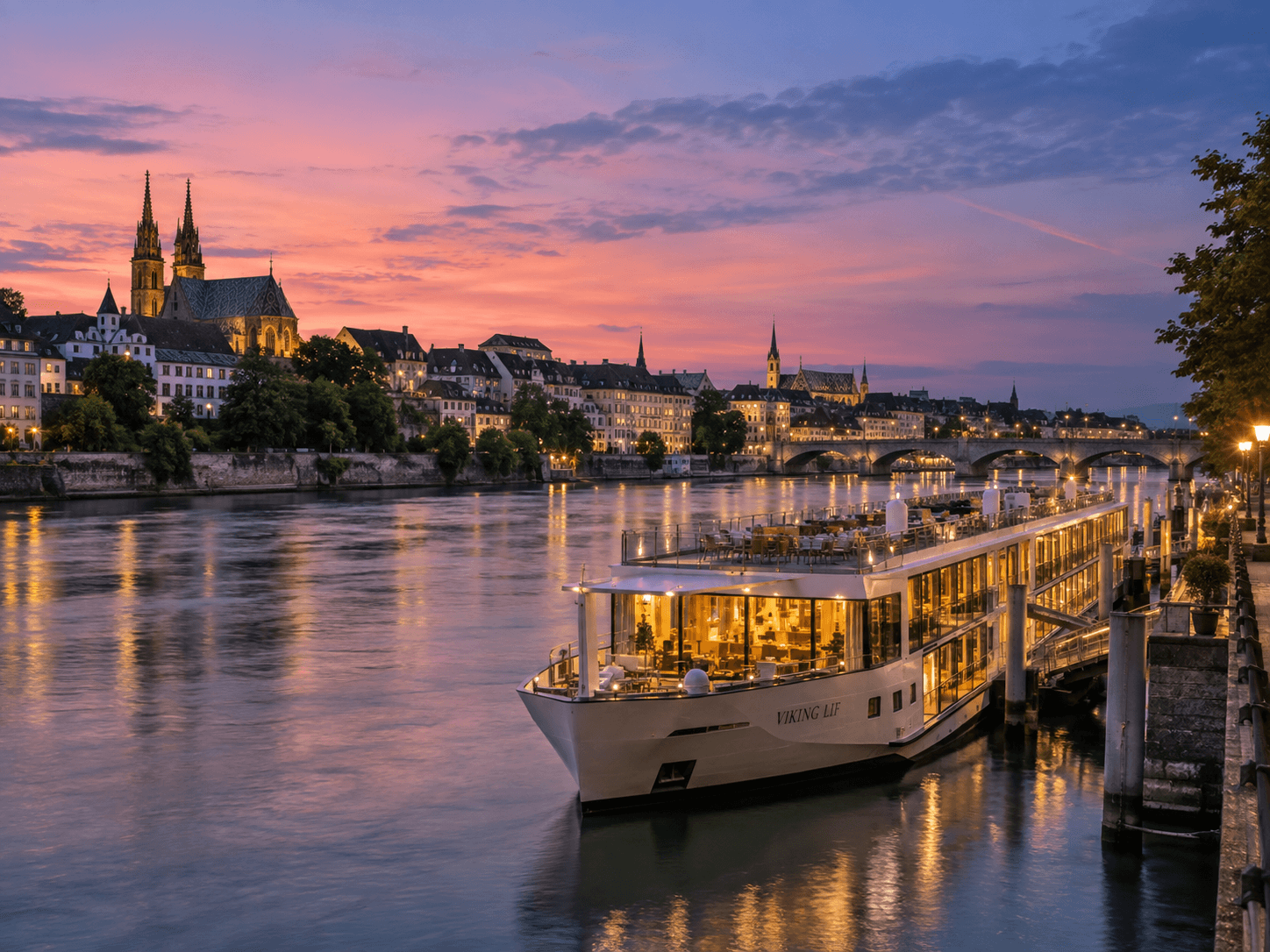
Basel sits where Switzerland, France and Germany meet, which is why it works as a rail hinge as well as a cruise port.
That is the whole concept. You are not choosing between the two. You are using the train to cover ground the ship cannot reach, and using the ship to cover the part of the trip where you would rather unpack once and let the scenery move past the window.
If you are still deciding which mode suits you, that is a different question, and we wrote a whole post about it: European train travel vs river cruise vs tour. This post assumes you already want both.
Voice Search: Quick Answers About Rail and River Cruises
Can I take a train to my river cruise instead of flying?
Yes, if you are already in Europe or willing to fly into a different city. Most European river cruise ports sit on major rail lines with direct or one-change service from other capitals. You will still need a transatlantic flight to get to Europe in the first place.
How many days should I add before a river cruise?
Two nights, minimum, if you are arriving by train. That gives you one full buffer day for a strike, a delay or a missed connection. It also gives you a day to actually see the embarkation city instead of sprinting through it.
Is a rail pass worth it for a river cruise trip?
Usually not. A rail pass pays off when you take many journeys over many days, and a cruise-plus-rail trip is the opposite shape. Price your actual routes as advance point-to-point tickets first, then compare.
Which river cruise ports have a big train station?
Amsterdam, Basel, Vienna, Budapest, Cologne, Prague and Passau are all well connected. Basel is the standout because it is a three-country junction, which makes it easy to arrive from Paris, Zurich or Frankfurt.
Do I have to carry my own bags on European trains?
Yes. There are no porters at most stations, luggage racks fill up quickly, and platform changes often involve stairs. Pack like someone who will be lifting their own suitcase, because you will be.
How do I get from the airport to my river cruise ship?
Almost always by train to the city’s main station, then a short taxi or transfer to the dock. Schiphol runs into Amsterdam Centraal in under twenty minutes, and Vienna, Zurich and Frankfurt all have rail links straight from the terminal. Your cruise line will sell you a transfer, but it is rarely the fastest option.
What time do river cruise ships leave on embarkation day?
Boarding usually opens in the early afternoon and the ship sails in the evening, but the published time varies by line and itinerary. Read your documents rather than assuming, because some Danube sailings leave earlier than you would expect. Plan to be at the dock several hours before the stated departure, not minutes.
Train First or Cruise First?
Put the rail days after the cruise if you can, because a train delay on the way home costs you nothing while a train delay on the way to the ship costs you the ship.
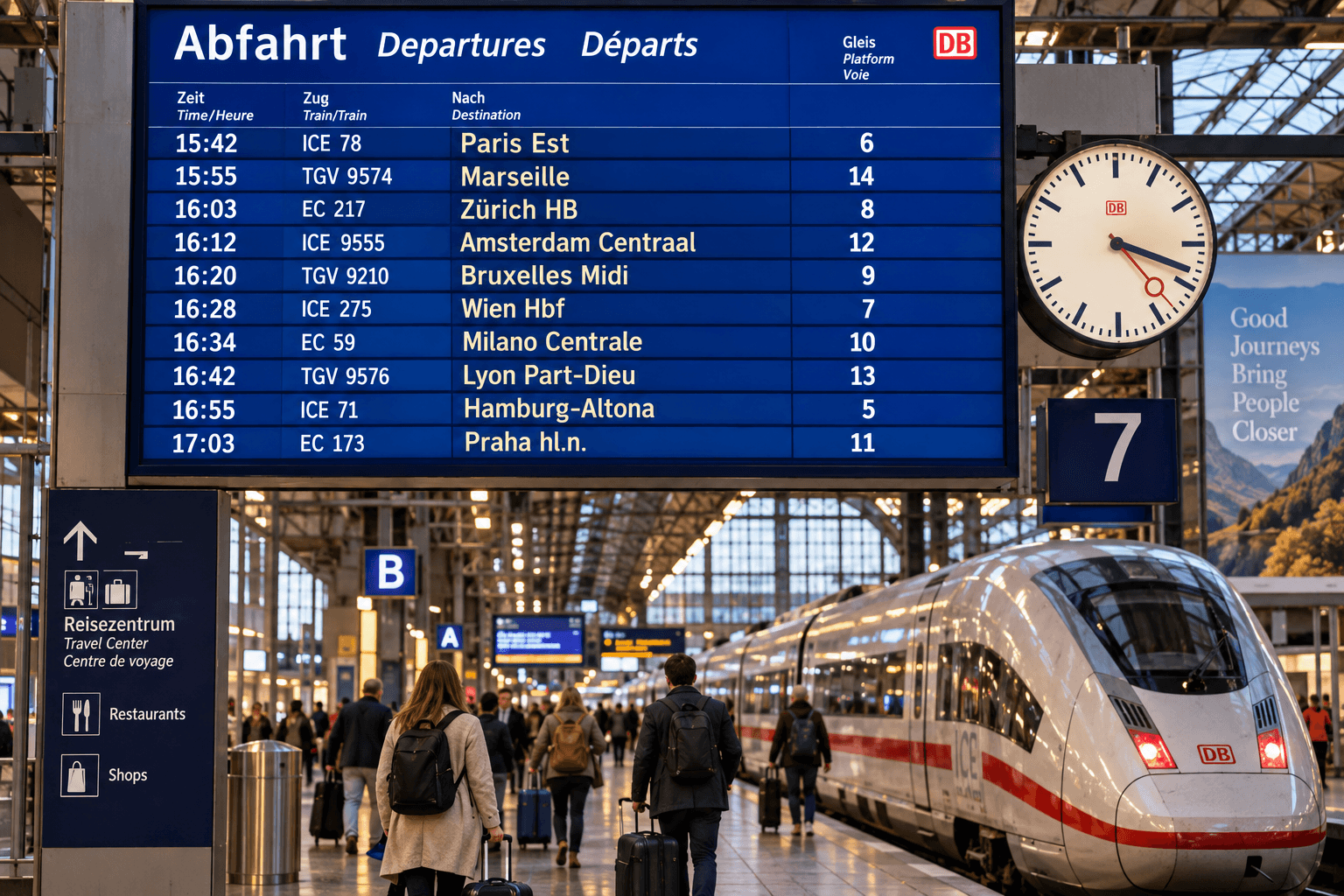
Most European stations post platform assignments 15 to 20 minutes before departure, so allow standing-around time.
That is the single most useful rule in this post. Your river ship sails on a published schedule and it will not wait. European trains are reliable, and they are also subject to strikes, weather, engineering works and the occasional cow on the line. A delay after your sailing is an inconvenience. A delay before it is a ruined vacation.
But sequencing is not always a free choice, and here is the honest counterargument. Jet lag is real, and spending your first three European days on trains while your body clock is upside down is not anyone’s idea of a good time. Some travelers genuinely do better arriving, sleeping, sailing for a week on a ship that does the moving for them, and only then picking up a rail itinerary once they are adjusted.
So the practical version: rail after the cruise is safer. Rail before the cruise is fine too, as long as you build in real slack and arrive at the embarkation city two nights early rather than the morning of.
The 4 Ways to Book Rail and River Cruises in Europe
Four companies will sell you a packaged rail and river cruise itinerary, and everyone else is asking you to book two separate trips and connect them yourself.
Here is who actually does what. The cost labels work the way they do on all our posts: Included means it is in the fare, Possible charge means it may cost extra, and Ask first means it varies and you should confirm before you commit.
Big-budget travelers who want the train to be the event
AmaWaterways
Land packages in Rome, London, Basel, Barcelona, Lisbon
Ask first
Rhine, Danube, Douro and others
Adding city nights, not rail journeys
Viking, Avalon, Scenic, Tauck
Pre- and post-cruise hotel extensions
Possible charge
All major rivers
Simple add-on nights at the port city
Do it yourself
Cruise from one source, trains from another
Possible charge
Anywhere
Travelers who want exact control and lower cost
*One of our preferred vendors who have helped us create unforgettable vacations for our clients
Two notes worth having. Uniworld’s rail partner is Golden Eagle Luxury Trains, and its European Cruise & Rail itineraries run long, 13 to 20 days, on routes like Budapest to Venice and Paris to Istanbul. That is a different product from adding three train days to a Rhine sailing, and it is priced like one.
And AmaWaterways does publish a rail travel option with private transfers between station and ship, but it appears on the UK site as a no-fly product for British guests, on selected sailings only. Their site is explicit that guests “manage your luggage throughout the entire journey” and should be comfortable changing platforms and stations. If you are booking from the US, treat this as a maybe and ask, not as a shelf product.
Every Rhine river cruise ends at Amsterdam or Basel, and both are excellent rail cities, which is why the Rhine is the easiest river in Europe to pair with a train trip.
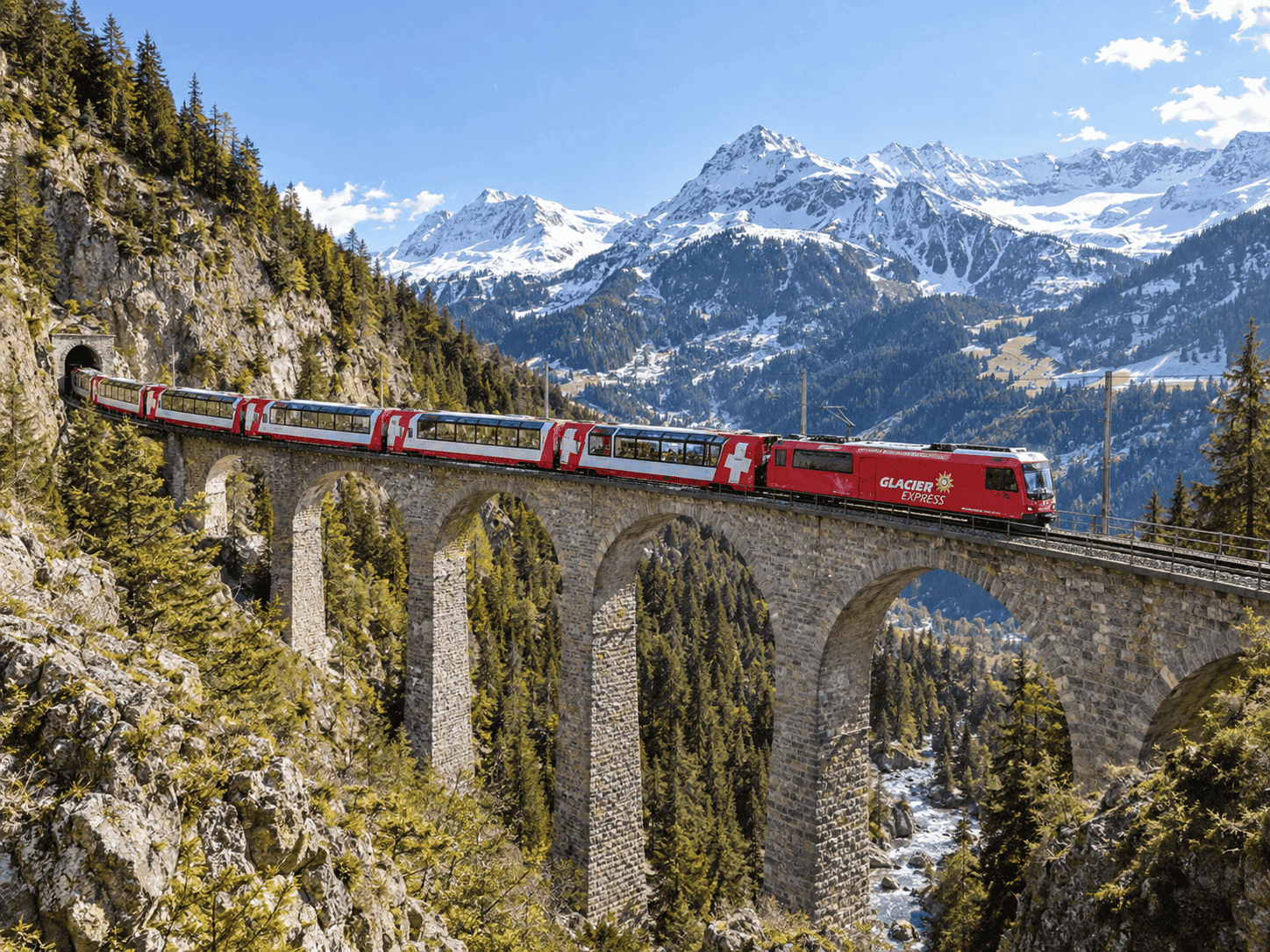
The Glacier Express runs Zermatt to St. Moritz and is a reserved-seat service, so it cannot be boarded spontaneously.
Amsterdam Centraal is a direct Eurostar ride from both Brussels and Paris, with departures through the day. Basel SBB is the better of the two, honestly. It sits where Switzerland, France and Germany meet, so you can arrive from Paris, Zurich or Frankfurt and connect onward to the Swiss alpine railways without a long detour.
That last part is the Rhine’s best trick. Railbookers builds a four-night Zermatt and St. Moritz extension around the Glacier Express specifically for Rhine cruisers, because Basel is the natural hinge between a river sailing and Swiss mountain rail. Great Rail Journeys sells eleven-day Glacier Express and Rhine combinations for the same reason.
One caution on timing. The Swiss panoramic trains run a thinner winter schedule, and the Rhine has its own good and bad months for water levels and weather, so check the best months to sail the Rhine before you lock rail dates around a sailing.
There is also a five-day Basel to Amsterdam routing via Paris and Brussels that works beautifully as a post-cruise leg if your sailing runs the other direction. You finish on the ship in Basel, then loop back to Amsterdam overland through two more capitals.
One planning fact people miss. Switzerland uses the Type J plug, which is its own thing. A slim Type C Europlug generally seats in a Type J socket because the pin positions line up, but a chunky Type F Schuko should not be forced into one. Check your adapter before you get to Basel, not after.
Danube Rail Routes: Budapest, Vienna and Passau
Danube cruises terminate at Budapest or somewhere in the Vienna and Passau corridor, and all three connect east to Prague and west to Munich on fast, frequent trains.
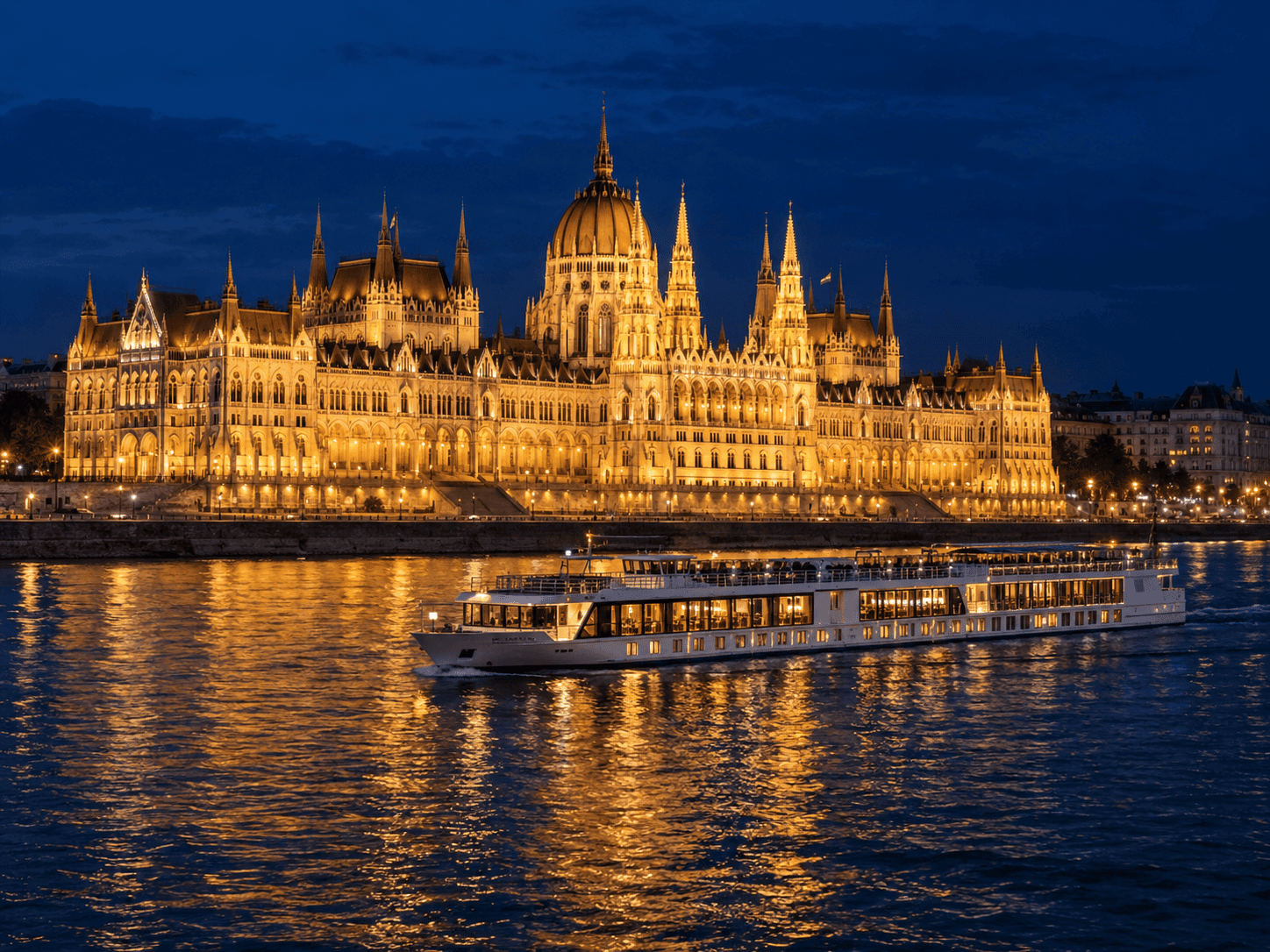
Most Danube itineraries schedule the Budapest illumination sailing on the first or final night, so check which before booking rail days.
Vienna Hauptbahnhof is the hub that makes this work. Vienna to Budapest is a railjet run, city center to city center, and the Man in Seat 61 lists roughly twenty eastbound departures a day with advance fares starting at €19.90 in second class. Prague to Vienna is about the same shape, with railjet and comfortjet services running around nine times daily.
What that frequency buys you is flexibility. On the Rhine you are often committed to one long connecting journey. On the Danube you can leave Vienna at nine or at two and it barely changes your plan.
The Railbookers Prague and Berlin extension from Budapest runs four nights and bundles a 48-hour Prague Card and 48-hour Berlin Pass. That is the standard Danube post-cruise move and it is popular for a reason. You end a week of castles and wine villages in two cities that feel completely different from the river.
Passau deserves a mention because a lot of Danube itineraries start or end there, and it is small. Lovely, but small. Build in the connection time to reach Munich or Vienna, and do not assume you can do it in a morning.
Every European River and Its Rail Gateway
Every major European river cruise route has at least one embarkation city on a mainline station, which means almost any river can be paired with a train trip, not just the Rhine and the Danube.
The Rhine and the Danube get the attention because they carry the most ships. But the Seine starts in Paris, which is the best-connected city on the continent, and the Douro starts in Porto, which is a straight run up from Lisbon. If your heart is set on a river nobody writes rail articles about, you are probably fine.
River
Rail gateway city
Main station
Nearest airport
Direct or near-direct rail from
Rhine
Amsterdam
Amsterdam Centraal
Schiphol (AMS)
Brussels, Paris, Cologne, Frankfurt, Berlin
Rhine
Basel
Basel SBB
EuroAirport (BSL), Zurich (ZRH)
Paris, Zurich, Frankfurt, Milan
Main and Moselle
Frankfurt
Frankfurt Hbf and Flughafen Fernbahnhof
Frankfurt (FRA)
Basel, Cologne, Paris, Amsterdam, Munich
Danube
Vienna
Vienna Hbf
Vienna (VIE)
Budapest, Munich, Prague, Zurich, Venice
Danube
Budapest
Budapest Keleti
Budapest (BUD)
Vienna, Prague, Munich
Danube
Passau
Passau Hbf
Munich (MUC)
Munich, Vienna, Regensburg, Nuremberg
Main-Danube Canal
Nuremberg
Nuernberg Hbf
Nuremberg (NUE)
Munich, Frankfurt, Berlin
Seine
Paris
Gare du Nord, Gare de Lyon, Gare de l’Est
Charles de Gaulle (CDG)
London, Brussels, Amsterdam, Basel, Avignon
Rhone and Saone
Lyon
Lyon Part-Dieu
Lyon (LYS)
Paris, Avignon, Marseille, Geneva
Rhone
Avignon
Avignon TGV
Marseille (MRS)
Paris, Lyon, Marseille
Garonne and Dordogne
Bordeaux
Bordeaux Saint-Jean
Bordeaux (BOD)
Paris, Toulouse
Douro
Porto
Porto Campanha
Porto (OPO)
Lisbon, Vigo
Elbe
Prague
Prague hlavni nadrazi
Prague (PRG)
Vienna, Berlin, Munich
Elbe
Berlin
Berlin Hbf
Berlin (BER)
Prague, Hamburg, Munich, Amsterdam
Station and airport pairings here are commonly available and stable. Direct service patterns change with the December timetable each year, so confirm your specific route with the operator before you book anything non-refundable.
If the Douro is your river, our Douro river cruise guide covers the ships and the fare tiers, and the Lisbon to Porto rail leg is the easiest pre-cruise add-on in Europe.
Rail and River Cruise Itineraries by Day Count
A combined rail and river cruise trip works best at 10 to 14 days total, which is a seven-night sailing plus three to six rail days on one end.
Adventures by MJ :: Rail & River Planning
How Long the Train Actually Takes
Fastest scheduled city-centre to city-centre journey times on the rail corridors that feed Europe’s Rhine and Danube river cruise ports. Bars are drawn to scale against an 8-hour rail day.
Rhine corridor ports: Amsterdam & Basel
Paris › Brussels Midi
1h25
Paris › Basel SBB
3h05
Paris › Amsterdam Centraal
3h25
Paris › Zurich HB
4h04
Amsterdam › Basel 1 change
7h10
Danube corridor ports: Vienna, Passau & Budapest
Vienna › Budapest Keleti
2h37
Vienna › Munich Hbf
4h03
Prague › Vienna Hbf
4h05
Vienna › Venice S. Lucia
7h16
Vienna › Zurich HB Arlberg route
7h52
Read it this way
Anything under about four hours is a half-day and still leaves you an afternoon. Anything over seven is the whole day, so give it its own line on the itinerary and do not schedule it the day you board.
Sources: Man in Seat 61 route and international departure pages; NS International Amsterdam–Basel timetable. Fastest scheduled services, verified September 11, 2026. Times vary by departure and season, and engineering works can add an hour. Always confirm with the operator before booking.
7-Day Rail and River Cruise Itinerary: A Short Rhine Sailing Plus Two Rail Days
Best for: travelers with one week who still want both halves.
Fly into Amsterdam, sail a shorter four or five night Rhine itinerary, then take the train to Brussels or Cologne for two nights before flying home. Seven days is tight and you will feel it, but it works if you accept that the rail portion is two cities rather than a journey. The trap here is trying to fit the Swiss alpine trains into a week. Do not.
10-Day Itinerary: Swiss Rail, Then a Rhine Cruise to Amsterdam
Best for: first-timers who want Swiss mountain rail and the least risk of missing the ship.
Fly into Zurich. Two nights in Zermatt or St. Moritz with a Glacier Express leg, then rail to Basel and overnight there before boarding. Sail Basel to Amsterdam over seven nights and fly home from Schiphol. This is the version I recommend most often, because the rail portion sits at the front where you are freshest and the buffer night in Basel is built in.
12-Day Itinerary: Paris and Brussels by Train, Then the Rhine from Basel
Best for: travelers who want three capital cities and the river in one trip.
Fly into Paris. Two nights there, one or two in Brussels, then TGV down to Basel for your buffer night. Seven-night Rhine sailing to Amsterdam. This one reverses the Railbookers Basel-to-Amsterdam routing and gives you three capitals plus the river without ever repeating a city.
14-Day Itinerary: Danube Cruise First, Then Prague and Berlin by Rail
Best for: anyone nervous about train delays, because every train happens after the sailing.
Fly into Munich or Vienna, sail the Danube to Budapest, then take the rail extension north through Prague and Berlin before flying home. This is the safest sequencing of the three, because every train you take happens after the ship has already sailed. If you are nervous about connections, book this shape.
What a Rail and River Cruise Actually Costs
The rail portion of a combined trip is almost always cheaper than travelers expect, and the pass you were about to buy is usually the wrong tool for it.
Here is why. A rail pass is priced for volume. RailPass.com currently lists a four-travel-day Global Pass around $337 in second class and $437 in first, verified September 11, 2026, and most high-speed and night trains still require a separate seat reservation fee on top of that. Meanwhile, a Vienna to Budapest advance ticket starts around €19.90 and Prague to Vienna starts around €14.90.
Do that math on a typical cruise-plus-rail trip with three or four journeys and the pass loses, often badly. Where a pass starts making sense is a genuinely rail-heavy itinerary with six or more travel days and a lot of spontaneity. If that is your trip, buy the pass. If your trip is a river cruise with train days attached, buy tickets.
Book the advance fares as soon as the timetable opens, which is usually somewhere around 90 to 180 days out depending on the operator. Those cheap fares are quota-limited and train-specific, and they vanish. Check current pricing directly with Eurail, ÖBB and Deutsche Bahn rather than trusting any number in a blog post, including this one.
Our guide on when to book a European river cruise covers the cruise side of that timing, and the two booking windows are not the same, which trips people up constantly.
You are about to go price four train tickets. Do it once, with the pass math and the reservation traps already settled.
Rail Travel 101
Pass or point-to-point, day train or sleeper, and the reservations nobody warns you about. Free.
Whether a rail pass actually saves you money, which is not the obvious answer
The seven questions to settle before you book anything
First-timer routes in Europe, Switzerland, Canada, Japan and the States
What to bring on board, and the seat reservations that catch people out
One email, and you can unsubscribe whenever. We’re Mike and Sue, and we build these trips for clients every week.
5 Mistakes That Wreck a Rail and River Cruise Trip
Nearly every combined trip that goes sideways goes sideways for one of these five reasons, and four of them are fixable at the planning stage.
Arriving the morning of embarkation. You know this one already. Two nights. I will keep saying it.
Overpacking for the train half. River cruise cabins have modest storage and train luggage racks have less. A bag you can lift overhead on your own is not a nice-to-have.
Buying the pass before pricing the tickets. Run the actual routes first. It takes ten minutes and often saves two hundred dollars.
Ignoring which station. Large cities have several. Paris in particular will send you to Gare de Lyon for Basel and Gare du Nord for Amsterdam, and those are not close together.
Assuming the cruise line handles the train. With four exceptions in the table above, it does not. Your rail booking and your cruise booking are separate contracts with separate cancellation terms.
Packing for a Trip That Is Half Train, Half Ship
Pack for the train, because the train is the constraint. Anything that works on a European platform will work fine in a river cruise cabin.
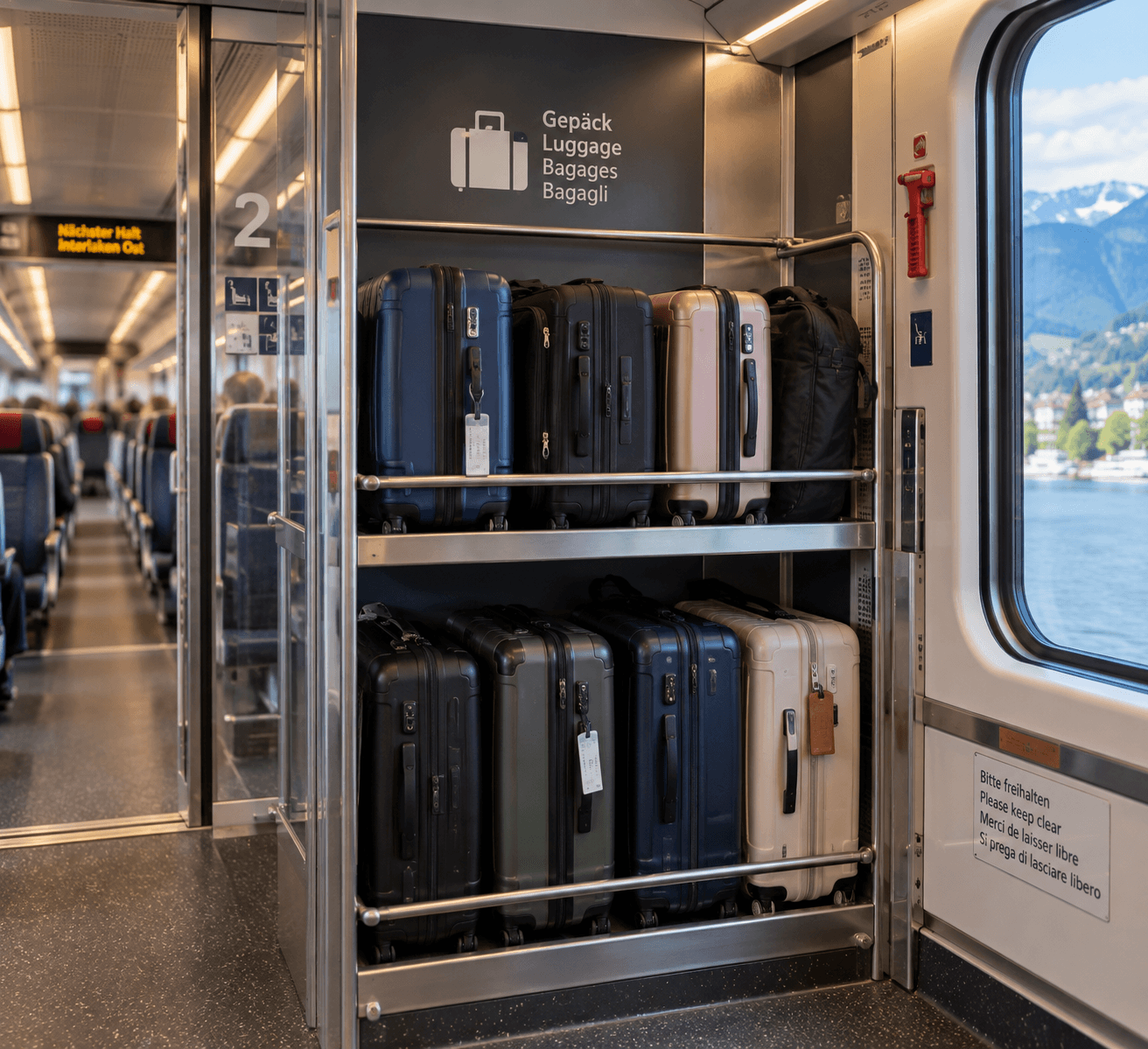
End-of-carriage racks are first come, first served and there is no assigned luggage space on most European trains.
The gear that matters here is narrow and specific.
Soft-sided carry-on spinner with a low profile. Train luggage racks are shallower than airline overheads and they fill up by the second stop. A soft bag squeezes into the space a hard shell will not.
Compression packing cubes. River cruise cabins are efficient rather than roomy, and cubes let you live out of the bag on train days without unpacking twice.
Portable luggage scale. Trains do not weigh your bag, but the flight home does, and you will buy things.
If you want the full list, our guide to river cruise cabin types covers what actually fits in each category.
A Word on Paperwork
Americans currently need only a valid passport for a rail and river cruise trip through Schengen Europe, though the EU’s new entry requirements are still being phased in and the rules may change before you travel.
Entry requirements for Europe are in motion right now. The EU’s Entry/Exit System rolled out across Schengen in 2026, and ETIAS, the travel authorization Americans will eventually need, has slipped toward 2027 with a transitional period after launch. Switzerland is inside Schengen but outside the eurozone, so you will want Swiss francs for the Basel end of a Rhine trip.
Check the official EU travel page and the U.S. State Department country pages before you book, and again about a month out. This is genuinely one of those things that changes between your deposit and your final payment.
Frequently Asked Questions
Which European river cruise lines offer rail packages?
Uniworld is the main cruise line with a true rail product, pairing its river ships with Golden Eagle Luxury Trains on long Danube and Balkans itineraries. AmaWaterways publishes a rail travel option on its UK site for selected European sailings. Viking, Avalon, Scenic and Tauck sell hotel extensions in port cities rather than rail journeys.
How far in advance should European train tickets be booked?
Advance fares typically open somewhere between 90 and 180 days before departure depending on the operator, and the cheapest tiers sell out first. Book as soon as your cruise dates are confirmed and non-refundable. Those advance tickets are tied to one specific train, so lock the cruise before the rail.
Is it better to travel by train before or after a river cruise?
After, if you have the choice, because a rail delay after your sailing costs you nothing while a delay before it can cost you the ship. Rail before the cruise works fine as long as you arrive in the embarkation city two nights early. Jet lag is the honest argument for cruising first.
What happens if a train delay makes someone miss embarkation?
You are responsible for catching up to the ship at the next port, at your own expense, unless the cruise line booked your rail as part of the package. This is the single strongest reason to use one of the packaged operators if you are nervous. Travel insurance with missed-connection coverage is worth pricing either way.
Are seat reservations required on European high-speed trains?
On many of them, yes, and a rail pass does not cover the reservation fee. High-speed and night trains across France, Italy, Spain and most international routes require a reserved seat. Regional and many German domestic trains do not.
How much luggage can be taken on a European train?
There is no weight limit on most European trains, but there is a practical space limit and no one will help you with it. Racks at the carriage ends fill quickly, overhead shelves are shallow, and platform changes often mean stairs. One bag you can lift plus one personal item is the realistic ceiling per person.
Can a Eurail pass be used to reach a river cruise port?
Yes, a pass will get you to Amsterdam, Basel, Vienna, Budapest and every other major embarkation city. Whether it should is a different question, since a three or four journey trip rarely justifies the pass price plus reservation fees. Price the individual tickets first and buy the pass only if it actually wins.
Which river is best for a combined train and cruise trip?
The Rhine, if you want Swiss alpine rail, because Basel connects straight into the Glacier Express and Bernina networks. The Danube, if you want more cities, because Vienna and Budapest sit an easy train ride from Prague, Munich and Berlin. Both work, and the choice usually comes down to mountains versus capitals.
Final Thoughts
The combined trip is more fun than either half on its own, and it is not harder to plan. It just has one hard edge to respect, which is the ship’s departure time. Everything else is flexible.
If I were building this for the first time, I would sail the Rhine from Basel to Amsterdam, add three Swiss rail days in front of it, and book the two nights in Basel before I booked anything else. That itinerary has the fewest ways to go wrong and the best scenery-to-hassle ratio in Europe.
And if you sail it the other direction and finish in Basel with a Glacier Express ticket in your pocket, that is also a wonderful trip. There is no wrong answer here. There is just the version that matches how you like to travel.
Let’s Sketch It Out Together
Building one of these takes about twenty minutes of conversation and a look at the timetable. If you have a river in mind and no idea where the train days should sit, send us the dates and we will map the shape of it. No obligation, no pitch, and if the answer is that you should book it yourself on Railbookers, we will tell you that too.
Affiliate Disclosure: This post may contain affiliate links. If you make a purchase through one of these links, we may earn a commission at no additional cost to you. We only recommend products and services we believe may be helpful to travelers.
Hi, I'm Sue. I plan cruises, all-inclusive resorts, and slow multi-country trips through Europe. I'm a certified Hawaii travel specialist, and I book through host agency Outside Agents as a member of the Travel Leaders Network. Twenty years in senior HR leadership before this, which mostly taught me how to read what people actually want. I live in Grain Valley, Missouri with my husband and business partner Mike.