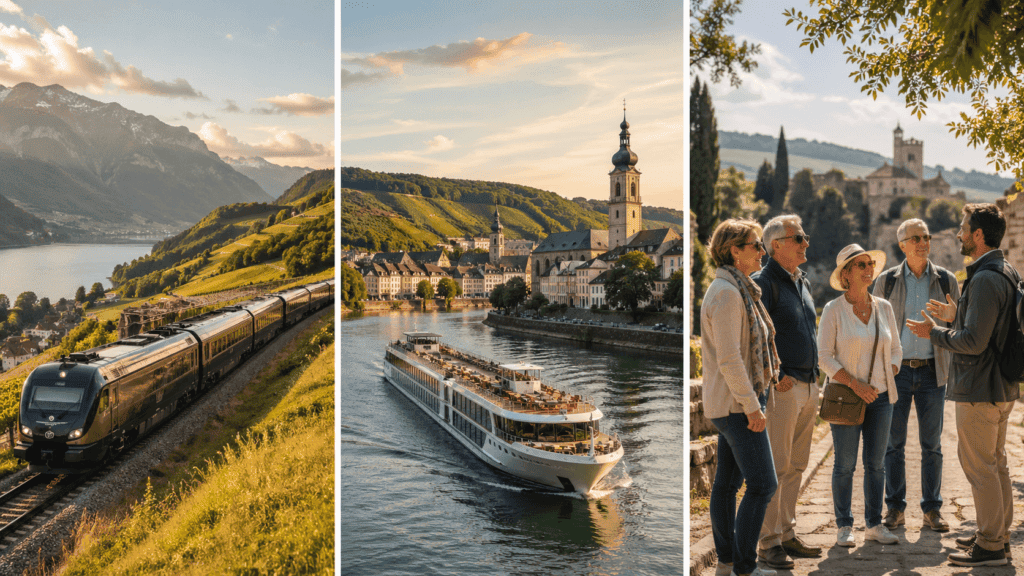
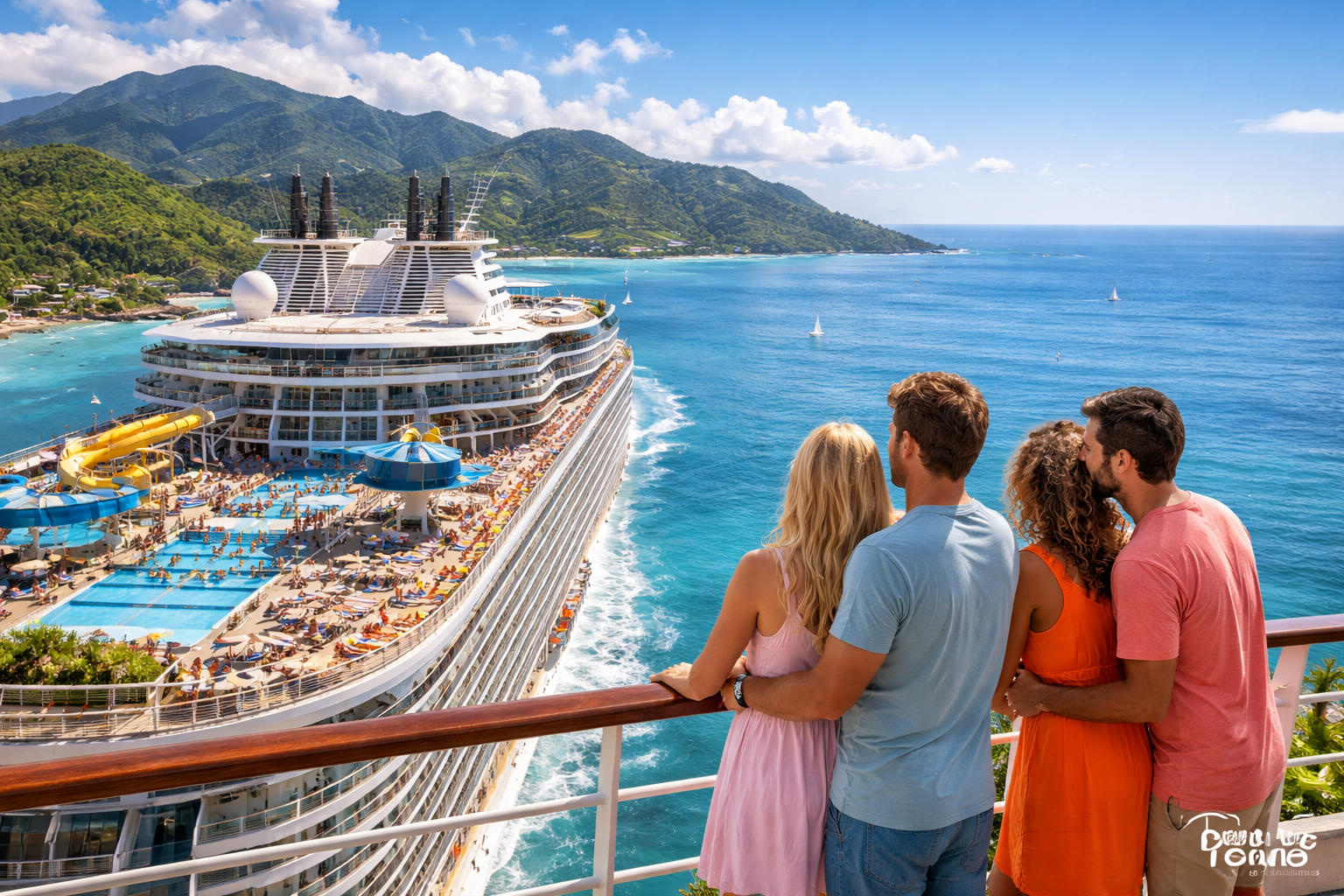
European Train Travel vs River Cruise vs Tour: Which Is the Best Way to See Europe?
You decided to do Europe. The hard part is over. The next question is the genuinely tricky one: do you go by train, by river cruise, or on a guided tour? We compare cost, flexibility, vibe, and who each format is actually for, so you can stop overthinking and start packing.
Last updated: October 2, 2026 :: Written by Sue Nelson, Travel Advisor | Adventures by MJ · Reading time: 12 minutes
Sue specializes in cruise, multigenerational, and bucket-list European travel.
European train travel, river cruises, and guided tours are having a moment. The dollar is doing its best, the trains are faster than they have ever been, and roughly everyone you know is suddenly “going abroad this fall.” If you are one of them, congratulations. The hard part is over. You decided to go. Now comes the genuinely tricky question: when comparing train vs river cruise vs tour in Europe, which one is actually right for you?
Three formats dominate the conversation right now. European train travel, currently enjoying a full-blown renaissance thanks to faster networks, gorgeous new sleeper trains, and bookable rail itineraries from companies like Railbookers. River cruises, still the most civilized way to glide through Central Europe with a glass of wine in hand. And guided land tours, still the champion for travelers who want the most countries stamped per dollar spent.
Each has loyalists. Each has real trade-offs. Each will give you a fundamentally different trip to remember.
So let’s settle the train vs river cruise vs tour question once and for all, with a comparison your future self will thank you for.
If you only read this section, here is the cheat sheet:
Choose European train travel if you want flexibility, deep local immersion, and the unbeatable romance of arriving in a city by rail.
Choose a river cruise if you want comfort, beauty, and the privilege of unpacking exactly once.
Choose a guided land tour if you want maximum destinations covered with minimal planning energy on your part.
Still with us? Good. Let’s dig in.
Key Takeaways: Train vs River Cruise vs Tour
Train travel is best for flexibility, sustainability, and travelers who want to set their own pace.
River cruises are best for couples, travelers 50+, and anyone who wants to unpack only once.
Guided tours are best for first-time visitors with a long bucket list and limited planning energy.
A 10-day European train trip in 2026 typically costs $1,800–$4,500 per person.
A 7-day European river cruise in 2026 typically costs $2,800–$5,500 per person.
A 10-day guided land tour in 2026 typically costs $1,500–$6,500 per person.
Trying to decide between a European train trip, river cruise, ocean cruise, or guided tour? This guide breaks down the best ways to see Europe in 2026 so you can choose the travel style that fits your pace, budget, and dream itinerary.
First, Let’s Define What We’re Actually Comparing
I’ve booked all three formats for clients, and each one comes with trade-offs the brochures don’t mention. Here’s how they actually compare from the advisor’s side of the desk.
Before the rounds begin, a quick housekeeping note. These three formats often get lumped together as “Europe trips,” which does no one any favors.
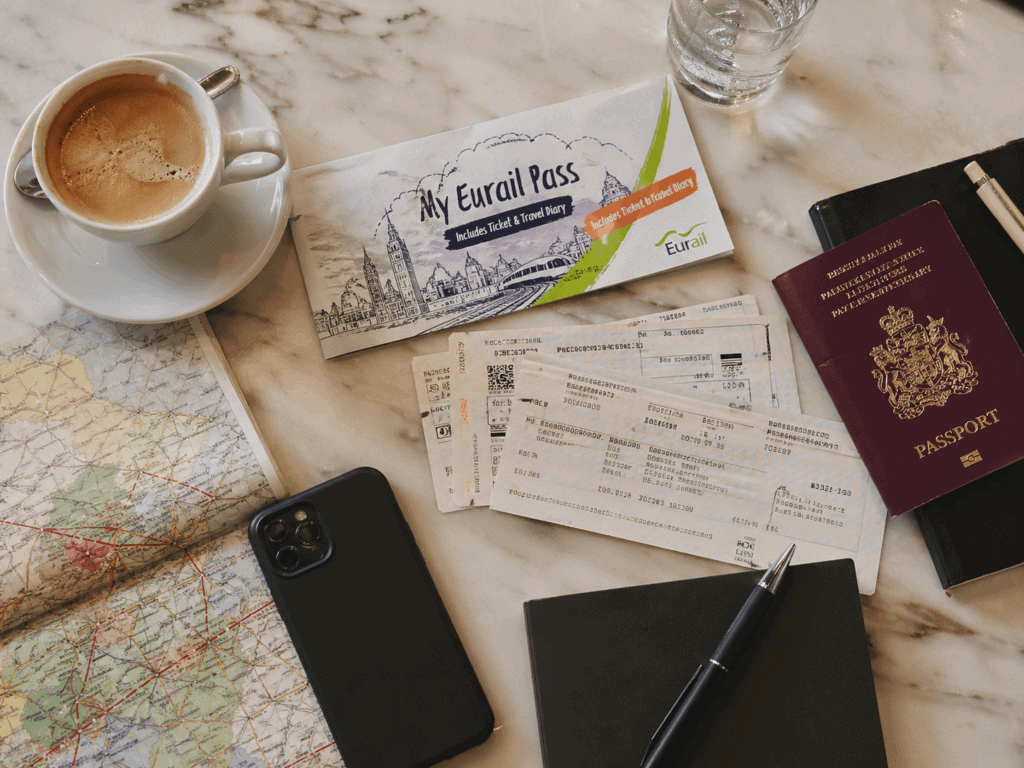
European train travel means navigating Europe primarily by rail, using an Interrail pass, point-to-point tickets, or a curated rail-based itinerary. You stay in hotels of your choosing (or your travel advisor’s choosing), and you move between cities on trains that range from speedy intercity services to overnight sleepers and luxury journeys like the Venice Simplon-Orient-Express. You set your own pace, mostly. You eat where you want. The train does the heavy lifting between stops. Done well, it is the most rewarding DIY Europe itinerary you can build.
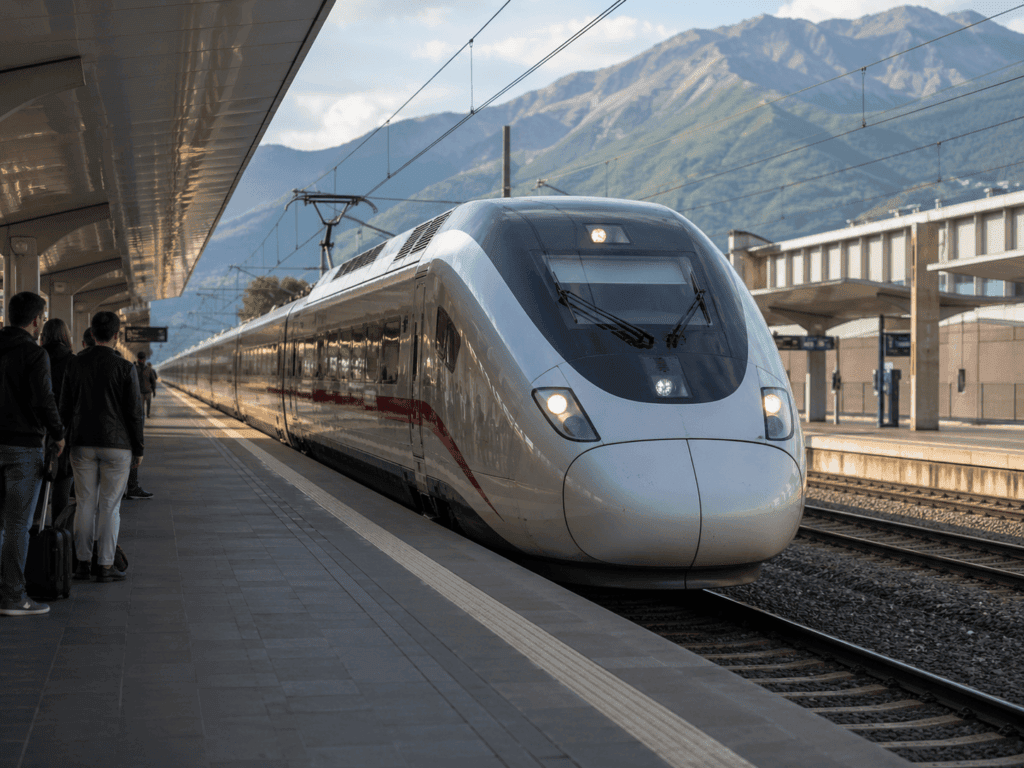
From the Eurostar slipping beneath the English Channel in just over two hours to Italy’s Frecciarossa screaming across Tuscany, modern European rail spans every speed and style.
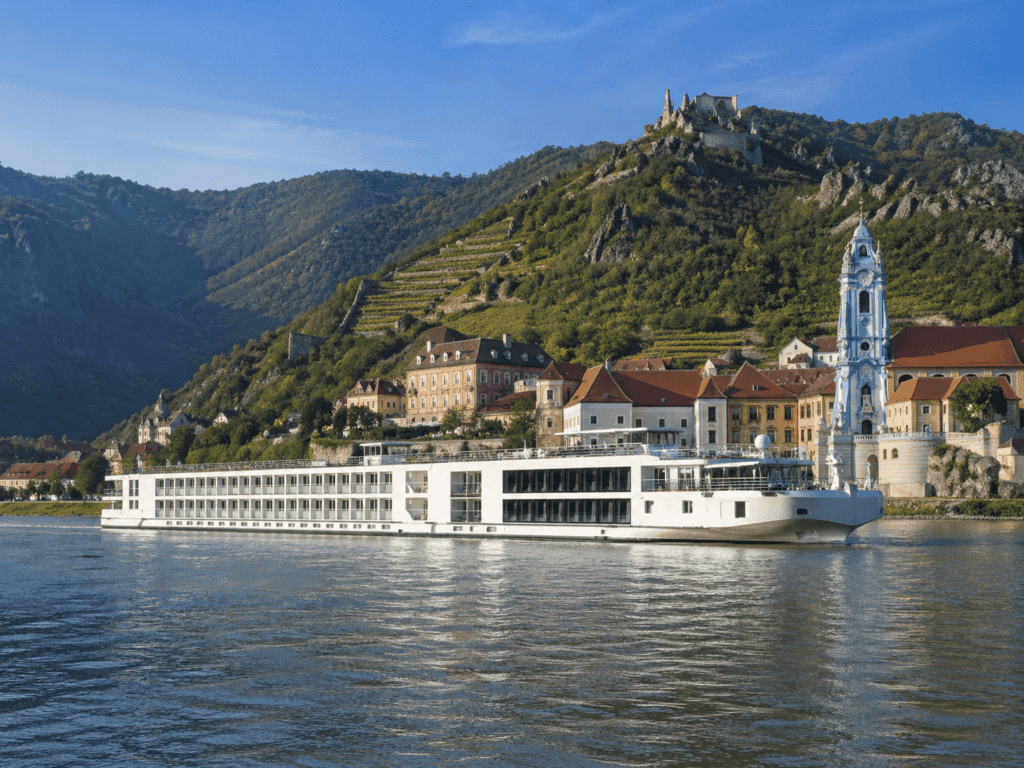
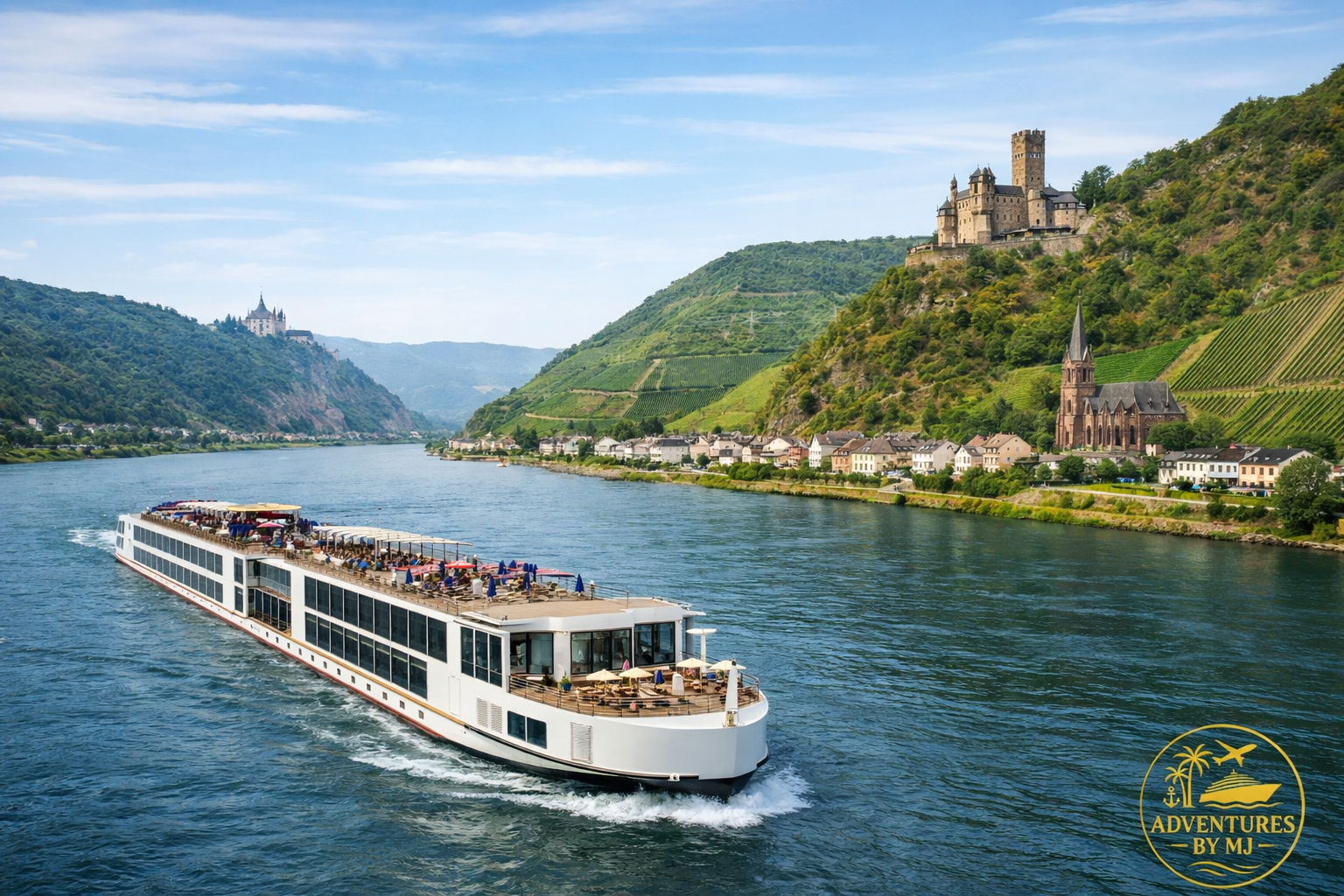
A European river cruise puts you on a long, sleek riverboat that travels along the Danube, Rhine, Seine, Douro, or Rhône. Your cabin floats with you. Meals, excursions, and entertainment are built in. Most cruises run seven to fifteen days and cover one geographic spine.
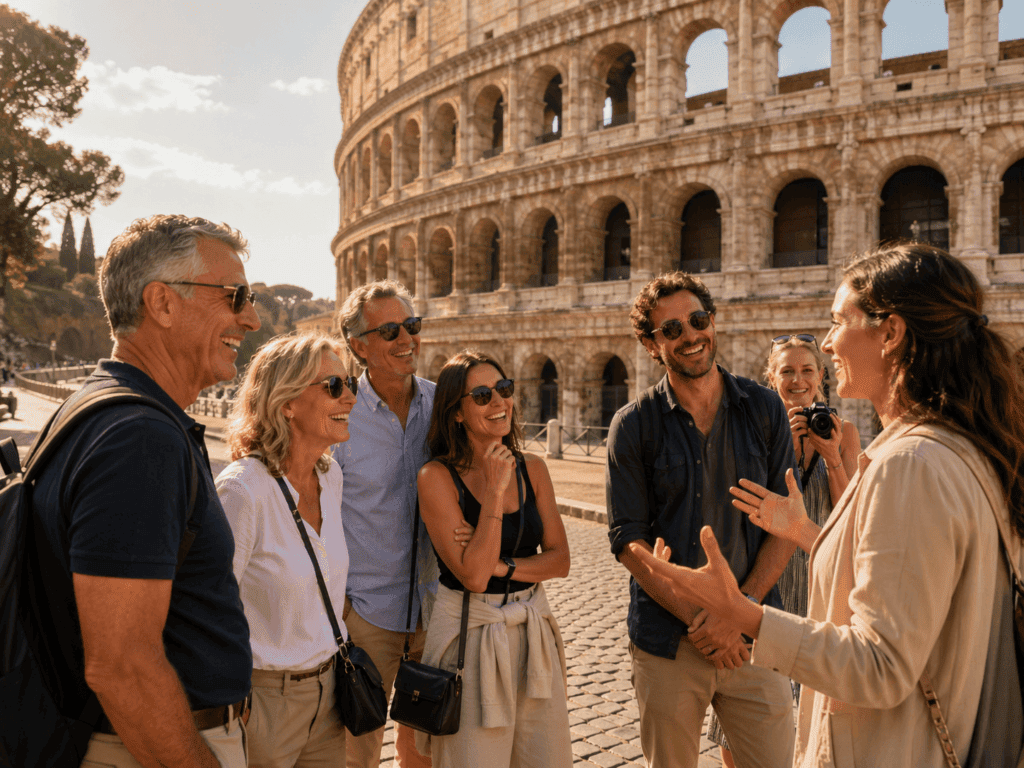
A guided land tour moves a group of travelers through multiple destinations by motorcoach (and sometimes train), led by a tour director and following a pre-set itinerary. Think Tauck, Insight Vacations, Globus, Trafalgar, Rick Steves, and dozens of others. Hotels change every two or three nights. The breadth is remarkable. The pace can be brisk.
Three completely different vacations. Let’s compare them properly.
European trains have quietly become one of the fastest, most civilized ways to move through the continent.
Round 1: Ease and Logistics
Winner: River Cruise, with Train Travel a strong second.
A river cruise is the easiest format ever invented for traveling Europe. You unpack once. Your cabin moves while you sleep. You wake up in Vienna, eat breakfast somewhere along the Danube, and step off in Budapest before dinner. There is essentially no friction.
Cruise Lines International Association says river cruise bookings keep rising, and most river ships carry fewer than 200 passengers.
You unpack once. The view changes overnight. Hard to argue with that math.
European train travel sits comfortably in second place. Yes, you are technically packing and unpacking a few times, but train travel has a magical built-in convenience: most major rail stations are smack in the center of the city. No 90-minute taxi from a faraway airport. No arriving at a hotel exhausted from a connecting flight. You step off the train, you walk to your hotel, you drop your bag, you go find lunch. Modern European rail has been refined for decades, and it shows.
Guided land tours, by contrast, involve real logistical choreography. Bags out by 7 a.m. Bus loaded by 7:30. New hotel by 4 p.m. New restaurant by 7. Repeat. It is doable and many travelers love the rhythm of it, but the friction is real.
Whichever format you choose, packing light wins. A solid train-friendly carry-on with great wheels saves you from wrestling oversized luggage onto rail racks, into cruise cabins, or up boutique-hotel staircases that have not changed since 1894.
Round 2: Flexibility and Spontaneity
Winner: Train Travel, by a country mile.
This is where rail wins decisively, and it is not particularly close.
On an Interrail pass, you can wake up in Florence, decide over espresso that you’d rather be in Bologna by lunch, and simply board the next train. You are not locked into a ship’s schedule. You are not following a tour director’s clipboard. You can stay an extra night somewhere unexpectedly charming, skip a city that bores you, or detour to a tiny coastal town because someone at dinner mentioned it. That is the dream.
(Pro tip for the spontaneity-minded: a good set of packing cubes makes repacking on three minutes’ notice roughly 80% less stressful, which matters when you’re suddenly catching the 11:42 to Bologna.)
An Interrail pass is rarely the cheapest option for one country. For four-plus countries, it usually pays for itself.
River cruises operate on a fixed itinerary tied to docking schedules. Excursions are optional, but the boat will be leaving Passau at 4 p.m. with or without you. Land tours are even more rigid. You move when the group moves.
Train travel attracts the “but what if we love it there” travelers. The ones who want options. The ones who get genuinely uncomfortable when a stranger hands them a printed schedule.
For a deeper look at structuring a flexible Europe trip without going feral, our guide on the best way to see Europe without rushing is a useful companion read.
Round 3: Cost (And Whether an Interrail Pass Is Worth It)
Winner: It depends, but train travel typically wins on cost-per-flexibility.
Let’s talk numbers, because cost is genuinely confusing across these three formats.
A typical seven-day European river cruise lands somewhere between $2,800 and $5,500 per person, including most meals, excursions, and accommodation. Crew tips are usually extra on Viking and AmaWaterways, while all-inclusive Uniworld builds them into the fare. It looks pricey upfront, but the all-in nature of the pricing is genuinely valuable.
A guided land tour ranges anywhere from $1,500 (budget operators) to $6,500+ (premium operators) for a similar duration. Inclusions vary widely. Always read what is and is not included before you compare prices.
European train travel is the most variable of the three because you control more of the variables. A 10-day rail itinerary covering France, Switzerland, and Italy can be done for as little as $1,800 per person all-in if you book mid-tier hotels and use an Interrail Global Pass strategically. The same itinerary can also cost $4,500 if you want luxury hotels and first-class rail. The flexibility cuts both ways.
(The first-class vs second-class European train debate is real, but for most journeys under five hours, second class is clean, comfortable, and roughly half the price. Save the upgrade for the long-haul routes.)
Rail Pass or Point-to-Point Tickets?
A rail pass makes the most sense if you’ll ride long distances on many days and want the freedom to change plans. Advance tickets usually cost less if you can commit. Eurail changed its name to Interrail in September 2026, so Americans now buy an Interrail pass too, and the math has more moving parts than it used to. Our route-by-route guide to whether an Interrail pass is worth it for Americans is coming later this fall.
For more on pricing across the year, our breakdown of whether now is the right time to book summer 2026 travel covers timing and rate trends.
Round 4: The Vibe
Winner: Three-way tie. They are simply different vibes.
Each format has a personality. Choose the one that matches yours.
According to the International Union of Railways, passenger rail traffic worldwide was back to 2019 levels in 2024, and European traffic grew by roughly another 1.5% in 2025.
Train travel is the most local, most independent, and frankly the most romantic of the three. There is something profoundly cinematic about a European train pulling into a centuries-old station. You are sharing the carriage with locals. You are reading a paperback as the Alps go by. You are ordering espresso in a station café from someone who has never once been impressed by tourists. It feels like Europe at its most authentic.
And there is genuinely nothing like boarding a European sleeper train in Vienna and stepping off in Venice while still in your pajamas.
River cruises are quieter, more refined, and decidedly adult. The crowd skews 50 and up. The dress code at dinner is “smart casual to your grandmother.” You will likely make friends at your dinner table whom you will email for the next decade. It is genuinely lovely if that sounds appealing.
Guided land tours are the most social, by far. You are spending eight to fourteen days with the same group, sharing meals, photo ops, and occasional motion sickness. Tours specifically designed for younger or active travelers (yes, they exist) can be a blast. The connections are real. The “remember when our bus broke down outside Salzburg” stories will outlive you.
Round 5: Coverage and Itinerary Breadth
Winner: Tied, depending on what you mean by “coverage.”
For a true multi-country Europe trip, this is the format that delivers the most stamps in the shortest window. A two-week tour can take you across Paris, Lucerne, Venice, Florence, Rome, and Vienna. You will be tired. You will also see a lot. According to the European Travel Commission, air travel in Europe grew faster in October and November 2025 than it did in the summer peak.
Guided tours win on coverage. A two-week itinerary can stitch six countries together while you focus on showing up.
Train travel offers astonishing range too, but on your terms. You can do six countries in two weeks if that is the assignment. Or you can spend two weeks in Italy alone, hopping by rail between Milan, Cinque Terre, Florence, Siena, Rome, and Naples. You build the canvas.
Rail is also unbeatable for stringing multiple short European city breaks together, since you skip airport transit between each one and arrive in the city center every time.
River cruises are inherently linear. A Danube itinerary will not include Paris. A Rhine cruise will not visit Rome. You are following a waterway, which is its own kind of glory, but the geography is constrained.
If your itinerary is going to span five or six countries (whether by tour or by train), a current edition of Rick Steves’ Best of Europe is genuinely worth its weight in checked-bag fees. Use it to triage which cities deserve a full day and which need ninety minutes and a cappuccino.
If you are weighing rail against floating, our companion piece on European river cruise vs ocean cruise is worth a read for the broader cruising context.
Round 6: Sustainability
Winner: Train Travel.
Worth flagging, because more travelers are asking. European trains, particularly high-speed services and electrified networks, have a dramatically lower carbon footprint than buses, planes, or cruise ships per passenger mile. According to the European Environment Agency, trains are the most efficient way to travel in the EU, with emissions per passenger-kilometer that are only a fraction of flying or driving.
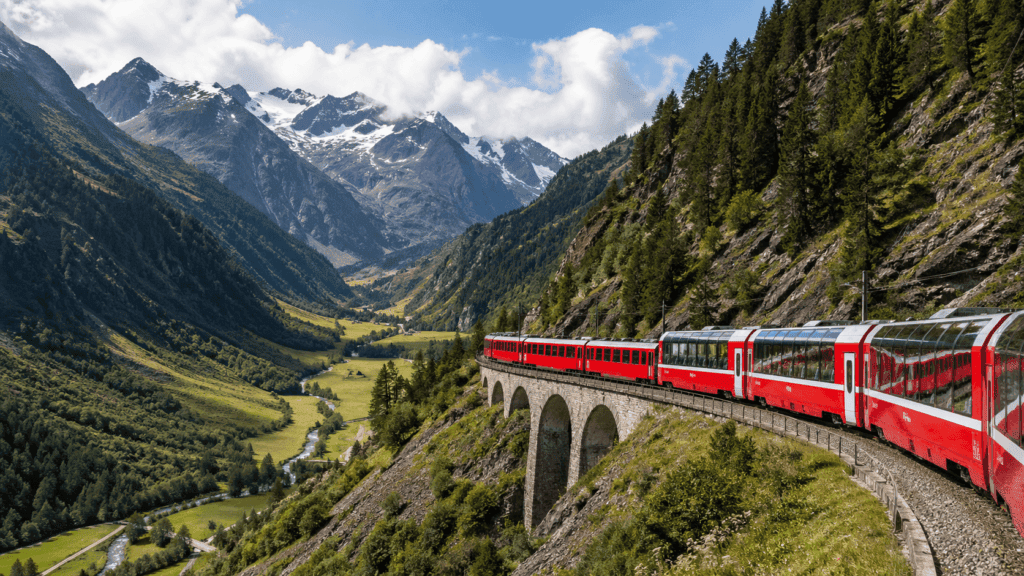
The Glacier Express through the Swiss Alps is the most-photographed train route in Europe for a reason.
If sustainability is part of your decision criteria, rail is the obvious winner. River cruises are the runner-up (smaller ships, generally efficient routing). Long-distance motorcoach tours fall last, especially if they are rolling diesel coaches across multiple countries.
If a picture is worth a thousand words, the Glacier Express in motion is worth roughly fifty thousand. Have a look:
Round 7: Best For Who?
This is the only ranking that actually matters in your situation. Skim and find yourself.
First-time visitor with a long bucket list: Guided land tour. Period. Coverage wins for first timers.
Couple celebrating an anniversary: River cruise. Romantic, slow, beautifully curated.
Traveler with a free spirit and zero patience for group dynamics: Train travel. Pack light, pick a pass, go.
Multigenerational family trip: Guided land tour or river cruise. Either handles multiple ages well.
Solo traveler: River cruise (built-in social) or guided tour (built-in friends). Train travel for the very independent solo.
Young couple, mid-budget, wants flexibility: Train travel, all day.
Anyone over 65 who has earned the right to not lift their own luggage: River cruise.
Sustainability-minded travelers: Train travel.
Travelers who say “we want to see everything”: You won’t, but a tour gets closest.
Leaning toward the river cruise? Smart pick for a lot of travelers, but “river cruise” isn’t one product, it’s three very different vibes depending on the line. Which River Cruise Is Right for You? Ama vs Viking vs Avalon sorts out who each one is really for, what’s included, and where they quietly differ on the things that matter (think: cabin size, age range onboard, and the price-to-experience math). Send me the comparison →
If the river cruise column sounded like you, the free guide is the next step.
Grab Our First-Time River Cruiser’s Guide:
What to Know Before You Go
Thank you!
Check your inbox for your River Cruise Guide
Comparison Snapshot
Category
Train Travel
River Cruise
Guided Land Tour
Flexibility
Excellent
Low
Low
Logistical ease
Good
Excellent
Moderate
Cost (per person)
$1,800–$4,500 (10 days)
$2,800–$5,500 (7 days)
$1,500–$6,500 (10 days)
Inclusions
Mostly DIY
Most things included
Varies; read the fine print
Geographic breadth
High and customizable
Constrained to one river
High
Pace
You control it
Relaxed, fixed
Often brisk
Social atmosphere
Local and independent
Refined, intimate
Built-in group of friends
Best demographic
All ages, independent travelers
50+, couples
Mixed ages, all comfort levels
Sustainability
Excellent
Moderate
Lower
Romance factor
High
Very high
Moderate
The Bottom Line
For most travelers in 2027, the best way to see Europe depends on three variables: how much you want to plan, how much you want to move, and how much flexibility matters. Train travel wins on flexibility and sustainability. River cruises win on comfort and ease. Guided tours win on coverage and minimal planning. There is no universally “best” option, only the option that matches the trip you actually want.
Europe 2026 · Decision Guide
Train, River Cruise, or Guided Tour?
Three legendary ways to see Europe. Three very different trips. Pick the one that fits the version of you who actually shows up at the airport.
🚂
Train Travel
The Independent One
Maximum flexibility
Local, authentic immersion
You set the pace
Interrail pass options
Lowest carbon footprint
10 days, p/p$1,800 – $4,500
🚢
River Cruise
The Civilized One
Unpack exactly once
Most things included
Refined, quiet pace
Best for couples 50+
Built-in dining and excursions
7 nights, p/p$2,800 – $5,500
🚌
Guided Tour
The Efficient One
Maximum cities covered
Zero planning energy required
Built-in social group
Tour director handles logistics
Great for first-timers
10 days, p/p$1,500 – $6,500
Who Wins By Trip Style
First-timer with a long bucket listWants to see “as much as possible”
Tour
Coverage wins. A good tour stitches 5+ cities together for you.
Anniversary or honeymoonRomance, wine, and views
Cruise
Floating past Vienna at sunset is, frankly, hard to beat.
Free spirit, hates schedulesWants to “see where the day takes us”
Train
An Interrail pass is basically a permission slip for spontaneity.
Multigen familyThree generations, one trip
Cruise or Tour
Either handles mixed ages well. Cruise is easier on knees.
Solo travelerWants company without commitment
Cruise or Tour
Built-in dinner companions on both. Train is for the very independent solo.
Mid-30s couple, mid-budgetWants flexibility and adventure
Train
Best ratio of flexibility to cost in the entire equation.
Sustainability-minded travelerWants the lowest footprint
Train
Rail wins on emissions per passenger by a wide margin.
Travelers 70+Comfort and zero logistics
Cruise
Single hotel that moves itself. No luggage choreography.
Foodie travelerWants culinary deep dives
Train
Train travel = freedom to chase that one trattoria everyone raves about.
Group of friends, 4+Big group, easier logistics
Tour
Group dynamics built in. Less herding cats from your side.
Before You Book
Interrail pass math (Train)4+ countries with multiple journeys = pass usually wins. 1-2 countries = point-to-point usually cheaper.
Watch the river levels (Cruise)Late summer Rhine and Danube levels can affect sailing. Shoulder season is safer.
Read the inclusions (Tour)Tours vary wildly. “All-inclusive” can mean breakfast and a coach. Read the fine print.
Book reservations early (Train)High-speed and sleeper trains often fill up 60-90 days ahead.
Single supplements (Cruise)Solo travelers often pay 50-100% more. Some lines waive it. Always ask.
Pace check (Tour)If a tour visits 8 cities in 10 days, that’s 8 hotel changes. Be honest about your stamina.
A Quick Word on Railbookers and Why Curated Rail Itineraries Are Having a Moment
If the idea of European train travel sounds magnificent in theory but slightly intimidating in practice, you are not alone. Picking trains, navigating booking platforms (Trainline, Rail Europe, the carrier-direct sites), wrangling reservations, sleeper berths, transfers, hotels: it is a lot.
This is where curated rail companies like Railbookers earn their keep. They package the rail journey into a bookable, all-in-one itinerary. You get the trains, the hotels, the transfers, and the local know-how (which seat car, which side of the train for the better view, which station entrance to use), without having to teach yourself how the Italian rail system numbers its platforms.
For travelers who want the train experience without the planning burden, this is the sweet spot for 2027 trips. Rail with the soft landing of a curated trip.
We have a strong relationship with Railbookers and can accommodate custom itineraries, too.
Quick Voice Search Answers: Train vs River Cruise vs Tour
What is the most relaxing way to see multiple European countries?
A river cruise, because you unpack once while the ship carries you through three or four countries in a week on the Rhine or Danube. Meals and excursions are planned for you, so your biggest decision is sun deck or shore.
What is the best way to tour Europe without flying?
Take the train. Europe’s high-speed lines link most major cities in a few hours, center to center, with no airport security lines. If you want one slower week in the middle, add a river cruise and let the boat do the moving.
What is a rail and river cruise trip in Europe?
It’s a river cruise with train travel added before or after, so you get the scenery of both. Think a Swiss rail journey into a Rhine cruise from Basel, or a train to Prague after a Danube sailing. Rail specialists like Railbookers can build the train side around your cruise dates.
What are the best train routes in Europe for a first trip?
Italy’s Rome, Florence and Venice line is the easiest first win, with fast trains of roughly 90 minutes to two hours between each city. For a cross-border classic, take the Eurostar between London and Paris, and for pure scenery, ride the Glacier Express across the Swiss Alps.
Are Europe train tour packages worth it?
Yes, if you want the train experience without the planning, because a package bundles tickets, seat reservations, hotels and transfers into one booking. You’ll pay more than buying tickets yourself, but you skip the hardest part, which is lining up train times with hotel check-ins.
Can Americans buy an Interrail pass?
Yes. Eurail became Interrail on September 10, 2026, so Americans now buy an Interrail Pass with the same benefits and pricing as before. Eurail passes bought earlier stay valid on their original terms.
Frequently Asked Questions
Is European train travel better than a river cruise for first-time visitors?
For first-time visitors who want maximum flexibility and a wide variety of cities, train travel is excellent. River cruises are arguably easier and more relaxed for travelers who feel overwhelmed by logistics. The honest answer: train travel is better if you crave independence, and a river cruise is better if you want comfort and zero planning friction. Both are spectacular ways to see Europe for the first time.
Is an Interrail pass worth it in 2027?
For travelers visiting four or more European countries with multiple rail journeys, an Interrail Global Pass typically pays for itself and adds meaningful flexibility. For trips concentrated in one or two countries, point-to-point tickets or a one-country Interrail pass are usually more cost-effective. Always run the math against the actual itinerary you plan to take, including reservation fees on high-speed and sleeper trains.
How much does a 10-day European train trip cost in 2026?
A 10-day train-based European itinerary in 2026 typically runs $1,800 to $4,500 per person all-in, depending on hotel tier, rail class, and how many countries you cover. Budget travelers using hostels and second-class trains can come in lower. Travelers booking luxury hotels and first-class rail can easily exceed the high end. Curated rail packages from operators like Railbookers tend to land in the mid-range with the most predictable pricing.
Is European train travel safe?
Yes, European train travel is consistently rated among the safest forms of transport in the world. Petty theft (especially around tourist-heavy stations and on overnight trains) is the main concern, and it is easily managed with an RFID-blocking travel wallet, a basic luggage lock, and standard travel awareness.
Which is better for couples: a river cruise or a train trip through Europe?
For pure romance and “do nothing but enjoy each other and the view,” a river cruise is hard to beat. For couples who want adventure, flexibility, and the ability to detour together, train travel is the dreamier option. Many couples actually do both in different decades of their lives. Neither is wrong.
Are guided tours better for older travelers than train travel?
Guided tours are often easier for older travelers because someone else handles the logistics and the luggage. That said, plenty of travelers in their 70s and 80s love rail travel because European trains are accessible, comfortable, and stress-free in their own way. The right answer depends on mobility, energy levels, and how much logistical lifting feels enjoyable.
Can I combine a river cruise with train travel in Europe?
Absolutely, and many travelers do. A common itinerary pairs a Danube river cruise with a few extra days in a non-cruise city like Prague or Salzburg, connected by train. Combining formats often delivers the best of both worlds: the comfort of a cruise plus the flexibility of independent rail. Many travel advisors specialize in stitching these hybrid trips together.
What is the most scenic European train route?
The Glacier Express through the Swiss Alps and the Bernina Express are widely considered the most scenic train routes in Europe. The West Highland Line in Scotland and the Flåm Railway in Norway are also frequently cited contenders. For sleeper-train romance, the Venice Simplon-Orient-Express remains a category-defining experience.
How far in advance should I book European train travel for 2027?
For high-speed and reservation-required trains (like France’s TGV, Italy’s Frecciarossa, and most Eurostar services), book 60 to 90 days ahead for the best fares. Sleeper trains and the Glacier Express often sell out three to six months in advance during peak season. Interrail passes themselves can be purchased closer to the trip, but seat reservations should be locked in early.
What is the cheapest way to travel around Europe in 2027?
The cheapest way to travel around Europe in 2027 is regional rail with point-to-point tickets in shoulder season, paired with budget accommodations. Long-distance buses (FlixBus, BlaBlaCar) can be cheaper than rail but cost you significant time. For most travelers, second-class regional trains offer the best balance of cost, speed, and comfort.
Is it better to fly or take trains between European cities?
For city-pairs under 1,000 km (about 620 miles), trains are almost always better than flying once you factor in airport transit, security, and luggage time. Paris to London, Madrid to Barcelona, Berlin to Munich, and Rome to Florence are all faster city-center to city-center by rail than by plane. For longer distances like Lisbon to Athens, flights win on time but lose on emissions.
Do you need to speak the local language to travel Europe by train?
No. English is widely spoken at major European train stations, on high-speed services, and in tourist-focused cities. Apps like Google Translate, the Interrail app, and Trainline handle ticketing and signage gaps easily. Learning a few basic phrases (“hello,” “thank you,” “where is platform”) goes a long way and is genuinely appreciated.
What is the best month for European train travel in 2027?
May, June, and September are the best months for European train travel in 2027, balancing pleasant weather with manageable crowds. April and October work well for travelers who prioritize lower prices over warm weather. July and August are scenic but crowded, expensive, and prone to heat advisories on non-air-conditioned regional services.
Final Thoughts: There’s No Wrong Answer, Only the Wrong Trip for You
Here is the truth no one writes on a tour brochure. You can have an extraordinary European trip on a train, on a river boat, or on a guided coach tour. None of these formats are objectively better than the others. They are simply better at different things, for different travelers, in different seasons of life.
The mistake is forcing yourself into a format that doesn’t match the version of you who is actually showing up to the airport.
If you are already exhausted by the idea of planning multiple cities, do not book a train trip. Book the cruise.
If the idea of being on a fixed schedule with a tour director makes your eye twitch, do not book the guided tour. Book the train.
And if you simply want to see as much of Europe as humanly possible in two weeks and you would like someone else to do the thinking, book the tour. Bring good walking shoes and a universal travel adapter that handles every plug from Lisbon to Sofia.
The version of Europe waiting for you is the same one that has been waiting for everyone else: storied, generous, and not particularly fussy about how you arrive. What matters is that you do.
The hardest part of a Europe trip isn’t choosing between train, cruise, or tour. It’s closing the laptop and booking it.
Still Stuck? Let’s Talk It Through.
Choosing between train travel, a river cruise, and a guided tour is genuinely hard because all three are good answers. If you’d like to skip the spreadsheet phase and just talk through what kind of Europe trip actually fits you, that is exactly what we do.
Written by Sue Nelson, Travel Advisor | Adventures by MJ | Updated for 2027
Affiliate Disclosure: This post may contain affiliate links. If you make a purchase through one of these links, we may earn a commission at no additional cost to you. We only recommend products and services we believe may be helpful to travelers.
Hi, I'm Sue. I plan cruises, all-inclusive resorts, and slow multi-country trips through Europe, and I'm a member of the Travel Leaders Network. Twenty years in senior HR leadership before this, which mostly taught me how to read what people actually want. I live in Grain Valley, Missouri with my husband and business partner Mike.