Greece Guided Tour vs Island Hopping vs Cruise: Which Is Right for You
Three ways to see Greece in 2027, and one honest comparison. A travel advisor breaks down guided tours, ferry island hopping, and Mediterranean cruises using real crossing times, published costs, and the new Santorini cruise caps, so you can pick the version that fits how you travel.
Last updated: August 24, 2026 :: Written by Sue Nelson, Travel Advisor | Adventures by MJ
Reading time 12 minutes
The Greece guided tour vs island hopping vs cruise question comes down to how much of your vacation you want to spend making decisions. A guided tour is the right answer if you want the mainland’s ancient sites explained by someone who knows them and you never want to look at a train schedule. Island hopping wins if you want three or four days in one village, and you are genuinely fine with a ferry that occasionally does not sail. A Mediterranean cruise wins if you want to see a lot of Greece in a week without repacking, and you accept that Santorini gets you for about eight hours.
Key Takeaways: Greece Guided Tour vs Island Hopping vs Cruise
Guided tours are built for the mainland (Athens, Delphi, Olympia, the Peloponnese), where the story matters more than the view. Rick Steves’ 14 day Athens and the Heart of Greece tour runs from $4,645 per person plus air for 2027, with groups of 24 to 28.
Island hopping is built for depth, not coverage. Two islands in ten days is a good trip. Five islands in ten days is a moving job.
Cruises are built for coverage. One unpacking, six or seven ports, and dinner waiting for you every night whether or not the wind cooperated.
Greece is busier than it has ever been. The Bank of Greece counted 37.98 million visitors in 2025, up 5.6 percent, generating 23.6 billion euros.
Santorini now caps cruise arrivals at 8,000 passengers a day, and Santorini and Mykonos charge a per passenger levy in high season.
The Meltemi wind blows June through September and peaks in July and August. It is the single biggest reason a ferry plan needs slack in it.
Most happy Greece trips are hybrids: a few land nights before or after a cruise, or one island stitched onto the end of a guided tour.
Figures in this post come from the Bank of Greece, the Greek cruise passenger levy schedule reported by Cruise Industry News, Greek Ministry of Culture visitor limits at the Acropolis, published Direct Ferries and Ferryhopper schedules, and Rick Steves’ published 2027 tour pricing. All verified August 24, 2026.
Somewhere between booking your flights and standing on a hot dock in Piraeus with a rolling bag and a printed ticket you cannot scan, you will have to answer the Greece guided tour vs island hopping vs cruise question. It is not a personality quiz. It is a logistics question wearing a very pretty dress. Greece is a country of roughly 6,000 islands and islets, of which about 227 are inhabited, and there is no version of this trip where you see all of them. What you are really choosing is which 4 percent of Greece you get, and how hard you want to work for it.
I plan a lot of these trips, and the pattern is consistent: people do not regret the option they chose. They regret trying to do all three in ten days.
Greece Guided Tour vs Island Hopping vs Cruise: The 60 Second Comparison
Read this table first. If one column makes you exhale, that is probably your trip.
Guided Tour
Island Hopping
Mediterranean Cruise
Best for
Ancient sites, mainland Greece, first timers who want context
One or two islands, slow mornings, repeat visitors
Seeing a lot of Greece in one week
Typical length
8 to 14 days
10 to 14 days
7 to 10 nights
Unpacking
4 to 6 times
2 to 4 times
Once
Time per stop
1 to 3 nights
3 to 5 nights
5 to 10 hours
Who decides
The tour operator
You, every single day
The itinerary
Weather risk
Low (buses drive)
High (ferries cancel)
Low to moderate (ships reroute)
Ballpark land cost
$4,600 to $7,500 per person plus air
$2,200 to $5,000 per person plus air
$1,400 to $4,500 per person plus air
Sunsets in Oia
Maybe one
As many as you want
Only with an overnight port call
Worst case
You wanted a beach day and got a museum
A cancelled ferry eats a hotel night
You loved a port and the ship left at 6 pm
In one sentence: a guided tour buys you explanation, island hopping buys you depth, and a cruise buys you coverage.
Ballpark costs are 2027 planning ranges built from published tour pricing, current ferry and hotel rates and cruise fares available at the time of writing. They are not quotes, and shoulder season moves every one of these numbers.
Quick Answers for Voice Search
What is the best way to see Greece in 2027?
There is no single best way, but there is a best fit. Choose a guided tour for mainland history, island hopping for depth, and a cruise for coverage. First time visitors with 10 days or fewer usually get the most out of a cruise or a short guided tour with a couple of island nights attached, because Greek travel days are longer than they look on a map.
Should I book a Greek island cruise or take ferries myself?
Take ferries if you want three or more nights per island and you can absorb a cancelled sailing. Book a cruise if your calendar has no slack in it. The ferry network is excellent and genuinely affordable, but it answers to the wind, and the wind does not answer to anyone.
How long does the ferry from Athens to Santorini take?
About 5 hours on a high speed catamaran and 7 to 8 hours on a conventional ferry. The route covers roughly 137 nautical miles from Piraeus, with about 33 sailings a week in season across three operators, according to Direct Ferries. Flights from Athens take under an hour, which is why a lot of smart itineraries fly one direction and sail the other.
Is a guided tour of Greece worth the money?
It is worth it when the value is the explanation, not the transportation. Delphi, Mycenae and Olympia are piles of extraordinary rock that mean very little without a guide who can tell you what happened there. Beaches do not need a guide. Ruins do.
How many Greek islands can I actually see in a week?
Two well, or three if two of them are neighbors. A cruise can show you five or six, but as day visits rather than stays. Every ferry hop costs you a half day once you count checkout, the port, the crossing and finding your next room.
Do I need anything new to enter Greece in 2027?
Possibly, and the rules are still changing. The EU’s Entry/Exit System reached full implementation on April 10, 2026, and ETIAS, a 20 euro online travel authorization valid for three years, is expected to follow with a phased transition. Rules are still moving, so confirm on the official EU travel site before you book anything nonrefundable.
The Best Way to See Greece Depends on One Question
Here is the question: do you want Greece explained to you, or do you want Greece to happen to you?
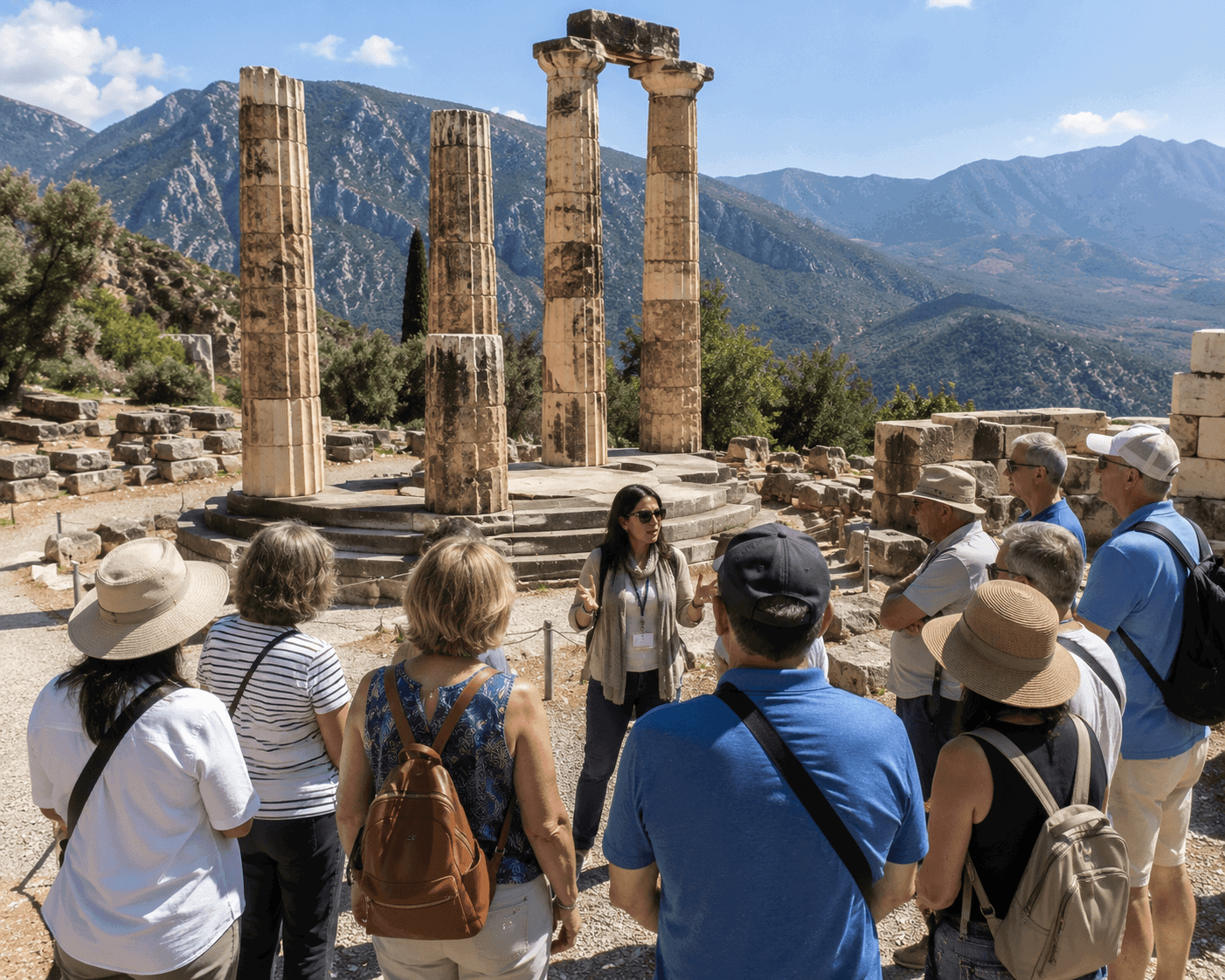
That sounds like a fortune cookie, so let me make it concrete. Mainland Greece is a history trip. The Acropolis, on the UNESCO World Heritage List since 1987, along with Delphi, Olympia, Mycenae and Epidavros, is not scenic in the way Santorini is scenic. These places are meaningful, and meaning requires narration. A guide standing at the Lion Gate at Mycenae telling you that this doorway is older than the Parthenon by a thousand years is the entire product.
The islands are a different vacation with the same passport. Nobody needs the Cyclades explained. They need a room with a view, a taverna that does not rush them and a bus schedule they can more or less trust.
The mistake is not choosing wrong. The mistake is choosing the mainland experience and expecting the island feeling, or the reverse. If you are still weighing broader European styles of travel, our breakdown of European train travel vs a river cruise vs a guided tour uses the same logic on a bigger map.
A guided tour of Greece is a mainland product with an optional island tacked on the end, and the walking is real.
The itinerary is mostly buses and ruins, in the best way
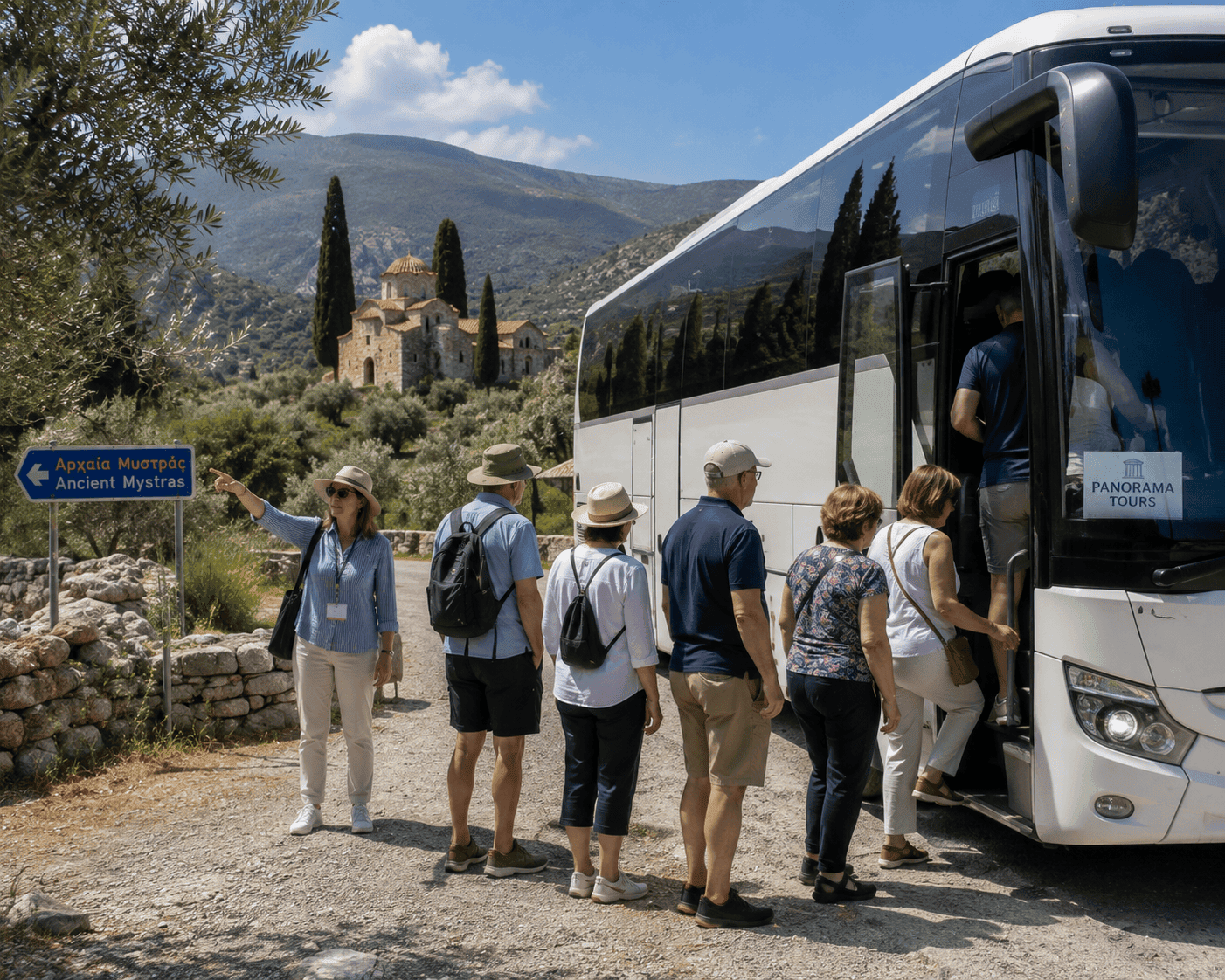
Rick Steves’ 14 day Athens and the Heart of Greece tour covers Athens, Delphi, Olympia, the Mani Peninsula, Monemvasia, Nafplio, Mycenae, Epidavros and the island of Hydra. Published 2027 pricing starts at $4,645 per person plus air, with a $840 single supplement, groups of 24 to 28, 13 nights of hotels, all breakfasts and half the dinners, and all guide and driver tips included. That is a useful benchmark even if you book elsewhere, because it tells you what a well run 14 day Greece land tour actually costs.
Other operators worth pricing against it: Collette, Globus, Trafalgar, Insight Vacations, Gate 1 Travel, Intrepid, EF Go Ahead Tours and Road Scholar, which runs Greece programs aimed squarely at travelers 60 and over. Small group operators typically cap at 12 to 18. Big coach tours run 35 to 45. That number changes your trip more than the brochure photos do.
The physical demand is the part people underestimate
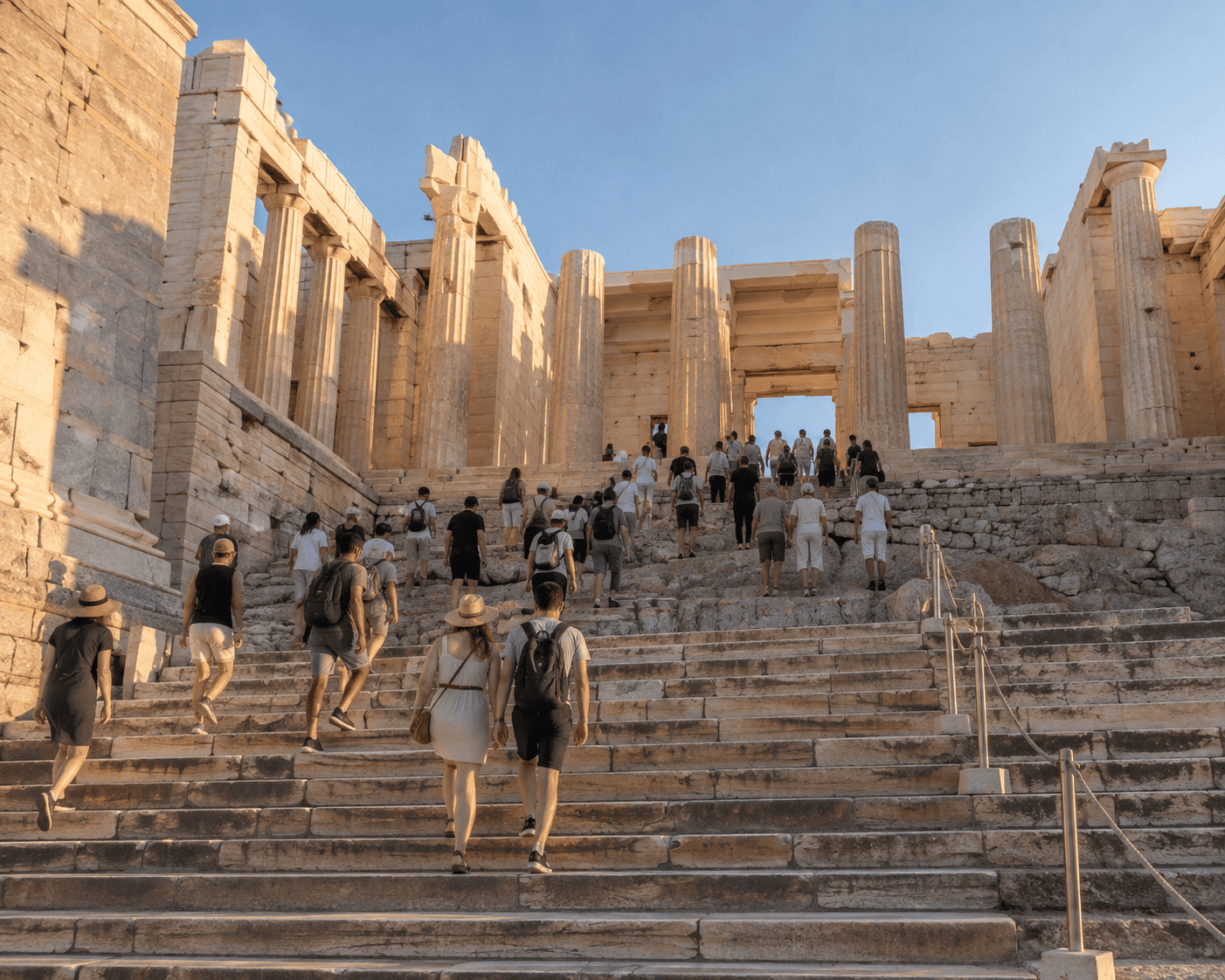
Rick Steves’ own tour description warns participants they must be ready to “hike over steep, slippery, uneven terrain” and handle “200 stairs to the top of the Acropolis,” with daily walking of 2 to 8 miles. That is not unusual for Greece. It is typical. Ancient Greek sites are on hills because defending a hill is easier, and marble that has been polished by 2,500 years of feet is exactly as slippery as it sounds.
Who a guided tour actually fits
Solo travelers who want company at dinner. Travelers who do not want to drive. Anyone whose favorite part of a museum is the docent. Couples where one person loves logistics and the other has quietly done all of it for 20 years and would like a break. If your idea of a good vacation involves not once opening a booking app, this is your column.
What Greek Island Hopping Actually Looks Like
Island hopping is the best value in Greek travel and the most fragile plan you can make.
The ferry network is genuinely excellent
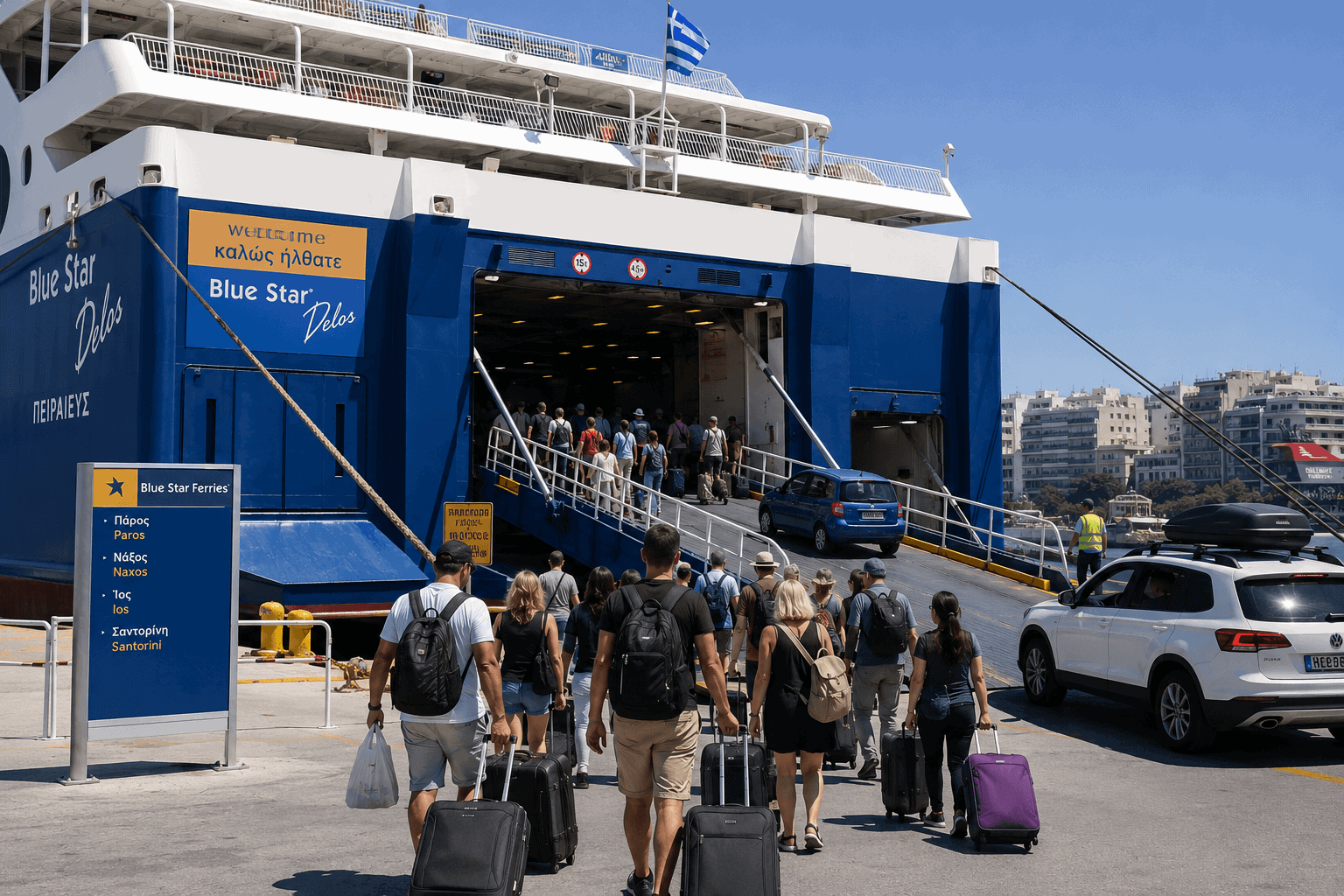
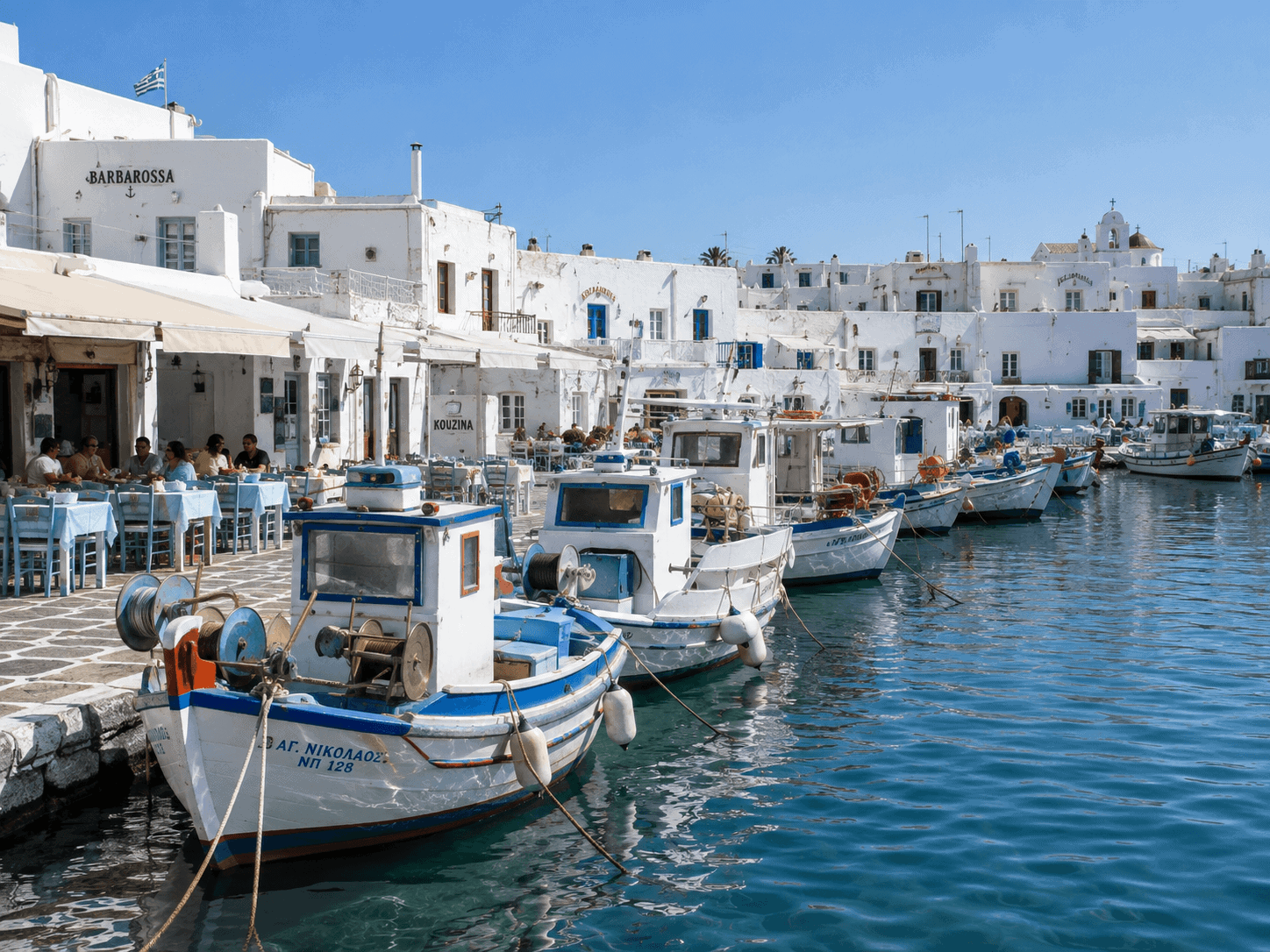
Piraeus is the largest ferry port in Europe, moving roughly 20 million passengers a year, and the Cyclades are well connected in season. From Athens you can be in Mykonos in 2 hours 50 minutes on a SeaJets high speed vessel or 5 hours 50 minutes on Blue Star, in Naxos in as little as 3 hours 15 minutes, in Santorini in about 5, in Heraklion on Crete in 7 hours 50 minutes and in Rhodes in 12 hours 50 minutes. Fares start around $50 to $75 for a foot passenger in economy, which is the part that makes Americans blink. The chart below has the full comparison, and it is worth two minutes of your time before you draw any island route.
Adventures by MJ :: Greece Planning Data
Athens to the Islands: What the Boat Actually Costs You in Hours
Sailing times and distances from the port of Piraeus. Bars show the fastest advertised crossing versus a typical conventional sailing.
Fastest crossingTypical conventional ferryScale: 0 to 18 hours
Mykonos 104.5 nm
2h 50m
5h 50m
Naxos 113.7 nm
3h 15m
5h 20m
Santorini 137 nm
5h 00m
7h 30m
Heraklion, Crete 168 nm
7h 50m
9h 30m
Rhodes 287 nm
12h 50m
17h 55m
Piraeus departures, peak season
Route from Piraeus
Distance
Fastest
Conventional
Sailings per week
Foot fare from
Mykonos
104.5 nm
2h 50m
5h 50m
25
$55
Naxos
113.7 nm
3h 15m
5h 20m
32
$53
Santorini
137 nm
5h 00m
7h 30m
33
$55
Heraklion, Crete
168 nm
7h 50m
9h 30m
22
$38
Rhodes
287 nm
12h 50m
17h 55m
8
$56
Read it this way: every island you add is a round trip. Santorini and back to Piraeus is 10 hours of boat at best. Rhodes and back is more than a full day, which is why almost nobody ferries there from Athens on a two week trip.
Sources: Direct Ferries and Ferryhopper route data, peak season schedules. Distances in nautical miles. Fares are lowest advertised foot passenger economy fares in U.S. dollars and change constantly. Compiled August 24, 2026 by Adventures by MJ.
The Meltemi is a real planning constraint, not a travel blog cliche
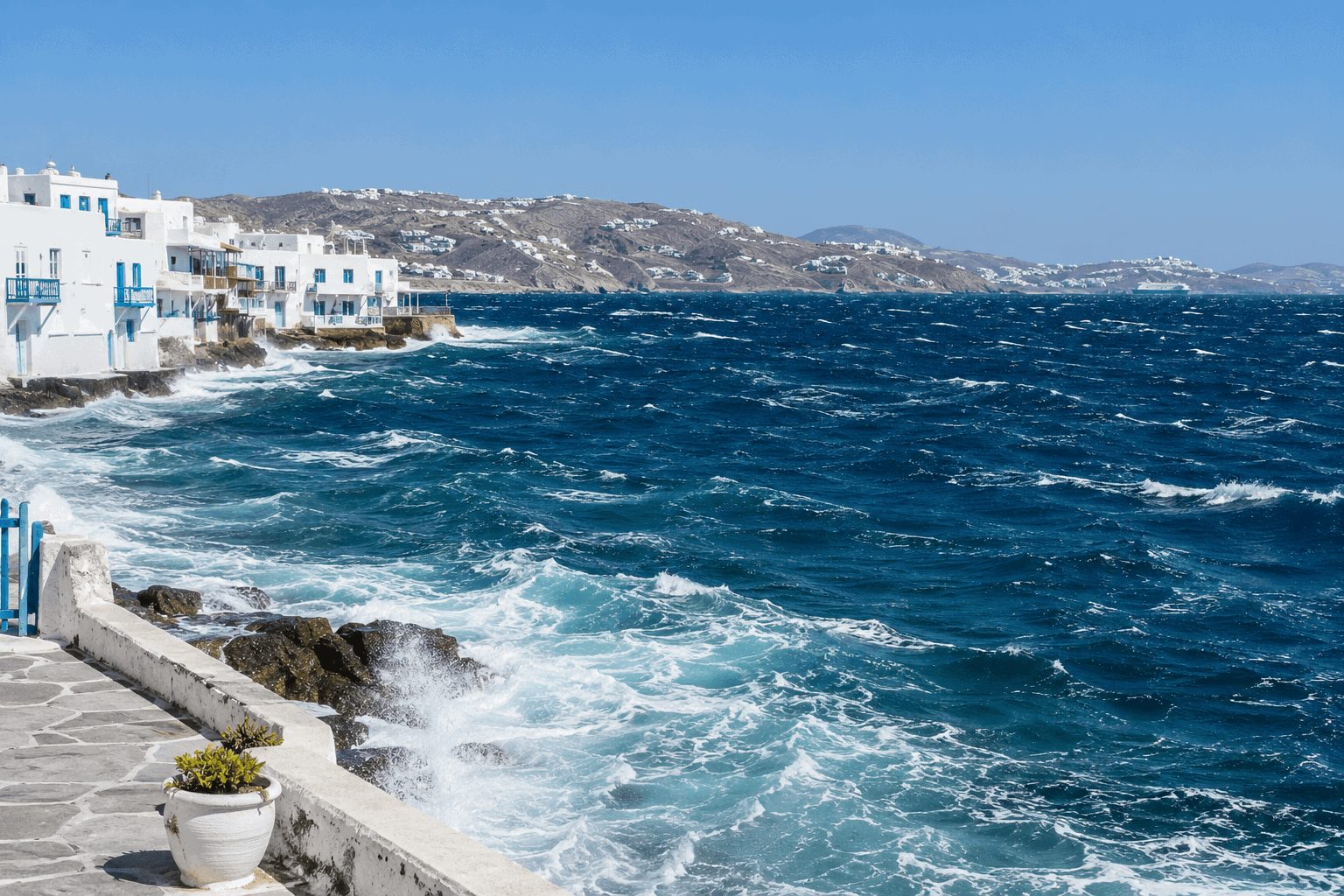
The Meltemi is a dry north wind that blows across the Aegean between June and September and peaks in July and August, reaching 7 to 8 on the Beaufort scale and occasionally exceeding 120 km/h. The Cyclades take the worst of it, and Mykonos and Tinos are famously exposed. Most days it just means a rough crossing and an umbrella that will not stay open. Some days it means the port authority suspends sailings.
The practical rule: never schedule your international flight home for the day after your last ferry. Build in a buffer night in Athens. It is the cheapest insurance in Greek travel, and if the wind behaves, you get a free evening in Plaka.
Who island hopping actually fits
Repeat visitors. Travelers with 12 or more days. People who like an unstructured Tuesday. Anyone whose dream sentence is “we found a place we liked and just stayed.” If your trip has a fixed anniversary dinner or a wedding in it, the ferry gods are not the vendor you want holding that reservation.
What a Mediterranean Cruise Through Greece Actually Looks Like
A cruise buys you coverage and unpacking, and it charges you in hours ashore.
The port list is the product
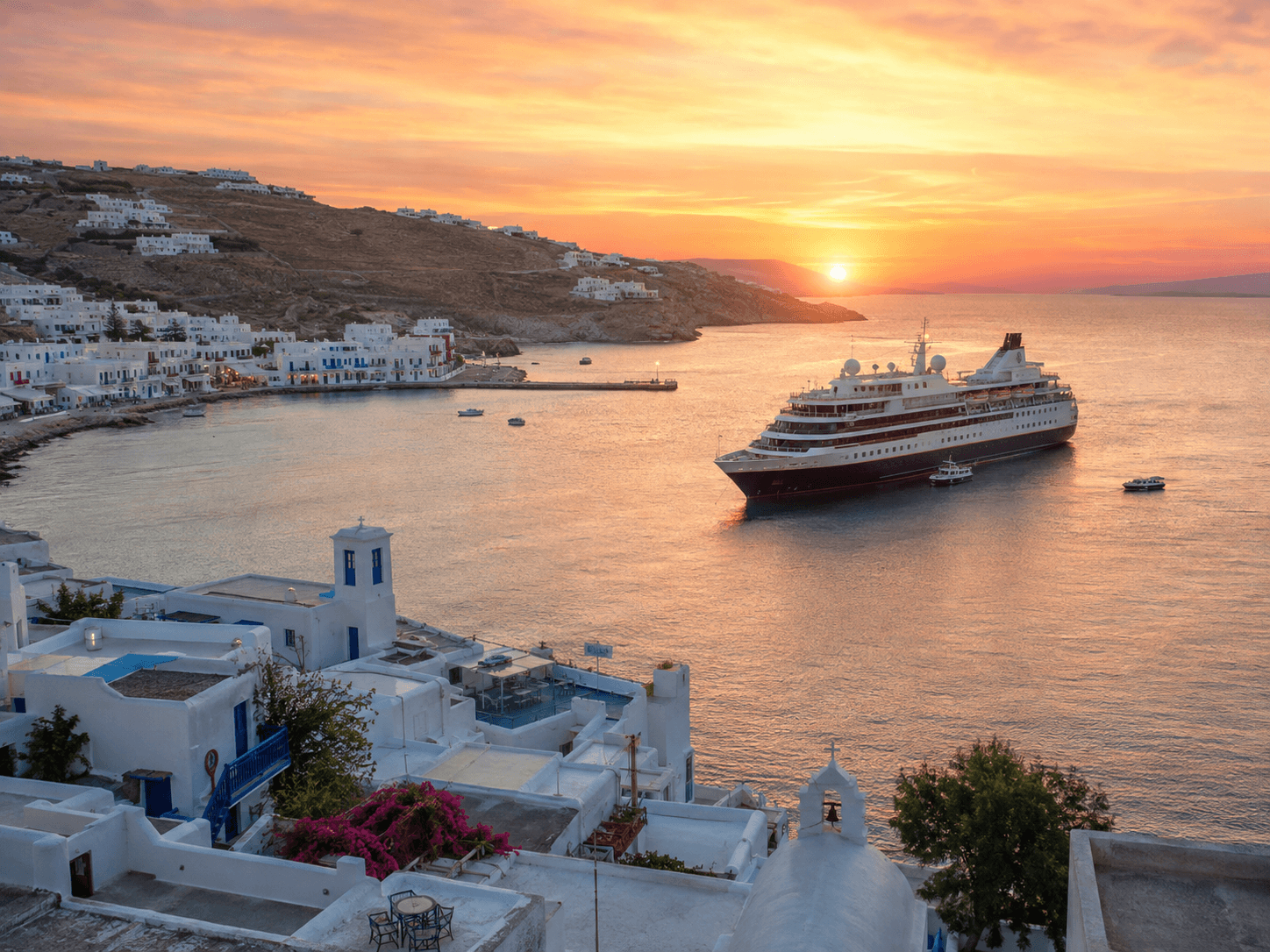
Celestyal is the Greece specialist, sailing Celestyal Discovery and Celestyal Journey on 3, 4 and 7 night Aegean itineraries with overnights in Santorini and Mykonos, which is the single most underrated feature in Greek cruising. An overnight port call is how you see Oia at sunset without paying Santorini hotel rates. Beyond Celestyal, Greek islands appear on itineraries from Royal Caribbean, Norwegian, Celebrity, Princess, MSC, Oceania, Azamara, Viking, Windstar, Seabourn, Silversea, Explora Journeys, Star Clippers and Variety Cruises. Deployments change every season, so confirm the specific ship and season before you fall in love with a port list. Our guide to the best Mediterranean cruise lines breaks down who each line is actually built for.
Ship size matters more in Greece than almost anywhere. Small ships get into Patmos, Hydra, Milos and Symi. Big ships get you a better price and a water slide. That trade is covered properly in our small ship vs large cruise ship comparison.
Santorini is a tender port, and that changes the math
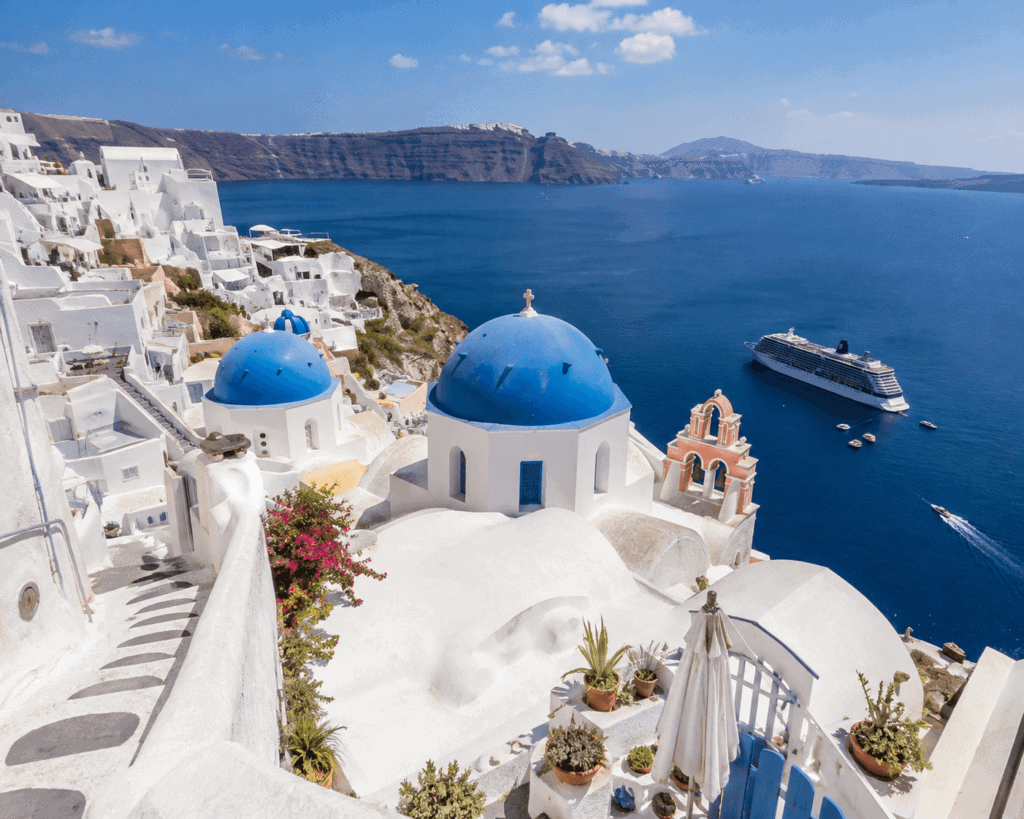
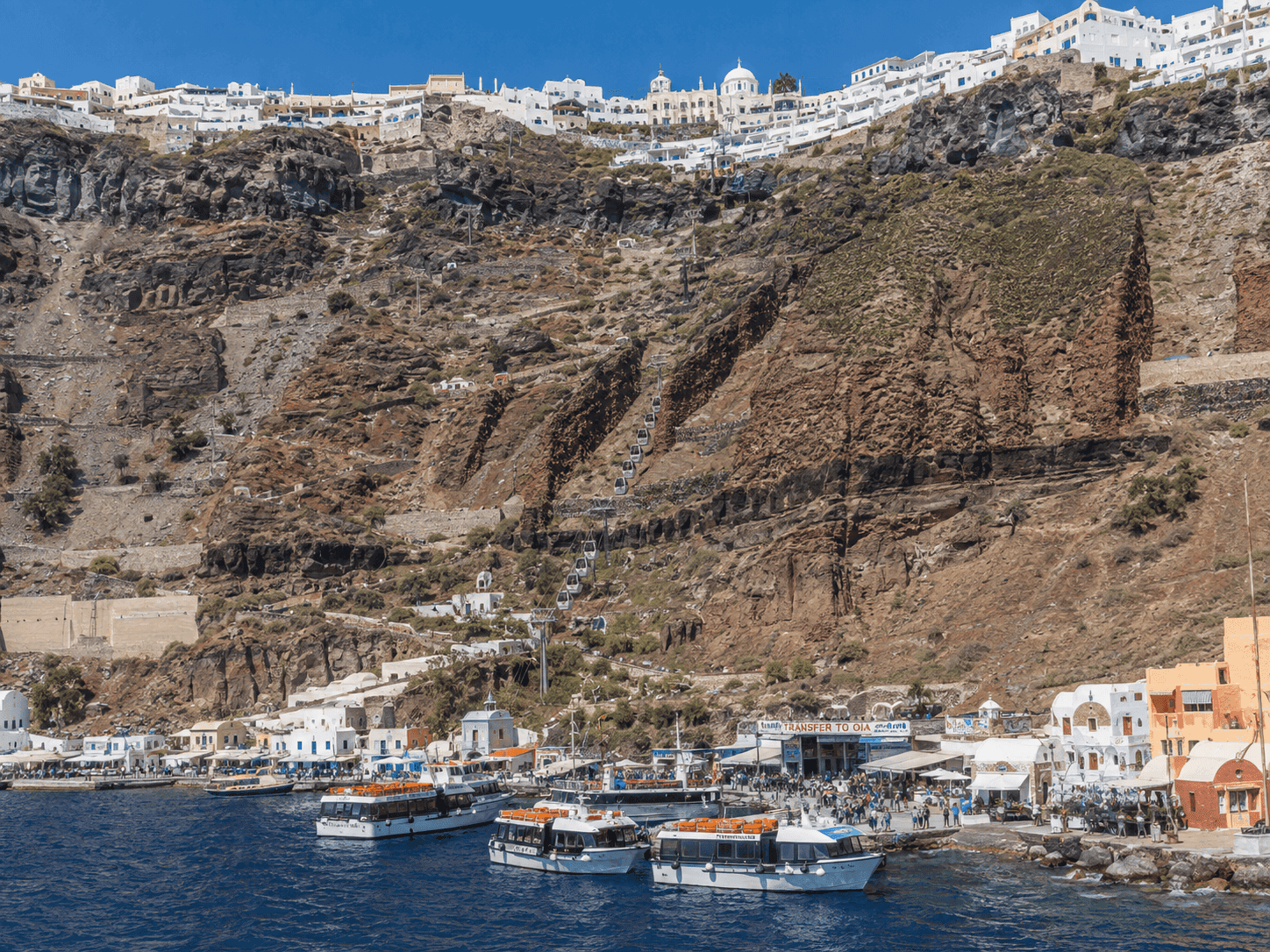
Santorini has no cruise pier. Ships anchor in the caldera and tender passengers to the old port at Skala, at the base of the cliff. From there you take the cable car, which runs about 5 minutes and costs a few euros each way, or you walk the 588 Karavolades steps up 300 meters of switchbacks that you share with working donkeys. On busy days with several ships in, cable car queues of one to two hours are common in both directions.
So a “full day in Santorini” on paper is often five usable hours on the island. That is enough for Oia or for a winery or for Akrotiri. It is not enough for all three, and pretending otherwise is how people end up sprinting for a tender.
Who a cruise actually fits
Multigenerational groups. First time visitors. Anyone with exactly seven days. Travelers who want to sample islands before committing to a return trip. My husband and I are Norwegian people ourselves, mostly because Freestyle dining means we are not planning a vacation around a 6:30 seating, and that same instinct applies here: pick the line whose rhythm matches yours, not the one with the prettiest brochure. If you are cruise curious in general, start with what makes a good cruise cabin, because on a port intensive Greek itinerary you will be in that room less than you think.
Greek Islands Travel Guide: Santorini vs Mykonos vs Naxos vs Crete vs Rhodes
Nobody actually searches for “the Greek Isles.” They search for a specific island and hope somebody tells them the truth about it. Here is the truth, compressed.
Island
Group
Best for
Ferry from Piraeus (fastest)
Airport
Cruise port
Santorini
Cyclades
The view, the caldera, one perfect dinner
About 5 hours
Yes
Tender only
Mykonos
Cyclades
Nightlife, beach clubs, Delos day trip
2 hours 50 minutes
Yes
Yes, plus tender
Naxos
Cyclades
Beaches, villages, families, value
3 hours 15 minutes
Yes, small
Limited
Paros
Cyclades
The balanced one, good ferry hub
About 3 hours
Yes, small
Limited
Crete
Crete
Everything, including a second week
7 hours 50 minutes to Heraklion
Yes, two
Yes
Rhodes
Dodecanese
Medieval old town, long season
12 hours 50 minutes
Yes
Yes
Milos
Cyclades
Sarakiniko, boat days, fewer crowds
About 3 hours
Yes, small
Small ships
Kos
Dodecanese
Beaches, easy flights, family value
Long, most travelers fly
Yes
Yes
Zakynthos
Ionian
Shipwreck Beach, Ionian scenery
Not served from Piraeus
Yes
Limited
Corfu
Ionian
Green landscape, Venetian architecture
Not served from Piraeus
Yes
Yes
Hydra
Saronic
No cars, day trip from Athens
Under 2 hours
No
Small ships
Two things fall out of that table immediately. First, Santorini and Mykonos are not close to each other in character, only in reputation, and putting both in a five day trip means you have booked a lot of boat. Second, Naxos and Paros do most of what people actually want from Santorini at roughly half the price and a third of the crowd, which is why they show up on almost every itinerary I build for a second visit.
Corfu deserves its own note. It sits in the Ionian, not the Aegean, and it does not connect to the Cyclades in any way that makes sense on a two week trip. Corfu is either its own trip or a cruise port. Trying to bolt it onto a Santorini itinerary is the Greek travel equivalent of adding Miami to a Seattle vacation.
Planning a slower version of Europe? Our Slow Europe Planner walks through how to build a trip around fewer stops and longer stays, and the Rail Trip Guide covers the same idea by train. Both are free.
Greece Vacation 2027: What It Actually Costs
Greece is not the bargain it was in 2015, and anyone telling you otherwise has not priced a Santorini caldera room lately. Greece welcomed 37.98 million visitors in 2025 and earned 23.6 billion euros, both records, according to Bank of Greece figures. Demand at that level shows up in your hotel bill.
Rough 2027 planning ranges, per person, excluding international air:
Trip style
Length
Per person, excluding air
What is included
Guided tour
10 to 14 days
$4,600 to $7,500
Most meals, guides, entries, all ground transport
Island hopping
10 to 14 days
$2,200 to $5,000
Nothing. Ferries are cheap, caldera hotels are not.
Mediterranean cruise
7 nights
$1,400 to $4,500
Cabin, meals, transport between islands. Excursions, gratuities and the port levy are extra.
Three fees people forget. Greece charges a per passenger cruise levy at Santorini and Mykonos, reported by Cruise Industry News at 20 euros in high season, 12 euros in the shoulder months and 4 euros in winter, with other Greek ports at 5, 3 and 1 euro. Greece also charges a nightly accommodation climate resilience fee that varies by property class and season. And the Acropolis now uses timed entry tickets with a daily visitor cap, so the ticket is a reservation, not a souvenir.
The infographic below collects the numbers that never make it into the brochure.
Adventures by MJ :: Greece Field Notes
Greece by the Numbers: The Caps, Fees and Winds Nobody Puts in the Brochure
Published figures from Greek and EU authorities and industry reporting, gathered in one place so you can plan around them instead of discovering them at the pier.
37.98M
Visitors to Greece in 2025, a record, up 5.6% (Bank of Greece)
€23.6B
Tourism revenue in 2025, up 9.4% year on year
8,000
Cruise passengers allowed at Santorini per day under the current cap
1. The Santorini cruise cap, and why 2026 tightened it
8,000 passengers per day, allocated by a ranked berth algorithm rather than turned away at the dock. Lower ranked calls get moved to other dates.
The 2026 calculation switched from assuming 80% berth occupancy to 100%. A 3,000 berth ship now consumes 3,000 slots, not 2,400.
Result: 595 ship calls booked for 2026 against 728 in 2025, a drop of 18.27%.
Before the cap, day visitor surges reached 11,000 to 17,000 on the worst days.
2. The cruise passenger levy, by season
Port
High
Shoulder
Winter
Santorini and Mykonos
€20
€12
€4
All other Greek ports
€5
€3
€1
Charged per disembarking passenger, in force since July 1, 2025. Shoulder covers October, April and May. Winter runs roughly November to March. Most cruise lines collect it on your behalf. Confirm the current season dates before you sail.
3. The Acropolis runs on an appointment now
20,000 visitors per day maximum, down from roughly 23,000 before the system began.
Hourly timed entry slots: 3,000 people between 8 and 9 a.m., 2,000 between 9 and 10 a.m., then declining quotas until closing.
Trialed September 4, 2023 and made permanent April 1, 2024. Book the slot, not just the ticket.
Inscribed on the UNESCO World Heritage List in 1987.
4. Santorini’s cliff is 300 meters of decision
Santorini is a tender port with no cruise pier. Ships anchor in the caldera.
From the old port at Skala: cable car up in about 5 minutes, or climb the 588 Karavolades steps shared with working donkeys.
Fira sits roughly 300 meters above sea level.
On multi ship days, cable car queues of 1 to 2 hours are common in both directions. Allow 90 minutes before all aboard.
5. The Meltemi is a scheduling fact
Blows across the Aegean June through September, peaking in July and August.
Reaches 7 to 8 on the Beaufort scale and has exceeded 120 km/h.
Strongest in the Cyclades, especially Mykonos, Tinos and Andros, and also felt in the Sporades, Dodecanese and Crete.
Typically builds from mid morning to sunset, then eases overnight. High speed catamarans are cancelled sooner than large conventional ferries.
6. Your documents, as of August 24, 2026
Passport: the U.S. State Department lists a requirement of 3 months’ validity beyond your date of departure from Greece.
Entry/Exit System: progressive rollout began October 12, 2025, with full implementation reported for April 10, 2026. Biometrics at the border.
ETIAS: expected to launch in the last quarter of 2026, then a six month transitional period and a six month grace period before it is required of everyone.
Cost:€20, valid three years or until your passport expires. Apply only through official EU channels.
Compiled August 24, 2026 by Adventures by MJ. Sources: Bank of Greece arrivals and receipts data, Cruise Industry News on the Greek passenger levy, Greek Ministry of Culture visitor limits at the Acropolis, UNESCO World Heritage listing, Hellenic port and ferry operator schedules, EU border system briefings and U.S. Department of State country information. Caps, fees, and entry rules change. Verify before booking. Questions about your own 2027 dates? Get in touch with Adventures by MJ.
5 Mistakes That Wreck a Greece Trip
1. Booking five islands in ten days
Every island you add costs you a half day in transit, minimum.
Every hop costs a half day minimum. Five islands is four half days on boats and in ports, which is two full vacation days spent in transit. Three islands is the ceiling for ten days, and two is better.
2. Flying home the day after the last ferry
Always put a buffer night in Athens between your last ferry and your flight home.
Covered above, and I will say it twice because it is the single most expensive mistake in Greek travel. Wind cancels ferries. Wind does not care about your seat assignment on the transatlantic.
3. Treating a cruise port day as a full day
An eight hour Santorini call is about five usable hours on the island.
Between tendering, the cable car queue and the 90 minutes you should leave before all aboard, an eight hour Santorini call is about five usable hours. Plan one thing. Do it well.
4. Going in August because that is when school is out
Late May, early June, mid September and early October beat August on crowds, price and wind.
August is peak Meltemi, peak crowd and peak price. Late May, early June, mid September and early October are dramatically better in every measurable way, and the sea is warmest in September. Our guide to the best time to travel to Europe has the month by month version.
5. Assuming your documents are fine because they were fine in 2019
The EU’s Entry/Exit System is live and ETIAS is coming, so re-check before you book.
The EU’s Entry/Exit System is now in full effect, ETIAS is coming with a phased transition, and Greece country information from the U.S. Department of State lists a passport requirement of “3 months’ validity beyond your date of departure”. Check all three before you book anything nonrefundable.
How to Combine All Three: 3 Greece Itineraries That Actually Work
The honest answer to Greece guided tour vs island hopping vs cruise is that a lot of the best trips are hybrids. Here are the three combinations I build most often.
10 Day Greece Itinerary: Athens Plus a 7 Night Cruise
This is the itinerary I recommend most often for a first visit. Three nights in Athens first, then a 7 night Aegean cruise. You see the Acropolis and the Acropolis Museum properly, on your own timed entry slot rather than squeezed into a port day, and the cruise handles every island transfer. Days 1 to 3 Athens, day 4 embark, days 5 to 10 the islands, with an overnight in Santorini if your line offers one.
10 Day Greece Itinerary: Two Islands, One Flight, One Ferry
The lowest transit version of an independent trip. Fly Athens to Santorini and spend four nights, ferry to Naxos or Paros for four more, then ferry back to Piraeus with a buffer night in Athens before you fly home. Two unpackings, one short flight, two ferry rides, and enough sitting still that you will actually remember it.
14 Day Greece Itinerary: Guided Tour Plus One Island
For people who want the history and the beach without choosing. A 10 day mainland tour covering Athens, Delphi, Olympia and the Peloponnese, ending back in Athens, then a 45 minute flight to Naxos or Paros for four unstructured nights. History first, beach as dessert, and you arrive at the island already knowing what everything you saw meant.
What Does Not Work
A guided tour immediately followed by a cruise with no gap. You will be exhausted, and you will have spent two weeks being told where to stand. Even people who love structure need one morning with nothing on it. If you want help sequencing this, our how to plan a trip to Europe guide covers the order of operations, and what a travel advisor actually does explains where a human helps and where one does not.
What to Pack for Greece
Short list, because Greece is not a gear destination. It is a footwear destination.
Is Greece guided tour vs island hopping vs cruise the right question for a first visit?
Yes, and the answer for most first timers is a cruise or a short guided tour. Both remove the hardest part of Greek travel, which is inter island logistics, and both give you a sampler you can use to plan a longer return trip. Save the full island hopping itinerary for visit number two, when you know which island you actually love.
What is the best way to see Greece if you only have 10 days?
Athens for three nights, then a 7 night Aegean cruise. That combination gets you the Acropolis at your own pace plus five or six islands without a single repacking day. If you would rather go deep than wide, do Athens for two nights and one island for six, and skip the second island entirely.
How much does a Greece vacation in 2027 cost per person?
Budget roughly $2,200 to $5,000 per person for two weeks of independent island hopping. A comparable guided tour runs $4,600 to $7,500, and a 7 night cruise runs $1,400 to $4,500, both excluding international airfare. Shoulder season can cut 20 to 35 percent off the hotel and cruise numbers. Add the Greek accommodation fee and, for cruises, the Santorini and Mykonos passenger levy.
Which Greek islands are easiest to reach from Athens?
Hydra, Aegina and Poros in the Saronic Gulf are under two hours by boat and work as day trips. Among the Cyclades, Mykonos, Paros and Naxos are all under four hours on a high speed ferry. Santorini takes about five hours by fast ferry, and Crete and Rhodes are long enough that most travelers fly.
Are Greek island ferries reliable in July and August?
Mostly, with real exceptions. The Meltemi wind peaks in July and August at 7 to 8 on the Beaufort scale, and port authorities suspend sailings when conditions cross the threshold. High speed catamarans are cancelled more often than large conventional ferries, which handle rough seas better. Build a buffer night into any July or August ferry itinerary.
Do cruise passengers pay the Santorini and Mykonos levy?
Yes, and it is usually collected by the cruise line rather than at the pier. Cruise Industry News reported the tiers as 20 euros per passenger at Santorini and Mykonos in high season, 12 euros in the shoulder months and 4 euros in winter, with other Greek ports charging 5, 3 and 1 euro. Check whether your fare includes it or bills it separately, because lines handle it differently.
Can you combine a Greek islands cruise with a land tour?
Absolutely, and it is one of the strongest ways to see Greece. The usual pattern is two to four land nights in Athens before the cruise, so you are not trying to do the Acropolis on a port day. Some travelers add an island stay after the cruise instead, which works well if you already know which island you want. Just avoid stacking a full guided tour directly against a full cruise with no rest day between them.
What should a Greek islands travel guide tell you that most do not?
That Santorini is a tender port where the alternative to the cable car queue is 588 steps. It should also tell you that the Meltemi decides your ferry schedule in July and August, and that Naxos and Paros deliver most of the Cyclades experience at a lower price. Also that Corfu is in a different sea and does not belong on a Cyclades itinerary. Those four facts prevent most of the disappointment I see.
How many days do you need in Greece?
Ten days is the practical minimum for Athens plus islands, and fourteen is where the trip stops feeling rushed. Seven days works if you cruise, because the ship moves while you sleep. Anything under seven should be Athens and one nearby island, not a Cyclades circuit.
Is it better to cruise or island hop in Greece?
Cruise if you have a week or less, island hop if you have twelve days or more. A cruise trades depth for coverage and removes every transfer decision. Island hopping trades certainty for time in one place, which is what most repeat visitors say they wanted all along.
Is it better to fly or take the ferry between Greek islands?
Fly for anything over about six hours by sea, and take the ferry for everything else. Athens to Rhodes is nearly 13 hours on the fastest boat and about an hour by plane. Athens to Naxos is three and a quarter hours by fast ferry, where flying saves you almost nothing once you count airport time.
Final Thoughts
Greece rewards commitment more than coverage. The people who come home glowing are almost never the ones who saw the most islands. They are the ones who found the taverna with the good grilled octopus and went back twice, or who stood at Delphi while somebody explained why the oracle sat exactly there, or who watched Oia empty out at 9 pm after the day trippers left because their ship stayed overnight.
So pick the column that matches how you actually like to travel, not the one that sounds the most impressive at a dinner party. A guided tour if you want the story. Island hopping if you want the stillness. A cruise if you want the sweep. And then, whichever you pick, leave one day with nothing on it. Greece is very good at filling an empty day.
If you are staring at 2027 dates and cannot decide which version is yours, send me your dates, your must sees and your absolute deal breakers, and I will sketch out what each of the three would actually look like for your trip. No pressure, no obligation, and I promise not to try to sell you August.
Written by Sue Nelson, Travel Advisor | Adventures by MJ | Updated for 2027
Sue Nelson is a travel advisor specializing in cruises, escorted tours and group travel, and the owner of Adventures by MJ. Costs, fees, caps and entry requirements in this post reflect published sources as of August 24, 2026 and are subject to change. Anything described here as typical or commonly available is not a guarantee from any tour operator, ferry company, cruise line or government agency. Confirm current rules and pricing before booking.
Affiliate Disclosure: This post may contain affiliate links. If you make a purchase through one of these links, we may earn a commission at no additional cost to you. We only recommend products and services we believe may be helpful to travelers.
Hi, I'm Sue. I plan cruises, all-inclusive resorts, and slow multi-country trips through Europe. I'm a certified Hawaii travel specialist, and I book through host agency Outside Agents as a member of the Travel Leaders Network. Twenty years in senior HR leadership before this, which mostly taught me how to read what people actually want. I live in Grain Valley, Missouri with my husband and business partner Mike.